
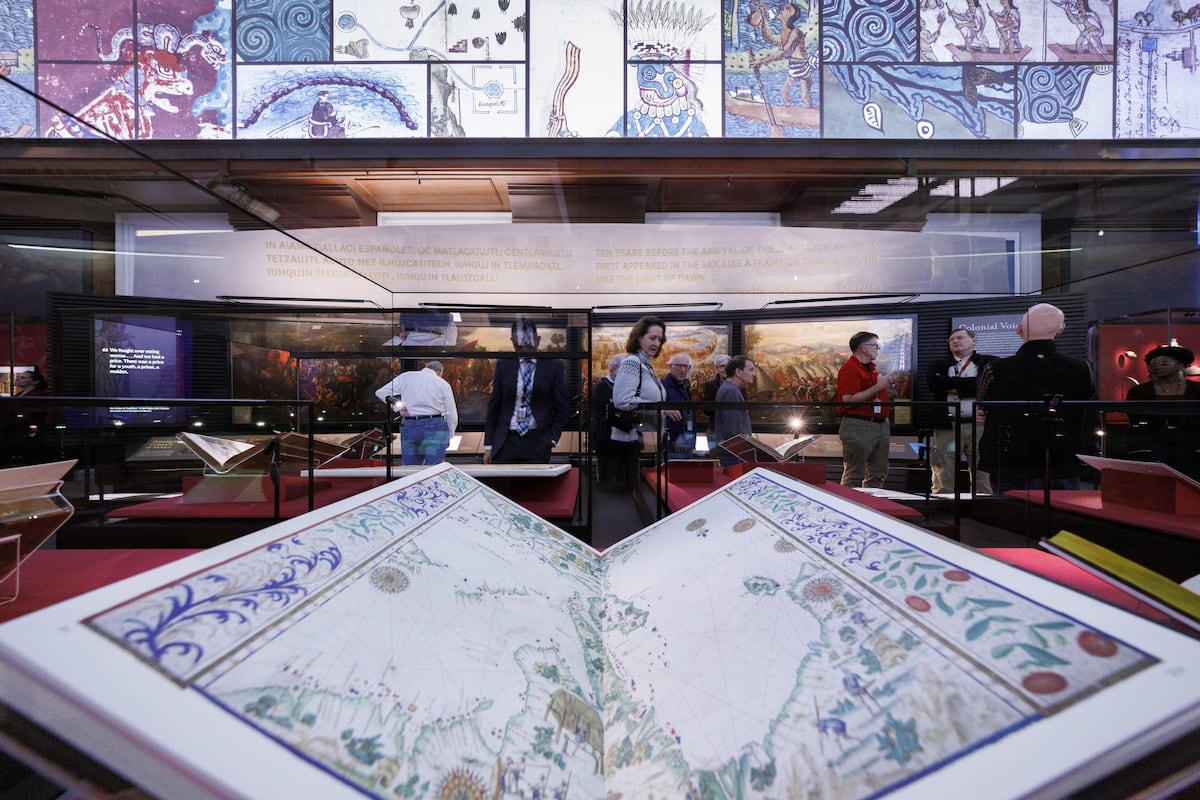
The Library of Congress in Washington offers a new journey through space and time starting this month. It begins at the end of a gallery that tells the history of the United States from its founding in 1776, a history that now marks 250 years. The following rooms, on the second floor of the imposing Jefferson building, take visitors through the indigenous civilizations of the American continent through an extraordinary collection of archaeological objects, paintings, and bibliographic gems. The gallery’s contents include items from Mesoamerica (a historical region encompassing parts of modern-day Mexico, Guatemala, El Salvador, Belize, Honduras, Costa Rica and Nicaragua), the Caribbean, and the Andes. The earliest artifacts on display are three-thousand-year-old jade stones called chalchihuitl in Nahuatl; yax tun, in Maya; and dzeque, in Mixtec. And the timeline reaches all the way to the present.The institution — the largest library in the world — brings together these treasures in a new permanent exhibition about the “Voices of the Early Americas.” The exhibition occupies what was once the reading room for Africa and the Middle East, and around 80% of it comes from the donation of 4,000 objects made to the institution by real estate developer and philanthropist Jay I. Kislak (1922-2018), according to an estimate by Stephanie Stillo, head of the Rare Books and Special Collections division.Four years ago, a foundation named after the businessman from Florida donated $10 million to the Library of Congress for the development of the new space. The result is a museographic display that showcases everything from Waldseemüller’s map (1507), the oldest known document featuring the word “America,” to a series of Taíno carvings, and the Huexotzinco Codex, from 1531. There are high-definition screens that put those early stories into context; and the restoration of a series of late 17th-century paintings depicting the Spanish conquest is presented.Matthew Robb, Mesoamerica specialist at the Library of Congress, considers the presentation a “new beginning” in the institution’s relationship with the “study of the Americas.”“It’s a long story,” he explains to EL PAÍS in the newly opened rooms. “If we go back to the origins of the library, we see that the first book collectors in what is now the United States wanted to know more about the history of other regions of the continent. That is especially relevant now that we are celebrating the 250th anniversary: ideas around independence from empires were topics of great importance, shared throughout the Western Hemisphere. For example, they were interested in the Aztec legacy of New Spain as a means to distinguish themselves from Europe, and as part of a different history.”To underline this idea, Robb recalls that in the sculptural frieze of the great rotunda of the Capitol, a review of the milestones of the young nation, there is an Aztec sunstone in the scene depicting the meeting between Hernán Cortés and Moctezuma in 1509.The new tour begins in a room with a large circular display case that holds pieces such as sophisticated Olmec ceramics from thirty centuries ago, a seated woman found at a site in Jalisco, or the so-called Tortuguero box, one of the highlights of the exhibition; a wooden artifact with hieroglyphic inscriptions that tell the story of a Maya dynasty.A panel warns that the “voices of the early Americas” used to title the new presentation combine those of indigenous peoples who navigated “worlds profoundly transformed in their own terms, claiming and affirming their capacity to decide over their own lives” with those of Europeans, who “created books, letters, maps, and paintings to justify, debate, and describe the subjugation of those peoples,” with the certainty that “language was always a companion of the empire.”Another panel in that first space reads (like the rest, in English) as a kind of justification, in which curators give examples of how words traveled through time, geography, and culture to make it possible to hear those voices in their own language. Thus, the description in Nahuatl of a mid-16th-century codex says: “Ten years before the arrival of the Spanish, an omen appeared for the first time in the sky: something like a flame or tongue of fire, like the light of dawn (In aiamo oallic españoles, oc matlacxiuht:centlamantli tetzauhtl achtoc nez ilhuicactich, ihuqqui in tlemjaoatl, ihuqquin tlecuecallotl, ihuqquin tlaujzcalli)”.The transition between the first and second rooms is marked by the arrival of the Spanish, with their laws, maps, dictionaries, and projects for the Christianization of the indigenous people and the extraction of resources from the New World in places like Cerro Potosí, in present-day Bolivia. Those riches (“80% of the world’s silver”) are reported in a copy of the Crónica del Perú (1553) by Pedro de Cieza León.The story then moves on to the efforts of the colonies in the 18th and 19th centuries to understand their past as a tool to “articulate new national identities” on the road toward independence. And it focuses on the Spanish translation of the Popol Vuh, a touchstone of Quiché Maya mythology. Proof of its cultural impact is a gouache on paper that Diego Rivera made, drawing inspiration from the story of the twin gods Hunahpú and Ixbalanqué.At the end of the tour, the voices of about 10 contemporary poets can be heard reciting their verses in Maya, Nahuatl, Mapuche, Zapotec, and Quechua, alongside images from the Chiapas Photography Project, which has been documenting indigenous lives in that Mexican state since the 1990s through the eyes of photographers from those communities. Closing the narrative of the new space with this dual proposal serves to “emphasize that these are living cultures, that have a past, in whose context they must be seen, but also a future,” according to librarian Catalina Gómez, in charge of the PALABRA archive. It is a project that brings together nearly a thousand original sound recordings by Portuguese-Hispanic writers of the 20th and 21st centuries, reading excerpts from their works. Among them are the verses of Acatlán, by the Nahua poet Ateri Miyahuatl. They say: “Lágrimas brotan / miedo que traga /deseo que ahoga / tengo a mi pueblo en la punta de la lengua / lo sé de memoria / y no lo recuerdo”. (Tears spring / fear that swallows / desire that drowns / I have my people on the tip of my tongue / I know it by heart / and I don’t remember it.”Sign up for our weekly newsletter to get more English-language news coverage from EL PAÍS USA Edition
The US Library of Congress opens up to the Americas
Full Article
Original Source
Read the full article at English →KhanList aggregates and links to publicly available news content. We do not host full articles from third-party sources. Always verify important information with original sources.