
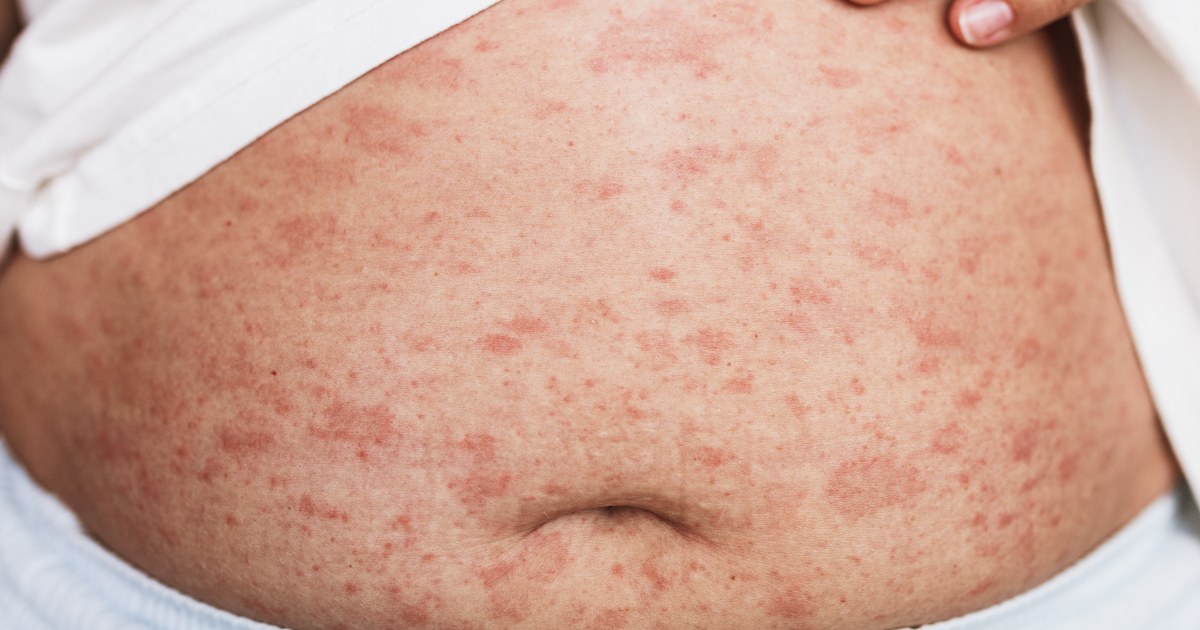
Measles, a vaccine-preventable disease once considered eliminated in the United States, has been surging across the country in recent months.Amid record-breaking outbreaks, the U.S. has officially lost its measles elimination status, which it held for over 26 years.Also known as rubeola, measles is a viral respiratory disease that causes fever, coughing, a runny nose and a characteristic blotchy red rash.If left untreated, measles can lead to pneumonia, swelling of the brain and death, per the U.S. Centers for Disease Control and Prevention. Measles is especially dangerous for young children.It’s airborne and widely considered one of the most contagious viruses in the world.Once a common childhood illness in the U.S., measles can be prevented with the measles, mumps and rubella (MMR) vaccine. Two doses of the MMR vaccine are 97% effective, per the CDC.Thanks to successful immunization efforts, measles was considered eliminated in the U.S. in 2000. After decades of progress, measles is now spreading continuously nationwide. The resurgence of measles in the U.S. and globally is being fueled by falling childhood vaccination rates, experts say.Here’s what to know about measles in the U.S.US Loses Measles Elimination StatusThe Pan American Health Organization (PAHO), the regional office for the Americas of the World Health Organization (WHO), announced on Tuesday that the U.S. had officially lost its measles elimination status.Measles is now considered endemic in the U.S. after “showing sustained transmission for more than 12 months,” Dr. Jarbas Barbosa, director of PAHO, said in a press briefing on Nov. 17. In addition to the U.S., Mexico also had its measles elimination status withdrawn this week. Canada lost its status in 2025.The Americas have reported some 58,000 cases total this year alone, compared to less than 15,000 in 2025, per PAHO. “These figures are a serious warning for our region,” Barbosa said.The U.S. losing its measles elimination status after 26 years has sparked alarm among many public health experts.“I’m certainly disappointed and concerned. We were the leaders in the world demonstrating that you could actually eliminate measles, and now we’ve slipped back,” Dr. William Schaffner, a professor of infectious diseases at Vanderbilt University School of Medicine, tells TODAY.com. “It’s like getting a report card. Years ago, we had an A. Now we’re getting an F,” Schaffner adds.“The United States has an extraordinary measles problem. We’ve had more measles cases in the last 18 months than we’ve had in the previous 25 years combined,” Noel Brewer, a professor of public health the University of North Carolina at Chapel Hill, told NBC News.Measles Cases in the U.S.As of Nov. 12, there have been 5,412 confirmed measles cases reported in the U.S. since the start of 2026, according to the CDC. Among these cases, 591 people have been hospitalized.As of Nov. 17, 10 measles-related deaths have been reported by state health departments: seven in Pennsylvania, two in Wisconsin and one in New York. The CDC has confirmed 6 deaths from measles this year to date. At least 45 states and the District of Columbia have reported measles cases in 2026, per the CDC: Alabama, Alaska, Arizona, California, Colorado, Connecticut, Delaware, Florida, Georgia, Idaho, Illinois, Indiana, Iowa, Kansas, Kentucky, Louisiana, Maine, Maryland, Massachusetts, Michigan, Minnesota, Missouri, Montana, Nebraska, New Jersey, New Mexico, New York, North Carolina, North Dakota, Ohio, Oklahoma, Oregon, Pennsylvania, Rhode Island, South Carolina, South Dakota, Tennessee, Texas, Utah, Vermont, Virginia, Washington, West Virginia, Wisconsin and Wyoming.Pennsylvania accounts for the lion’s share of measles cases so far this year with a case count of 1,529 as of Nov. 12, per CDC data. South Carolina, Utah and Wisconsin have also reported more than 500 measles cases since the start of 2026. Only five states have reported zero confirmed measles cases so far this year, per the latest CDC data: Arkansas, Hawaii, Mississippi, Nevada and New Hampshire.Children and teenagers account for many of the measles cases in the U.S. “It’s causing about one in 10 children to be hospitalized,” says Schaffner.Map of Measles HotspotsSo far in 2026, the CDC has confirmed at least 43 measles outbreaks nationwide. “We are having many outbreaks, some larger and smaller, throughout the United States,” says Schaffner. Here are the biggest measles hot spots in the U.S., according to an NBC News analysis of the most recent CDC data:Pennsylvania is currently seeing the nation’s largest outbreak. “We are seeing this outbreak now because of a failure to vaccinate. This virus is very serious. It can be deadly. It can cause a lot of pain and a lot of suffering, and I’m seeing that every day,” Dr. Evan Shirey, a pediatric infectious disease expert in Pennsylvania, told TODAY in a Nov. 17 segment.MMR Vaccination Rates Are FallingThe MMR vaccine is safe and effective, says Schaffner. Two doses, given at 12-15 months and 4-6 years of age, are 97% effective.“When more than 95% of people in a community are vaccinated, most people are protected through herd immunity,” the CDC says. This indirectly protects vulnerable individuals who can’t get vaccinated, such as newborns or pregnant women.However, childhood MMR vaccination rates have fallen below the 95% threshold in recent years, and they keep declining. During the 2025-2026 school year, only 92% of U.S. kindergarteners had been vaccinated against measles, per CDC data.Gaps in vaccination coverage can allow the virus to spread, leading to outbreaks.“We could get back to measles being at zero if parents would take their children to be vaccinated,” says Schaffner.Can You Get Measles If You’re Vaccinated?While exceptionally rare, it is possible to contract measles after you’ve been vaccinated, TODAY.com reported previously. Most people who are fully vaccinated against measles are considered to have lifelong immunity to the virus. Still, the MMR vaccine is 97% effective — which means roughly 3 in 100 people who get both doses can still get measles if exposed.Among the confirmed measles cases reported in the U.S. this year, only 2% had received both doses, per CDC data. However, the chances of getting measles after two doses of the MMR vaccine are still “extraordinarily low,” Schaffner previously told TODAY.com.When breakthrough infections do happen, they tend to be milder. There are no recorded cases of a healthy, fully vaccinated person dying from measles, according to TODAY.com reporting.Who Needs the Measles Vaccine?The CDC recommends all children get two doses of the MMR vaccine to protect against measles, starting at 12 months of age. “My advice would be for parents to speak with their pediatricians about vaccinating their children against measles,” says Schaffner.If you aren’t sure whether you’re fully vaccinated, you can request your immunization records from your doctor.People who were born before 1957, when measles was rampant, likely acquired immunity through infection, says Schaffner. The measles vaccine became available in 1963, but some people born between 1963 and 1968 may have received an earlier, less effective version of the vaccine or only one dose.“If your measles vaccination history is a little blurry, you can just get another dose of vaccine. There’s absolutely no harm in that,” says Schaffner.
The US Has Lost Its Measles Elimination Status, and These States Are the Biggest Hotspots. See the Map
Full Article
Original Source
Read the full article at Today →KhanList aggregates and links to publicly available news content. We do not host full articles from third-party sources. Always verify important information with original sources.