
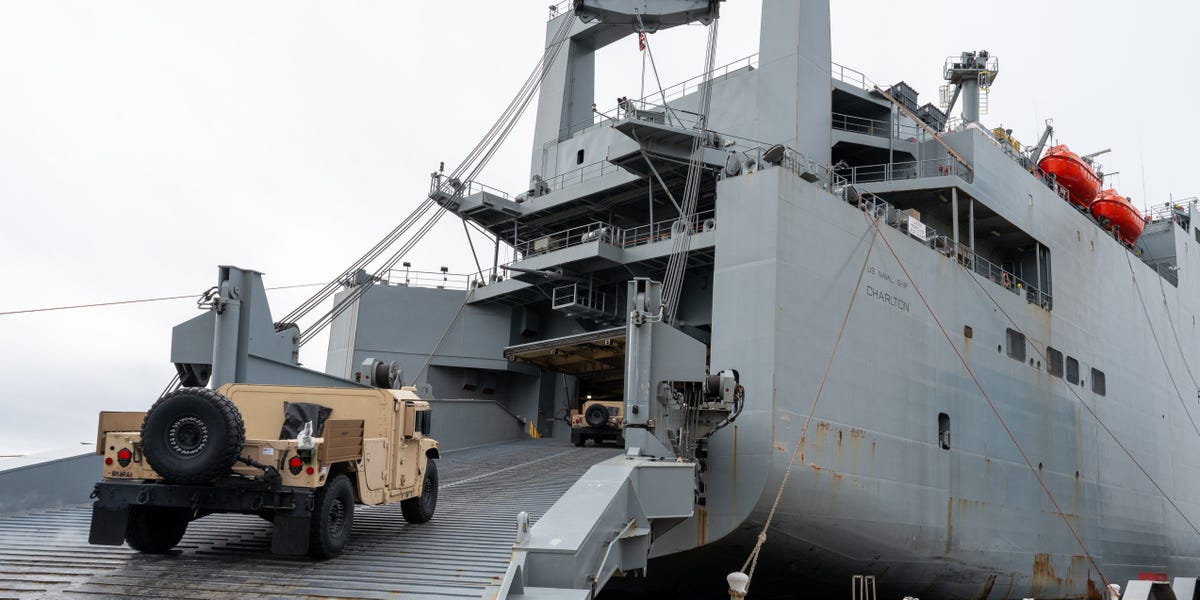
The US Army tested whether it could still deploy forces to war if attacks knocked out comms at American ports Tech. Sgt. Alex Fox Echols III/US Air Force Army vehicles are loaded onto the USNS Charlton at Joint Base Charleston, South Carolina, March 25, 2024. The US Army tested whether it could keep communicating with units at American ports after simulated attacks knocked their normal networks offline, rehearsing how it would deploy forces overseas if critical infrastructure at home came under attack.During a recent homeland defense exercise at Fort Eustis, Virginia, the Army's 597th Transportation Brigade used backup communications to connect with units in South Carolina and Texas. The drill simulated physical and cyberattacks that knocked military and commercial networks offline, creating a "catastrophic communications blackout" at key deployment hubs, according to an Army news release.Troops had to restore access to a key system that tracks military cargo moving by air and sea. Losing those connections could make it tougher to track equipment, ensure it reaches the right ports and ships, and move forces overseas on schedule.The service said in the release that the exercise proved successful, though it did not provide deeper details on the amount of stress put on the system, or any persistent challengesMore than 85% of US combat power resides in the continental United States, Gen. Randall Reed, the head of US Transportation Command, told lawmakers in March, making the military's ability to swiftly move troops and equipment vital for a major conflict or national emergency."A disconnected mobility force threatens the Joint Force's ability to win," Reed wrote in his testimony, calling for communications that can resist jamming and cyberattacks.The threat isn't limited solely to military networks. Potential adversaries could also target civilian infrastructure that US forces depend on. Some US military experts have characterized the current threat situation as "the end of strategic sanctuary."In February 2024, US cybersecurity and intelligence agencies warned that China-backed Volt Typhoon hackers had compromised critical infrastructure, including transportation and communications networks, positioning themselves to cause disruption during a major crisis or conflict. More recently, refrigeration systems in military commissaries have seen power outages linked to suspected malicious attacks. Read next Business Insider tells the innovative stories you want to know Business Insider tells the innovative stories you want to know Business Insider tells the innovative stories you want to know Business Insider tells the innovative stories you want to know Kelsey Baker is a military affairs reporter with Business Insider. She joined in 2025 and covers military personnel issues and how the military is overhauling how it prepares for future conflicts.Prior to joining BI, she worked at The Washington Post as a Military Veterans in Journalism Fellow covering human interest stories and international news and at The Chronicle of the Horse magazine covering horse sports. She holds a graduate degree in Journalism from Northwestern University, a degree in Diplomacy from Norwich University, and an undergraduate degree in History from the University of Denver. She previously served in the Marine Corps as a logistics officer, and later in the reserve.Contact her via email at kbaker@businessinsider.com, or via Signal at KelseyBaker75.75. Use a personal email address, a nonwork WiFi network, and a nonwork device; here's our guide to sharing information securely.
The US Army tested whether it could still deploy forces to war if attacks knocked out comms at American ports
Full Article
Original Source
Read the full article at Businessinsider →KhanList aggregates and links to publicly available news content. We do not host full articles from third-party sources. Always verify important information with original sources.