
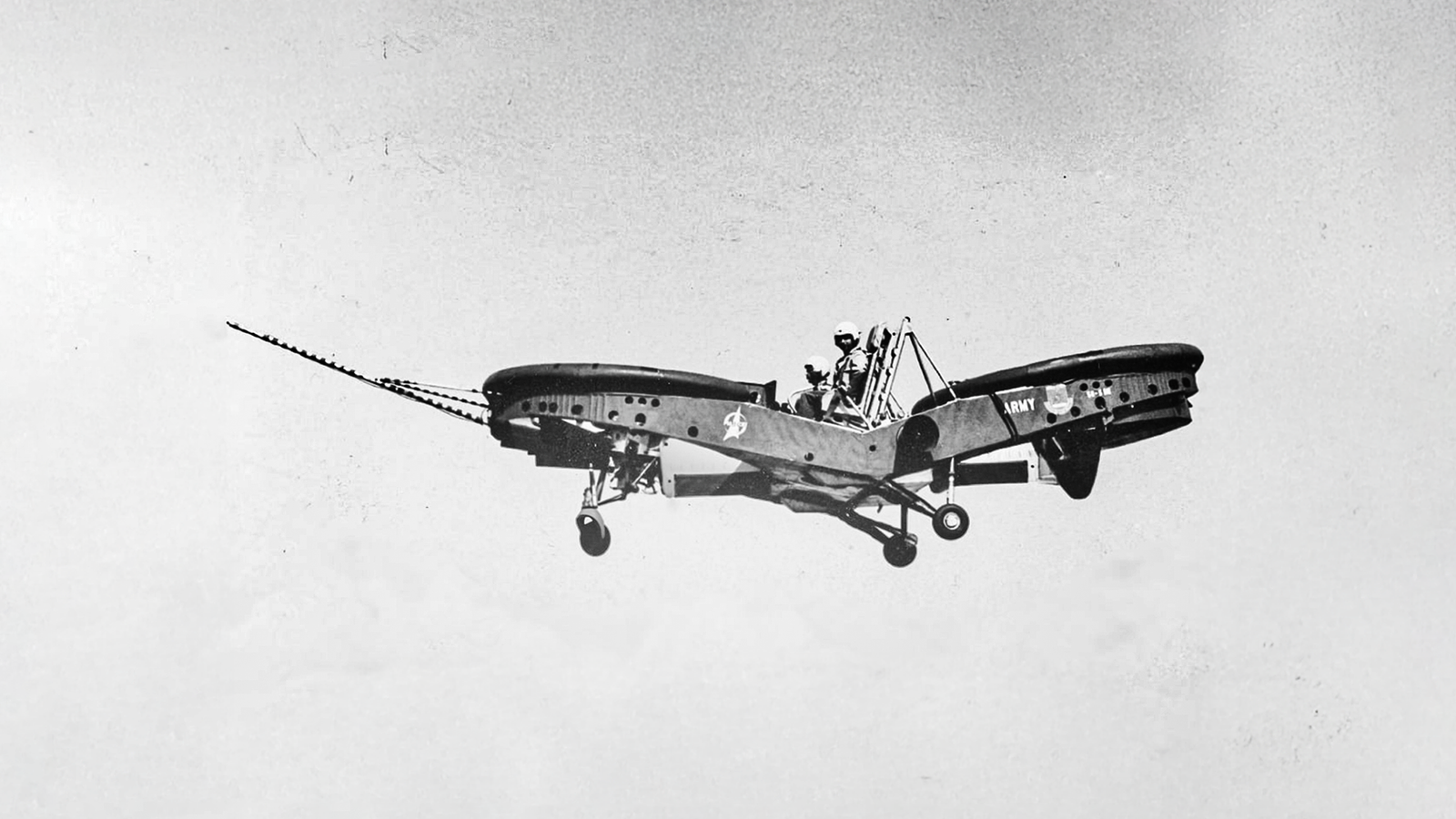
Published Sep 6, 2026, 11:00 AM EDT Luke Diaz is a freelance military writer with experience with active duty experience in the US Navy as well as defense and industrial engineering. He is a former Naval Flight Officer who performed tactical air control on the carrier-based E-2 Hawkeye. In 1958, a US Army development competition produced a machine that had no wings, no exposed blades, and a top speed slower than a family car. It could lift a pilot and passenger vertically off the ground, skim below treetop height quickly enough to avoid radar, and demonstrated in live-fire testing that it was stable enough to fire a recoilless rifle accurately. It was called the 'Airgeep,' and by every technical measure the Army had set out, it succeeded. Yet, within five years the program was dead, with no production order ever issued. The Airgeep did not fail a flight test. It won a three-way competition against its closest rivals and was still shelved. Although the Piasecki prototype was gas-powered, it has inspired a slew of personal, electric vertical takeoff and landing aircraft today. So why was the pioneer of eVTOL design seemingly terminated without cause? A Gap Between The Jeep & The Helicopter The answer starts with the Army's Transportation Research Command in 1957. It set out to create a 'flying jeep' that could transport troops and supplies over terrain that no wheeled vehicle could cross. The design aimed for speeds up to 70 mph while flying low enough to remain under radar coverage. That requirement ultimately led to the creation of Piasecki's Airgeep. Piasecki Aircraft, an established helicopter manufacturer, was one of three businesses given contracts via the program, along with Chrysler and Curtiss-Wright's Aerophysics branch. Piasecki's design challenge deviated significantly from typical rotorcraft theory. Instead of exposed main and tail rotors, it gave the Army something that a soldier could stand beside without being chopped down by a rotating blade. The VZ-8 Airgeep was configured in a tandem, horizontal ring-duct configuration. It had two tri-bladed rotors powered through a central mechanical gearbox, housing the pilot and passengers directly between the front and rear ducted fans. The circular ducts shielded the blades from obstacles and ground personnel while enhancing thrust in low-altitude flight. The Army also wanted something that could be flown with minimal training, a tall order. The automated rotor management function used a central combining gearbox that mechanically locked the two powerplants in synchronization. Meanwhile, the tandem configuration of the rotors canceled out the rotational work. Pilot inputs were distributed to both duct-rotors simultaneously, which eliminated the need for individual control. At the helm, it had a simple yoke and a single lever 'throttle' to change altitude instead of cyclic and collective helicopter-style controls. The safety and simplicity requirement is what pushed Piasecki toward an unusual airframe. The goal was to allow a soldier with only standard driver’s training to operate the vehicle with minimal instruction. A Ducted-Rotor Hull Built For Any Mission Piasecki's company-designated PA-59 was initially called the Model 59K Sky Car. The first prototype flew tethered in 1958 and made its first free flight on September 22, 1958, initially powered by two 180-hp Lycoming O-360 piston engines linked through a central gearbox. The two tandem three-bladed rotors were mounted inside ducted shrouds at either end of a flat, low-slung hull, with the crew seated between them and helicopter-style stick-and-pedal controls driving hinged vanes beneath the ducts for direction. Piasecki later renamed the design the Airgeep while the Army designated it VZ-8P. At around 24 feet (7.3 meters) long and under 3,650 lb (1,655 kg) fully loaded, it reached a maximum range of about 34 miles (55 km) while equipped with a recoilless rifle or a .50-caliber machine gun mount. By 1959, the twin piston engines had been replaced with a single 425-hp Turbomeca Artouste IIB turboshaft. The airframe was then re-engined with a 550-hp Garrett AiResearch TPE331 after being loaned to the Navy as a float-equipped variant dubbed the 'SeaGeep'. A second, more advanced airframe was created in 1962. The Model 59H Airgeep II, designated VZ-8P(B), was angled in the middle to offset the rotors and reduce forward drag. It was equipped with a powered tricycle undercarriage so it could taxi on the ground. It also came with ejection seats for a pilot, co-pilot, or gunner, along with room for three passengers. This variant was powered by twin 400-hp Turbomeca Artouste IIC engines cross-linked so either could drive both rotors. A Stable Gun Platform That Beat Its Rivals Army trials found the Airgeep stable enough to function as an effective weapons platform, successfully achieving its primary engineering challenge. While it was designed to operate within a few feet of the ground for cover and radar evasion, both Airgeep variants proved capable of climbing to several thousand feet. The Airgeep II reached a service ceiling near 3,000 feet without losing controllability and exceeded the Army's expectations. The Airgeep II's first untethered flight came on 15 February 1962, piloted by company test pilot Tommy Atkins. The type went on to demonstrate hovering and maneuvering beneath trees and between buildings, exactly the low-signature profile the original 1957 requirement had specified. That performance stood in sharp contrast to its two competitors. Chrysler's VZ-6 was overweight and underpowered despite a 500-hp engine. It flipped completely over on its first untethered flight attempt in 1959, effectively ending that program on the spot, according to Medium. Curtiss-Wright's VZ-7, a simpler quadrotor aerial platform, was judged easy to fly by its test pilots but was capped at roughly 32 mph and a 200-foot ceiling. Curtiss' exposed, unducted propellers also reintroduced the blade-strike hazard the ducted-rotor requirement had been written to avoid. Against both, the Airgeep was the Army's own assessment of the superior design. The fact that it was canceled anyway means the decision was not made on test results at all. Killed By The Very Helicopters Piasecki Built Credit: Departent of Defense The Army's verdict, recorded in its evaluation, was that the Flying Jeep concept overall was unsuitable for the modern battlefield. By 1963, the program had ended with no production contract for either Airgeep. The closed door was a moratorium on a design competition that had been in real-world flight testing for 5 years. The judgment was not so much about the Airgeep's performance. Instead, it was about what else was becoming available at the same time. Through the early 1960s, conventional turbine helicopters were rapidly maturing into exactly the workhorse role the flying jeep concept had been invented to avoid needing, ironically displacing aircraft built by Piasecki itself. The Army's Piasecki H-21 Work Horse was a twin-rotor helicopter that would carry the bulk of early US airlift and assault missions in Vietnam. It would then be replaced as the Army's frontline helicopter by the Bell UH-1 Huey turboshaft in June 1964, to be succeeded by the Boeing CH-47 Chinook arriving the following year to take over heavy lift. Turbine engines had gotten lighter, more reliable, and more powerful across the board during the same five years the Airgeep was flying. Those gains were flowing into helicopters that could already do the flying jeep's job, moving troops and cargo close to the front. They also carried far more weight, flew faster, and went farther than the diminutive machine deliberately built to hug the ground. A one- or two-seat radar-skimming platform with a 34-mile (55-km) range was a solution to a problem the Huey and Chinook were simultaneously making obsolete by brute capability growth. The Airgeep did not lose a competition against a better flying jeep. It lost to an entirely different category of aircraft that had caught up to its niche while exceeding it everywhere else. The Flying Jeep, Reborn As A Drone Credit: Departent of Defense The same tactical goal to get low, go small, and move supplies or firepower to the front line without exposing a full-size helicopter has not gone away. It has simply migrated from piloted airframes to uncrewed ones. In 2015, the US Army Armament Research, Development and Engineering Center and Army Research Laboratory began testing a 'hoverbike' concept with United Kingdom-based Malloy Aeronautics and SURVICE Engineering Company. It was dubbed the Joint Tactical Aerial Resupply Vehicle, an unmanned, quadrotor-based VTOL platform designed to deliver aid and equipment directly to troops. Malloy had originally set out, much like Piasecki in 1957, to build a piloted personal flight vehicle before its defense work shifted the design toward autonomous cargo delivery. That legacy has since scaled beyond a Kickstarter-funded prototype. Since September 2023, Malloy's next electric demonstrator has performed demo flights moving a 441 lb (200 kg) payload at up to 87 mph (140 km/h) during NATO exercises. In February 2024, the company was acquired outright by BAE Systems and folded into its Falcon Works advanced projects division to push heavy-lift autonomous VTOL technology further into military logistics. The core insight the Airgeep proved in 1958 - that a small, low-flying rotorcraft could out-maneuver a battlefield in ways a conventional helicopter cannot - was never wrong. In six decades, what changed is who sits in the cockpit. Although the Army decided a human-piloted flying jeep was unsuited to the battlefield over 60 years ago, the same tactical concept has been revived by simply taking the pilot out of the airframe and putting them behind a screen on the ground.
The US Army Flew The eVTOL Mission Profile In 1958, Then Quietly Walked Away
Full Article
Original Source
Read the full article at Simpleflying →KhanList aggregates and links to publicly available news content. We do not host full articles from third-party sources. Always verify important information with original sources.