
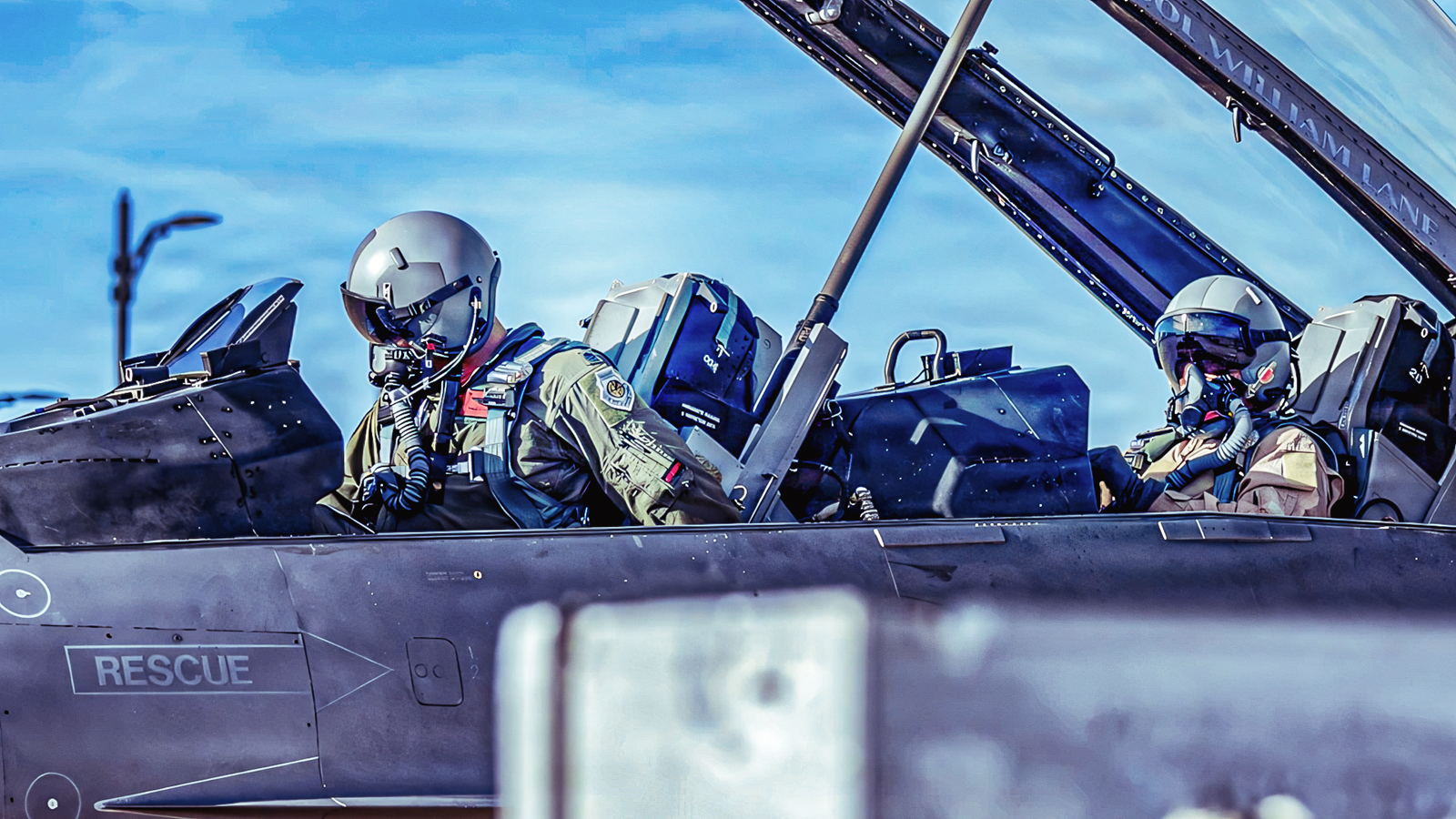
Published Oct 6, 2026, 8:00 PM EDT Luke Diaz is a freelance military writer with experience with active duty experience in the US Navy as well as defense and industrial engineering. He is a former Naval Flight Officer who performed tactical air control on the carrier-based E-2 Hawkeye. The US Air Force will graduate about 1,555 new pilots in 2026, finally clearing an annual target of 1,500 that had eluded the service for years. Even as the USAF has won its first battle in the campaign against staff shortages, it is far from achieving victory. Lieutenant General Clark Quinn, commander of Air Education and Training Command, personally confirmed a true recovery is 15 to 20 years away. The deeper imbalance in the personnel turnover is derived from a pilot production line being robbed of trainers to produce new aviators due to the 'push-pull' between frontline squadrons and support commands. The service must constantly juggle between dedicating fully qualified and experienced aircrew to combat duty or training assignments. When events like Operation Epic Fury require more senior pilots, training commands are left short-handed. This staff crunch forces defense analysts to continue to speculate whether the service has actually solved its pilot shortage or has simply pushed the crisis down the line. It leaves a massive question mark over whether operational units can turn this influx of new aviators into experienced combat pilots, or if the training system is just sliding a bottleneck further to the right on the calendar. A Record Class Against A Shortfall That Will Outlast It Credit: US Air Force The recent landmark graduation numbers were revealed at the Air & Space Forces Association’s annual conference by General Quinn. He confirmed that 1,408 student aviators had earned their wings by mid-September, with another 147 slated to graduate before the close of the fiscal year. Barring any last-minute medical issues or maintenance cancellations, the final tally will hit roughly 1,555 pilots, putting the pipeline about 50 graduates ahead of the long-sought-after target. Last year, the total pilot deficit sat at 2,470. Air Force officials have repeatedly attributed the persistent shortage to three core problems: pipeline production, mid-career retention, and absorption. This final hurdle, absorption, dictates how many freshly qualified pilots an active-duty squadron can integrate into full combat operations without overwhelming its limited pool of Aviators and aircraft. Quinn noted it will take 15 to 20 years of continuous seasoning to cultivate the services' desired level of leadership. Because retention rates fluctuate wildly based on commercial airline hiring waves and economic conditions, the timeline for filling the gap remains highly fluid. Most of the empty billets sit in advanced staff and leadership positions held by senior officers. Quinn was quoted by Breaking Defense: “I can’t erase that pilot deficit in a short period of time. It’s going to take 15 or 20 years to get those types of people. I can make them today, but those jobs won’t be filled for quite some time. “I do know that if we don’t make 1,500, we’re never going to get that number down.” Defense observers and Pentagon planners suggest a solid decade of hitting the 1,500-pilot milestone would be the minimum to stabilize the force level. The outstanding mystery is exactly how a training pipeline that had fallen short for years suddenly unlocked this level of output. Overhauling The Pipeline With A Hybrid Model Credit: US Air Force The driving force behind the production surge is a hybrid model called the Future of Undergraduate Pilot Training. FUPT was introduced in spring 2025. Under this framework, students log 120 flying hours over 139 days at one of four civilian flying universities. They then earn an FAA private pilot license with instrument and multi-engine ratings before transitioning to an official Air Force undergraduate training base in Mississippi, Oklahoma, or Texas. The scheme successfully offloads basic flight training to civilian schools to bypass non-military-specific bottlenecks and save higher-performance airframes as well as the time of a limited pool of active-duty flight instructors. However, the military-specific leg of the pipeline remains highly vulnerable. The Northrop T-38 Talon jet trainers have been flying since the 1960s, and their high-tech replacement, the Boeing-Saab T-7A Red Hawk, is not scheduled to achieve initial operational capability until August 2027. Reaching that milestone requires delivering 14 aircraft to Randolph Air Force Base, but the training squadron has only received its third jet to date. Furthermore, Air Force leadership has not yet committed to a single-aircraft training pipeline built entirely around the Red Hawk. While streamlining the pipeline would slash the overhead costs of supporting a legacy weapon system, top brass are still weighing operational trade-offs. Where The Pipeline Narrows Downstream Credit: US Air Force Air Force Chief of Staff General Kenneth Wilsbach directly addressed the next major hurdle during the last congressional hearing on the topic. While the service is successfully hitting its initial pilot production milestones, the real friction point shifts to continuing to absorb those fresh graduates into combat squadrons. Any assertions of a strict ceiling should be treated with caution because there is no publicly disclosed cap on the number of new pilots a frontline unit can integrate each year. Formal Training Units for fighter squadrons were only producing 294 pilots annually, according to the report. Large funding infusions, additional training aircraft, and more experienced instructors are needed to scale things up. The overall shortfall is not always alleviated by forcing more graduates into the system than the downstream pipeline. This dynamic creates a systemic crisis known as over-absorption. Operational squadrons simply do not have enough seasoned flight leads and instructor pilots to train an influx of rookies on schedule. As an independent RAND study illustrates, it creates a brutal catch-22: cultivating the future supply of experienced aviators requires drawing from a pool of experienced pilots that simply does not exist today. Experience Takes Years That No Syllabus Can Compress Credit: US Air Force The severe ripple effects of the experience deficit become clear when looking at the cold numbers. Heather Penney, a senior resident fellow at the Mitchell Institute for Aerospace Studies, published a report highlighting that cultivating a qualified F-35 flight leader demands 250 flying hours and 60 simulator sorties after over a year of basic instruction. Turning out a fully capable combat pilot takes five full years. The fighter pilot shortfall alone has steadily worsened over the last two decades. The deficit climbed from 200 pilots in 2006 to 1,000 in 2017, finally hitting 1,150 by early 2025. This persistent gap leaves frontline squadrons with dangerously few experienced instructors to mature incoming rookies. Penney explicitly linked the decline to shrinking fleet sizes and underfunded sustainment budgets, noting that losing veteran pilots directly sacrifices vital combat survival skills and massive training capacity. Spending Alone Is Insufficient To Salve The USAF's Woes Credit: US Air Force Still, the Air Force is attempting to throw money at the problem to get more aircraft back into the sky. General Wilsbach told lawmakers that next year's budget requests nearly $10 billion for the flying hour program, which includes $7.4 billion dedicated strictly to active duty units. This represents a substantial 22% spike from the $6.1 billion allocated in fiscal year 2026. Wilsbach was quoted by Breaking Defense commenting on the impact of the new training program: “That new way of doing pilot training has allowed us to increase the number of pilots that we need per year, which is the way that we intend to man those new platforms that are coming.” “We’re a few years off from having to reduce the number of pilots that we have, but in the meantime, we’re making 1,500 a year." Additionally, to incentivize families and boost retention, the service also plans to let pilots stay at their assigned duty stations longer than the traditional two- or three-year rotation cycles. However, translating its massive financial injection in career-flow changes into results still depends on whether frontline units have planes that are mechanically ready to fly. The latest readiness data paints a much tougher picture. Whether Demand Will Fall Before Supply Catches Up Credit: US Air Force During a roundtable with the media, General Wilsbach clarified that the redesigned pipeline is intended to staff future platforms such as the B-21 stealth bomber and the F-47 fighter. Additionally, he pointed out that the unmanned drone wingmen designed to fly with human pilots, known as Collaborative Combat Aircraft, may eventually lower the total number of people needed in the cockpit. For the time being, the service intends to continue producing 1,500 new aviators each year while keeping an eye on how these autonomous technologies develop over the coming years. The Pentagon has yet to find a solution to the strange tension created by this future view. If drone wingmen drastically cut down the need for human pilots, the Air Force might find itself stuck running a massive, expensive production line sized for a fleet it no longer fields. Meanwhile, the severe shortage of experienced, mid-career officers will drag on anyway. You Can Take The Human Out Of The Cockpit But Not Out Of The Loop Credit: US Air Force Since a larger class does not always translate into a better-prepared fighter pilot, training commanders stress that the next major issue is to refine the curriculum, so the caliber of these graduates meets the sheer magnitude of the output. Over the coming years, there are very specific criteria to keep an eye on. By August 2027, the first B-21 Raider must land at Ellsworth Air Force Base, the T-7A Red Hawk trainer must reach initial operational capability, and Congress must actually fund and turn the $10 billion flying hour program into actual training sorties. If these milestones hold, the Air Force might pull out of its tailspin within a decade. But if aircraft availability keeps sliding, 1,500 rookies a year will simply pile up in a queue faster than squadrons can train them, keeping the experience deficit wide open.
The US Air Force Just Hit Its 1,500-Pilot Goal, But The Real Shortage Will Take 20 Years To Fix
Full Article
Original Source
Read the full article at Simpleflying →KhanList aggregates and links to publicly available news content. We do not host full articles from third-party sources. Always verify important information with original sources.