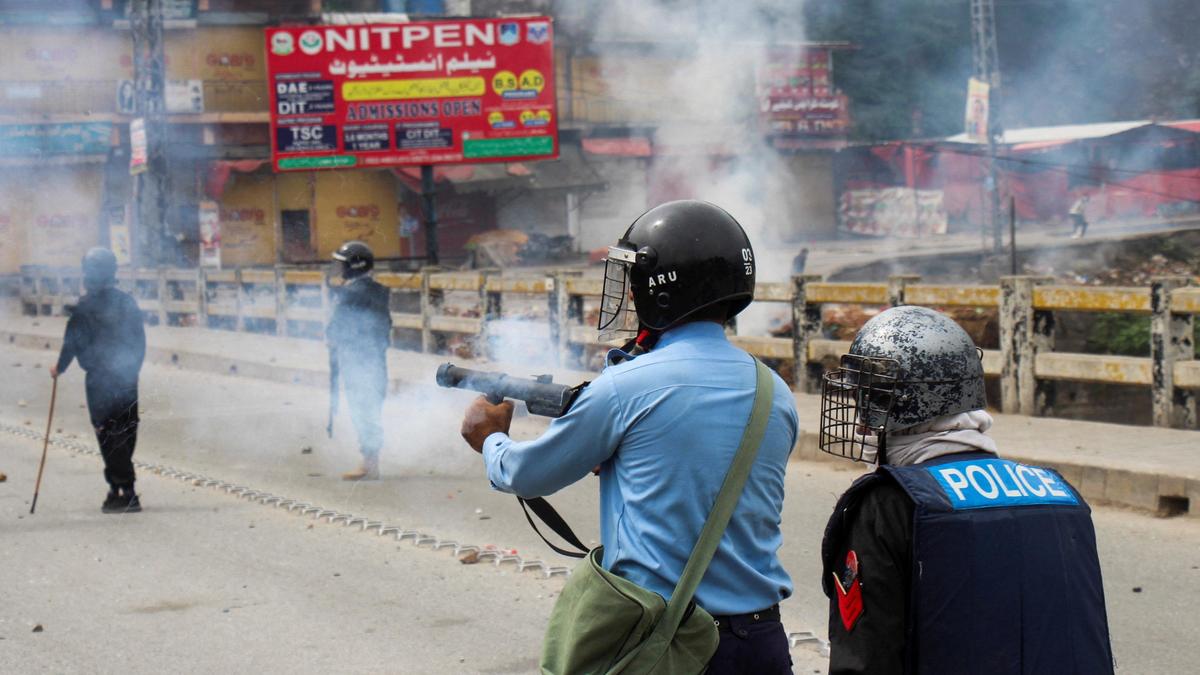
At 10:58 p.m. on 27 July, Pakistan’s Prime Minister Shehbaz Sharif, through his official social media account, was expressing solidarity with Spain over the devastating wildfires and conveying his sympathies to Prime Minister Pedro Sánchez. By then, reports had already identified several of the 19 people killed in Rawalakot, central Pakistan-occupied Kashmir (PoK), where security forces had allegedly opened fire on protesters. The contrast was stark: while the prime minister publicly responded to a humanitarian tragedy abroad, there was no acknowledgement of the bloodshed unfolding in a territory under Pakistan’s own administration and control.The contrast was difficult to ignore. While Islamabad’s attention appeared focused on a humanitarian tragedy thousands of kilometres away, one of the deadliest episodes of violence in recent years was unfolding within territory under Pakistan’s own administration. The protests, which began in early June 2026, have now entered their eighth week. Yet, as fresh fatalities were reported in Rawalakot on 27 July and in Mirpur the following day, the overall death toll in the last two months, according to local reports, had crossed 70. Throughout this period, there was no significant public statement and outreach from Pakistan’s top political leadership acknowledging the violence or expressing condolences to the victims. For protesters and their supporters, this symbolised the federal government’s apparent indifference to a movement that has evolved into the most sustained and significant mobilisation witnessed in Pakistan-occupied Kashmir in decades.The anger in Pakistan-occupied Kashmir shows few signs of subsiding. If anything, the developments of the past several weeks have only reinforced the structural trends that became apparent when the protests first erupted, as discussed in my two earlier analyses of the unfolding crisis for this publication in the last one-year. What initially appeared to be a mobilisation centred on economic grievances has steadily evolved into a wider political movement questioning governance, representation and Islamabad’s relationship with the territory. The persistence of the protests suggests that the underlying issues remain unresolved despite attempts to restore or project normalcy. There are some important political and social dynamics that emerged during the roughly 50-day protest movement that merit careful study, given their implications for any future India–Pakistan dialogue aimed at achieving a substantive and lasting peace in South Asia.The recent developments unfolded against a broader geopolitical backdrop. Pakistan’s international standing had initially appeared to improve following its role in facilitating dialogue between the United States and Iran. Against this background, the establishment seemingly viewed prolonged unrest in Pakistan-occupied Kashmir as an unnecessary domestic distraction that needed to be contained quickly. Unlike the response during a similar episode last year, the state adopted a noticeably harder posture towards the protesters.The timing of the latest violence added another layer of political significance. The Rawalakot killings occurred on the very day that the first phase of elections to the Pakistan-occupied Kashmir Legislative Assembly was held in the southern districts. The coincidence of electoral activity, which never assumed a lot of importance in the past because of institutionalized manipulation of the results, with fresh bloodshed underscored the deep political and social tensions and raised renewed questions about governance, state accountability and the credibility of the electoral process in the region.In the last two-months, the statements and speeches delivered by leaders of the Jammu Kashmir Joint Awami Action Committee (JAAC), the organisation spearheading the movement, provide perhaps the clearest indication of the depth of public anger simmering beneath the surface. They reveal that the present agitation is not simply a reaction to a single policy decision or an isolated economic grievance but reflects accumulated resentment over the manner in which the Pakistani establishment has governed the region over decades. The narrative employed by protest leaders points to a political mood that is far more volatile than the immediate demands alone might suggest.What stands out is that the movement combines everyday governance concerns with deeper structural, political and economic issues. The demands range from improving public services, including access to MRI facilities, healthcare and basic infrastructure, to institutional reforms such as abolishing the reserved refugee seats in the Legislative Assembly. Taken together, these demands suggest that public dissatisfaction extends beyond administrative shortcomings to the very framework through which Pakistan-occupied Kashmir is governed. The movement is therefore not merely about service delivery but also about political representation, accountability and the constitutional relationship between the region and Pakistan.The trajectory of the protests also reflects a shift in Islamabad’s approach. During the initial phase of the agitation last year, Pakistan accepted several of the JAAC’s demands in an effort to defuse tensions. However, the subsequent response became noticeably more coercive. Even individuals regarded as part of the establishment were not spared. Last month, a retired Inspector General of Police from the region was detained, while he was in Islamabad, after publicly calling for an objective assessment of the movement’s demands. The episode underscored the narrowing space for independent political opinion, even when expressed within constitutional limits.Pakistan’s mainstream political parties have largely refrained from making any serious effort to defuse the crisis. While the Pakistan Peoples Party (PPP) has made general calls for the establishment of a truth commission, it has stopped short of criticising the state’s heavy-handed response to the protesters. The ruling Pakistan Muslim League (Nawaz) (PML-N) has adopted an even more uncompromising stance. Pakistan’s Defence Minister Khawaja Asif, in a series of provocative statements, portrayed sections of the protesters as enemies akin to India, reinforcing the government’s confrontational approach. The only tangible attempt at political engagement came from the opposition alliance, Tehreek-i-Tahaffuz Ayeen-i-Pakistan (TTAP). A delegation led by Opposition Leader Mahmood Khan Achakzai, and comprising former Prime Minister Shahid Khaqan Abbasi, Senate Opposition Leader Allama Raja Nasir Abbas, and former senator Mustafa Nawaz Khokhar, sought to travel to Rawalakot to meet the protesters and express solidarity with their demands. However, the authorities stopped the delegation before they could meet the protesters.Geography and economics have also profoundly shaped politics in Pakistan-occupied Kashmir in the past. The region’s mountainous terrain, limited economic base and heavy dependence on financial transfers from Islamabad have constrained its political choices. Consequently, local political leaders have generally remained mindful of the establishment’s red lines. Even the recent protest movement has largely confined its demands to better governance, increased fiscal transfers and budgetary allocations commensurate with the region’s population, rather than calling for a fundamental break with Pakistan.Among the demands attracting particular attention in the protests is the abolition of the reserved refugee seats in the Legislative Assembly. Although often viewed as an institutional issue, the debate reveals deeper historical sensitivities. Within the Pakistani establishment, and even among legislators elected from these constituencies, reactions to any proposal questioning these seats have been exceptionally strong because they remain intertwined with memories of Partition, displacement and loss. Speaking in Pakistan’s National Assembly, Defence Minister Khawaja Asif, himself from Sialkot, a city that received large numbers of refugees from the Jammu plains after Partition defended the continuation of the reserved seats. Recalling stories of women who, he said, jumped into the River Chenab to escape communal violence in 1947, he argued that the seats constitute historical recognition of those sacrifices. The exchange illustrates how contemporary constitutional arrangements in Pakistan-occupied Kashmir continue to be shaped by memories of Partition nearly eight-decades later. In this context, it may be mentioned that similar memories exist among many Hindu and Sikh families on the Indian side who got displaced from PAJK. My own family carries such memories. My aged and ailing maternal great-grandfather was killed by his own son while fleeing the 1947 violence, because his son refused to abandon him as mobs were chasing the family. Stories like these remind us that behind competing national narratives are human experiences of fear, loss, and impossible choices on both sides.The protests once again exposed the broader political constraints under which Pakistan-occupied Jammu and Kashmir has evolved. Although Pakistan officially maintains that the territory’s final status remains disputed, political life has long functioned within clearly defined boundaries shaped by the military establishment and the centrality of the “Jammu and Kashmir issue” in Pakistan’s national security doctrine. Since the 1950s, pro-independence voices in the region, including leaders such as late Abdul Khaliq Ansari, have faced detention and sustained state pressure. The recent crackdown suggests that these structural constraints remain firmly in place. Individuals and their families have been specifically identified in the state crackdown.An important demographic detail further illustrates why these developments deserve closer attention. According to the latest figures released by the Election Commission of PoK the region has approximately 3.8 million registered voters, including approximately .4 million voters from the migrant seats. The last published census (2017) recorded a population of 4.05 million in the region. However, the 2026 electoral rolls of the region contain 3.37 million resident voters, suggesting that the current resident population is likely substantially higher than the 2017 census figure and may now exceed 5 million. The proportion of the population aged 18 years and above in South Asia generally ranges between 58% and 62%, reflecting differences in fertility rates and demographic structure.This demographic reality places Pakistan-occupied Jammu and Kashmir’s population broadly on par with that of either the Kashmir Valley or the Jammu province, the two principal provincial units of the Union Territory of Jammu and Kashmir, whose total population is about 13.8 million (2024–26 estimates). The region can therefore no longer be treated as a peripheral component of the undivided J&K, as it existed in 1947, but must be understood as a significant political and strategic entity in its own right. The two regions on either side of the Line of Control exhibit remarkably similar settlement patterns, with approximately three-quarters of their populations residing in rural areas, 72.6% in the Indian side of Jammu and Kashmir and about 75% in Pakistan-occupied Jammu and Kashmir. The remainder live in urban centres.The events of the past 50 days have also reopened fundamental questions about identity in Pakistan-occupied Jammu and Kashmir (PAJK). The controversy triggered by Pakistan’s Defence Minister Khawaja Asif’s remarks questioning whether residents of Rawalakot, Mirpur, Dhirkot and other parts of PoK could genuinely be described as “Kashmiris” exposed contradictions that have long existed within Pakistan’s official discourse. Rather than being a passing political controversy, the debate highlighted the tension between Pakistan’s portrayal of the former princely state as a single religious and political entity and the region’s far more complex ethnic, linguistic and historical diversity.Since the 1947-48 conflict, the Pakistani state has placed extraordinary emphasis on the idea of “Kashmir” and the “Kashmir cause”. Over time, the term “Kashmiri” has come to be applied almost indiscriminately to the inhabitants of PoK, even though the overwhelming majority of its estimated population of over five million speaks Pothwari and Pahari dialects rather than the Kashmiri language. In official discourse and popular narratives alike, the former princely state was once collectively referred to simply as “Kashmir”, and all their inhabitants were described as “Kashmiris”. This broad categorisation obscures the region’s considerable internal diversity.The reality is far more nuanced. The inhabitants of PoK share close ethnic, linguistic, cultural and familial ties with Pakistan’s adjoining Pothwar region in northern Punjab. Communities such as Jats, Rajputs and Gujjars straddle both sides of the provincial boundary, while Pothwari and Pahari remain the dominant spoken languages. Yet these identities have been largely subsumed within the broader political identity of “Kashmiri”. The erasure of ethnic and linguistic distinctions has been shaped by both state policy and local political incentives. On the Indian side, decades of scholarship and public engagement, led by public intellectuals such as the late Balraj Puri, have fostered a broader recognition that Jammu and Kashmir is home to multiple cultural, ethnic and linguistic identities. Contemporary politics, including the need to accommodate the aspirations of diverse communities, is largely a continuation of this long-standing evolution.For Islamabad, the homogenisation of identities serves an important political purpose. Pakistan’s claim over the former princely state has historically rested on its Muslim-majority character and the argument that Jammu and Kashmir represents the “unfinished agenda of Partition”. Acknowledging the region’s ethnic and linguistic diversity would also mean recognising that its constituent communities possess distinct historical experiences, political aspirations and cultural identities that cannot easily be accommodated within a single national narrative. This is particularly striking given Pakistan’s own history. The refusal to accommodate Bengali linguistic and cultural identity was a central factor behind the country’s dismemberment in 1971, when East Pakistan emerged as the independent state of Bangladesh.The persistence of the “Kashmiri” identity in PoK is not solely a product of state policy. It also reflects the region’s own political and social incentives. Unlike in the Indian side of Jammu and Kashmir, where identities such as Pahari and Gujjar have increasingly become recognised political and cultural categories, there has been relatively little public assertion of these identities in PoK. In Jammu and Kashmir, members of these Muslim communities are often quick to distinguish themselves ethnically from Kashmiri-speaking populations of the Valley. This process has evolved gradually over the decades and has been further reinforced by institutional incentives, including the recognition of both Pahari and Gujjar communities as Scheduled Tribes in India. In PoK, however, the incentive structure works in the opposite direction. Identifying as “Kashmiri” provides a distinct political identity that differentiates the region from neighbouring Punjab and reinforces its association with the larger Jammu and Kashmir. Consequently, the broader “Kashmiri” label has increasingly overshadowed the region’s own ethnic and linguistic diversity. So for different reasons, both the Pakistani establishment and the locals of PAJK have self-identified themselves as Kashmiris even though the Kashmiri speaking population in the region is not even one-percent.Khawaja Asif’s remarks inadvertently exposed these long-suppressed contradictions. They demonstrated that beneath the rhetoric of a unified “Kashmiri” identity lies a region whose politics, history and social composition are considerably more diverse than Pakistan’s official narrative has long acknowledged.Taken together, the protests have revealed several other structural realities. They have exposed the depth of public dissatisfaction with existing governance arrangements, demonstrated the emergence of a more assertive local political consciousness, highlighted the limits of viewing the region exclusively through a security lens, and reopened debates over identity, constitutional status and political representation. These are not transient developments. They represent deeper shifts in the political evolution of Pakistan-occupied nistered Jammu and Kashmir.There is little doubt that the Indian side of Jammu and Kashmir has remained in the international spotlight, particularly since the outbreak of militancy in 1989. Apart from the mayhem unleashed by terrorist outfits, the region has also attracted attention for a range of other reasons, including allegations of human rights violations. For the first time in the social media age, the developments in Pakistan-occupied Jammu and Kashmir have openly exposed the fragility of Pakistan’s long-standing claims. Despite prolonged internet shutdowns, restrictions on communications, and efforts to suppress information, the events of the past year have been widely documented through eyewitness accounts, social media, and independent reporting. The next time Pakistan claims to speak on J&K, it will have to contend with the record of the past year. This is a record that has raised serious questions about its own governance, democratic credentials, and treatment of the people living under its administration.This overall evolving landscape also assumes particular significance in light of earlier India-Pakistan engagements. During the tenures of Prime Ministers Atal Bihari Vajpayee and Manmohan Singh, several proposals envisaged a framework encompassing both sides of the Line of Control. Implicit in those discussions was the recognition that any durable peace would necessarily involve the populations living on both sides of the Line of Control. The lessons emerging from the past 50 days therefore deserve careful examination. The political transformations witnessed over the past year, particularly the sustained protest movement, will have to be factored into any future thinking. Any meaningful effort to achieve a substantive and lasting peace in South Asia will require a far deeper understanding of the region’s evolving political, constitutional, demographic and social realities.(Luv Puri has authored two books on Jammu and Kashmir namely Uncovered Face of Militancy and Across the Line of Control, the latter published by Columbia University Press based on field work in the region and Pakistan)
The unravelling of Pakistan’s narrative on Kashmir
Full Article
Original Source
Read the full article at Thehindu →KhanList aggregates and links to publicly available news content. We do not host full articles from third-party sources. Always verify important information with original sources.