
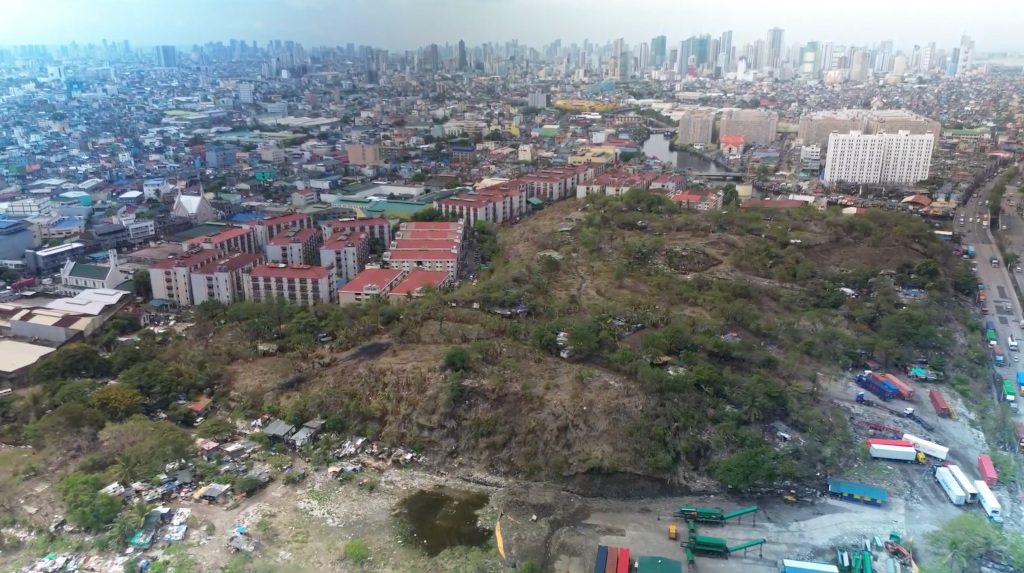
Smokey Mountain lies near the edge of Tondo in Manila, bordered by Malabon and Caloocan, Manila Bay and the Navotas Port. It’s called Smokey Mountain because it used to be a mountain of trash where fire erupts due to highly flammable methane that mass garbage exudes. On Google Maps, it can be pinned as Smokey Mountain Field of Dreams. The way to the 30 housing tenements in Smokey Mountain is through an arc that bears the signage: Paradise Heights. On Facebook, this is how Paradise Heights describes itself: “A wonderful community located beside Smokey Mountain. It is also known for its name Permanent Housing.” The people residing in the housing tenements were once people of the dumpsite, violently dispersed in 1995 when the government shut Smokey Mountain down. Smokey Mountain was giving Manila a bad name. It is a mountain of trash in the Philippine capital — the very image of urban poverty and environmental neglect. Former president Corazon Aquino wanted the National Housing Authority to lead the housing project and reclamation of a portion of Manila Bay near Road Radial 10 (R-10). The reclaimed land was supposed to be the government’s payment for their partner private firm in the development of Smokey Mountain. In 1993, the National Housing Authority partnered with private developer R-II Builders, owned by businessman Reghis Romero II. Smokey Mountain residents were relocated to temporary housing along R-10, which, because of locals’ dry humor, eventually took the name Happyland, derived from the Bisaya word hapilan (or dumpsite). Beside it is Aroma (or pleasant smell), another temporary housing site. Years later, when the permanent housing buildings were finished, Smokey Mountain residents came back. The housing tenements in Smokey Mountain surround a hill that retains legacy waste from the days when the dumpsite was still operational. That hill, which locals call the Upper Smokey Mountain, is home to more than a hundred families. Through the years, they have learned to plant and harvest crops for subsistence and livelihood. The smell of trash is unmistakable going up. But after a while the smell fades away. It was on this hill that Jenny Gamoc, 14, read from her phone a poem she wrote. We were sitting by the door of their house, the kitchenette in front of us. Jenny is a short girl with large eyes. At 14, her voice is clear and rings true, unbridled by the limitations her environment imposes. She allows herself to dream of better days and write about what angers her. Inside Jenny’s house is a single bed. The flooring is the earth. Their refrigerator is balanced on a platform. A small Sto Niño statue watches over their dining table. Tiny orange cats and a dog have made themselves at home. “Pahina (Page)” was what Jenny called her poem. Sa bawat pahina ng isang aklat, nasanay / tayong basahin ang mga salita, ngunit / hindi saliksikin ang mga kahulugang / nakatago sa likod ng mga ito. (In each page of a book, we were used / to read the words but / not understand their meaning / hidden behind them.) She read me her poem because I was asking what she wanted to be when she grows up. Jenny said she wanted to be an architect. Build happy homes for happy families. If that doesn’t pan out, she can try and be a journalist. Her third choice is to be a writer. Jenny grew up in Smokey Mountain and attends San Rafael Parochial School in Tondo. When Upper Smokey Mountain residents trooped outside Manila City Hall to oppose the relocation, she joined them. “Kaya talaga ako noon sumama, siyempre paninirahan namin ang nakasalalay,” said Jenny. (I joined because of course, it is our home that’s at risk.) Going around the hill, she would point at empty areas where a chapel or a house used to be. There are remains of demolished structures. Plastic trash is fraying, folded into the soil. There are plots where people farmed for food and livelihood. During harvest, they get sweet potatoes, water spinach, eggplants, and calamansi. From the top of the hill, we can see the roofs of the housing tenements densely packed and teeming with people. On the other side is a view of the port and the bay beyond. Home. Jenny during her interview with Rappler last June, inside her home at Upper Smokey Mountain. Photo by Franz Lopez/Rappler Since November 2024, residents have been asked to relocate in exchange for housing or financial assistance. Families are being offered units at Sunshine Ville, a housing project in Trece Martires, Cavite, that is more or less 70 kilometers away from their place in Tondo. The unoccupied units at Sunshine Ville suffer from neglect: a sink across the door, a small toilet room beside it, and garbage dumped inside. Weeds and grass are left untrimmed along the paths of the empty units. November 2024 1,240 families in Upper Smokey Mountain when relocation efforts began. Now 178 informal settler families left — 47 eligible for housing; others receive varied financial assistance or may appeal. Source: Data from court receiver as of August 2026 About 437 families were qualified for housing but the majority opted for the P60,000 worth of financial assistance. Those not eligible get varied amounts of financial assistance or can opt to appeal. The development plan that started in 1993 not only involved a housing project but also a clearing operation that was supposed to turn the former dumpsite commercially viable. This is what R-II Builders get in exchange for building the permanent housing in Paradise Heights for evicted dumpsite residents. What followed was a cat-and-mouse game between the government agencies concerned and R-II Builders over the terms of the contract and financial mess. In 2012, the Court of Appeals ruled in favor of R-II Builders, ordering the government to settle its obligations in the P4-billion civil suit. The Supreme Court affirmed this in 2017. There is now a court receiver who manages the assets in Smokey Mountain following the delayed disposition of assets. Corporate lawyer Norma Singson-de Leon is the appointed court receiver and handles the assets of the Smokey Mountain Asset Pool. She runs her office in Quezon City and has had experience of being the court receiver in other cases. But this was the first time, according to De Leon, that she is court receiver in a case that included the relocation of people. The properties she handles for the case are the remaining mound at Smokey Mountain, the temporary housing project in Vitas, Tondo, and portions of the Manila Harbor Center. De Leon is given the unsavory job of overseeing the removal of families and the clearing of legacy trash. “But the point is, it will be better for them in the long run,” De Leon told Rappler. “For them and their families. How can you live there when it’s very dangerous? Anytime, it can collapse.” She said she has hired private guards that patrol the Smokey Mountain area but denied allegations of harassment in the community. Upper Smokey Mountain residents went to the Commission on Human Rights last June, reporting harassment from private guards and seeking for an independent probe. She received no reports, De Leon said. “If something happens, I report it to the police. I cannot afford to make a mistake.” “How can you live there when it’s very dangerous? Anytime, it can collapse.” Norma Singson-de Leon · Court receiver, Smokey Mountain Asset Pool After clearing operations, Smokey Mountain will be freed up for development. And what businessman Reghis Romero II wants is a 100-megawatt waste-to-energy plant. Jerome Canlas, the president of Phil Ecology Systems Corporation (Phileco), said they are still applying for an environmental compliance certificate. Phileco is another Romero firm, like R-II Builders. It is the arm of their business that deals with waste management, previously managing the Navotas Sanitary Landfill that has since closed. Canlas is part of both companies. Linking the waste-to-energy plant to the relocation of Smokey Mountain residents is simply “nonsense,” Canlas told Rappler. “The thing is it just so happened that this is a suitable site when it’s clear,” Canlas said. “But irrespective of the WTE (waste-to-energy), if it pushes through or not, the project is a standalone project. To clear it.” Other factors are moving in favor of Romero. In 2024, the Manila local government said Upper Smokey Mountain is covered by the Supreme Court mandamus for Manila Bay rehabilitation because the area is located along the Marala River. For developers and the government, there exists a legal and environmental justification for why the families living on the hill should be relocated. Protest. Tondo residents hold a protest outside the building of R-II Builders on June 29, 2026, denouncing alleged harassment of private guards against their community. Photo by Leone Requilman/Rappler More recently Manila created a “local inter-agency committee” last April for the Smokey Mountain Dumpsite and Reclamation Project. This committee will “ensure and facilitate humane, peaceful, and orderly relocation” of families. Phileco has already partnered with Japan-based Kanadevia Corporation for waste-to-energy technology. In Congress, there is a push to amend the law and allow incineration technologies. No less than Philippine President Ferdinand Marcos Jr. endorses this project. "If this plan can contribute to converting waste into energy while preventing flooding and improving public health, we will do everything in our power to make it a reality,” Marcos said in a statement released by Kanadevia Corporation after his visit to Japan in June 2025. Inside Building 5, one of the housing tenements at Paradise Heights, electrical wires hang loose through the light shaft. The walls have accumulated dirt and grime through the years. A bare foam mattress was slung on the parapet wall. In this building lives Lolita Pablo. Lolita, 60, has hooded eyes behind round frames. Her hair was pulled in a severe ponytail and the white roots on her temples showed. Lolita was among those violently dispersed in 1995. She is wary of those protesting the relocation and waste-to-energy project, if only because she was among those who protested the demolition in the past. She remembers the day the demolition began very well: November 27, 1995. She had just given birth a few days ago. Police fired guns and tear gas. She told her children to cover their noses and mouths with wet clothes. When they went outside to flee, she carried her newborn, swathed in white clothes, close to her chest. Her other children followed behind, crying. “Kumbaga parang giyera nga,” she recalled. (It was like war.) Recollect. Lolita said remembering the 1995 demolition in Smokey Mountain still brings her to tears. Photo by Franz Lopez/Rappler Lolita said she remembered community organizers from Akbayan trying to call the mayor. “Wala namang sumasagot na mayor. Basta parang sarado na ’yung usapin na ’yan. Bahala na kayo kung mangyayari ’yan, mangyayari ’yan. May mamamatay, may mamamatay.” (The mayor was not responding. It seemed that there would be no dialogue about the demolition anymore. We were left to fend for ourselves. If something happens, it will happen. If there will be death, there will be death.) The mayor then was the late Alfredo Lim, former cop and Manila’s “Dirty Harry.” A news story from the Union of Catholic Asian News in 1995 recounted the killings of newborn Max Sabenicio and Ric Villaruente, leader of the urban poor’s group. A foreign journalist was shot. Lolita and her family eventually found themselves in Happyland, then found their way back again to Smokey Mountain, in one of the housing tenements in Paradise Heights. The 60-year-old believes people have learned to dream of better stations in life than just scavenging for trash. Along their hall was a tarpaulin congratulating a graduate. Lolita runs a sari-sari store. As part of the homeowners’ association, Lolita had attended a public scoping (a consultation with the community) in 2025 on the proposed waste-to-energy project. She is undecided on what she feels toward the project. But she knows that if there’s a push from the government and the developer, any protest will be futile. Like what happened in 1995. Asked if she was persuaded by the safety of the waste-to-energy plant, Lolita said: “Hindi ko rin alam [kung safe], kasi pag-aaralan pa nga nila eh. Kasi, siyempre, tao, nababagabag din kasi baka mamaya magkaroon ng epekto.” (I don’t know yet [if it’s safe], because they are still studying it. People can easily be worried that it will have impacts.) She pointed outside the window at the end of the hall of their tenement. They would just be sitting close to the waste-to-energy plant if and when it gets built in the future. Outside at noon, children in uniforms are walking home. A little beyond is a green mound of trash where houses stand and land has been plowed, what remains of that violent, deadly past that threatens to repeat itself. Somewhere on the hill, inside a house with the earth as flooring, a Sto. Niño statue watches over a family, tiny orange cats, a dog. A girl reads a poem she wrote. — Rappler.com Some quotes have been translated to English for brevity. Layout for this story was made with assistance from AI.
The unexpungeable odor of Smokey Mountain past
Full Article
Original Source
Read the full article at Rappler →KhanList aggregates and links to publicly available news content. We do not host full articles from third-party sources. Always verify important information with original sources.