
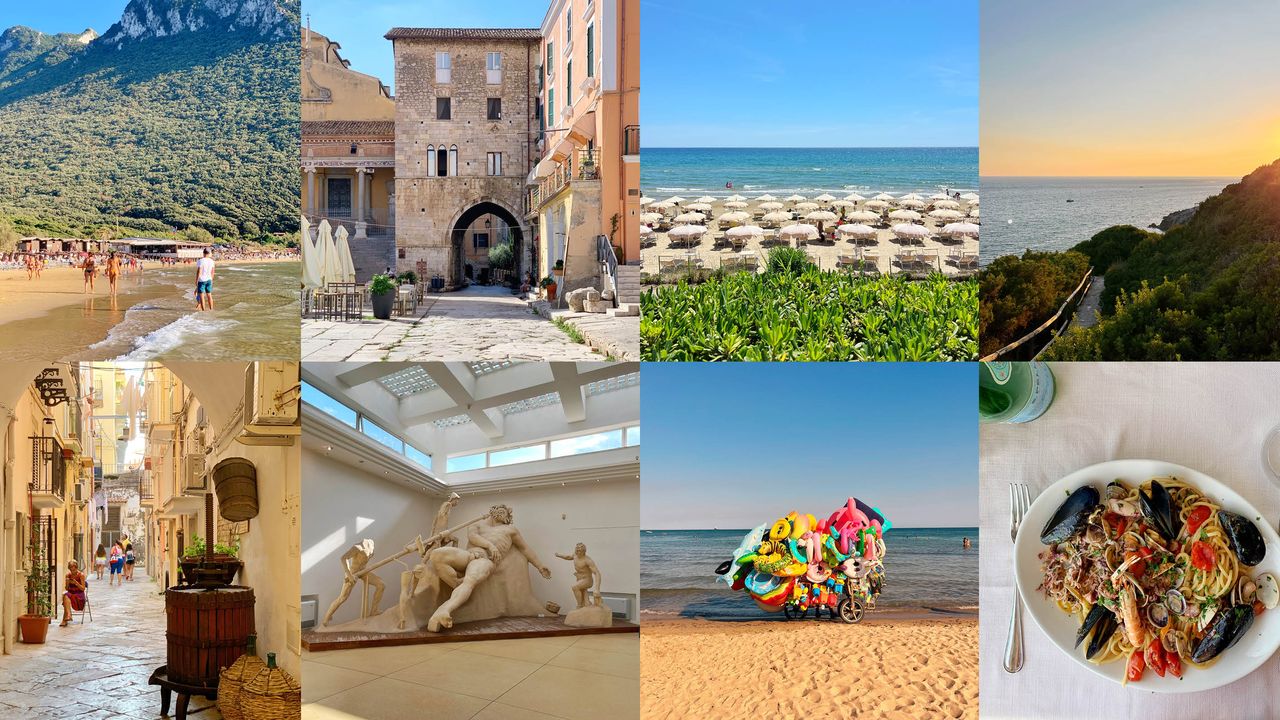
Every Fan of The Odyssey Should Visit This Overlooked Italian CoastlineNamed after Odysseus himself, this overlooked coastline between Rome and Naples combines mythological landmarks, ancient Roman ruins, crystal-clear beaches, and picturesque seaside towns.Laura ItzkowitzStaring up at the enormous statue of Polyphemus, the one-eyed cyclops from The Odyssey, displayed in the archaeological museum attached to the Villa of Tiberius, I was awe-struck by its hulking presence. I tried to imagine it standing over the Roman emperor’s guests in the grotto where he once threw lavish parties. Just a few minutes prior, I had walked through the ruins of the villa and seen the grotto carved into the side of the mountain overlooking the sea. It was discovered in 1957 during the construction of the Via Flacca, the road built to connect the towns along this stretch of coast between Rome and Naples. Just outside the archaeological site, a handful of barefoot teenage boys in swim shorts were kicking a soccer ball around on the compact sand by the edge of a shallow cove, the hilltop town of Sperlonga in the distance.View from the Tempio di Giove Anxur, Terracina Laura ItzkowitzStretching roughly 46.5 miles from Monte Circeo to Gaeta, the Ulysses Riviera takes its name from the hero of The Odyssey, proof of the area’s mythological ties. Romans have been flocking to this idyllic stretch of coast since the days of Tiberius, who ruled Rome from 14 to 37 CE and likely before. The statues of Polyphemus, Scylla and Charybdis, and other figures from The Odyssey discovered in Tiberius’s villa attest to the area’s millennia-long ties to myths and legends. Local lore places Circe’s island, Aeaea, either on Ponza, the idyllic isle just off the coast, or at Monte Circeo, the imposing mountain named for her. Rising high above the towns of Sabaudia and San Felice Circeo, it may have looked like an island because of the marshy wetlands surrounding it.Circeo centro storico Laura ItzkowitzSunset from the lighthouse, San Felice Circeo Laura ItzkowitzBut the Riviera also holds a legendary appeal for Romans, who remain loyal to summer vacations in the area. When I first moved to Rome in my early 20s, I remember hearing about it from my landlord, who used to wax poetic about Sperlonga, and the mother of one of my students, whose boyfriend had a summer home in Circeo, as she called it. Curious, I took the train to Sperlonga for a day trip with friends, and remember gazing down at the beach in awe. But it wasn’t until I moved back to Rome after an eight-year stint in New York City that I became a regular visitor.Driven by tales told by friends and colleagues, whose faces took on a dreamy glow as they recounted stories of summers spent there, I booked a room at the Hotel Chiaia di Luna on Ponza for a weekend away with the man who would become my husband. What I found was a place with the beauty of the Amalfi Coast as it was in the 1950s and ‘60s: rocky outcrops where people laid their towels down to sunbathe and dive off the rocks into the glittering turquoise sea, little family-run restaurants serving spaghetti with clams, pastel buildings overlooking the port.Grotto di Tiberio, Sperlonga Laura ItzkowitzThat dreamy trip to Ponza whet my appetite for the area. Curious to see the rest of the Riviera, I’ve gone back every summer, choosing a different town to stay in for the weekend and soliciting tips from various friends and acquaintances. In Gaeta, Daria Reina and Andrea Ferolla, who run the chic concept shop Chez Dede, sent me and my husband to the beach club where they had a season pass. A steep descent from the Via Flacca brought us down to the beach, where rows of orange-and-yellow umbrellas dotted the soft, golden sand and the water was the most breathtaking shade of aquamarine. Reina has been summering in Gaeta and Formia, the next town over, for decades and knows the area like the back of her hand.Appia Antica in Terracina Laura ItzkowitzSaporetti Torre Paola Laura ItzkowitzAt Papardò, the next beach club over, we found a couple of friends and joined them for slices of tiella, a local savory pie filled with stewed octopus and tomato or escarole and olives. The next day, we wandered through the narrow lanes of the Medieval quarter, where laundry hung from the balconies of the weathered buildings and little shrines to the Virgin Mary were decorated with flowers and candles. Before returning home, we stopped by an outdoor market to stock up on Gaeta olives and popped into a hole-in-the-wall bakery recommended by Reina to buy more tiella to snack on by the marina, where little fishing boats bobbed in the gentle waves.Gaeta alley Laura Itzkowitz“When I was a child in the 1970s, growing up in Brussels under its endlessly gray, rainy skies, arriving at my grandparents’ house in Formia in early July for the summer was a rush of uncontainable happiness. Summer had officially begun, the Italian kind,” she told me. “It’s no coincidence that between the 1950s and the 1970s Formia and Gaeta became favorite holiday destinations for many celebrities of the era. Alberto Sordi, Gina Lollobrigida, Pino Daniele, and Cy Twombly, to name just a few, bought houses here. Over the decades, the coast has hosted generations of Roman families from the north and Neapolitans from the south, who come here in search of pale sand and crystal-clear waters, unparalleled along Italy’s central Tyrrhenian coast.”Circeo beach Laura ItzkowitzOn subsequent trips, we stayed in Terracina, where we walked on a piece of the Appia Antica, the ancient road leading from Rome to Brindisi, feasted on fresh seafood at Da Mario l’Ostricaro, a retro restaurant overlooking the sea, devoured sorbetto made with sweet local strawberries at a gelateria on the main square, and wandered the ancient ruins of the Temple of Jupiter Anxur, high up on a promontory with views stretching the entire length of the coast.Gaeta beach club Laura ItzkowitzLunch at Saporetti Laura ItzkowitzIn San Felice Circeo, we spent a night in a cheap little pensione and found a calm stretch of spiaggia libera (free beach), where we set up our own umbrella and laid our towels on the sand, but splurged on dinner at the Hotel Punta Rossa, which exudes a very old school kind of glamour with its whitewashed walls and tile floors. Strolling around town before dinner, we popped into boutiques selling linen clothes and other beachy things before picking a bar at random and sitting down for an aperitivo.One of my favorite memories is from a long, leisurely lunch at Saporetti in Sabaudia, which draws affluent Romans for the perfect fritto misto and spaghetti with clams in a wood-paneled beach shack that looks like it hasn’t changed since the ‘60s. There, you’ll see businessmen and politicians who wear suits all year long walking along the beach under the shadow of Monte Circeo in speedos and swim trunks with their bikini-clad wives. All talk of business and politics are set aside in favor of conversations about food and other leisurely pursuits.Circeo street in the centro storico Laura ItzkowitzNo doubt things are changing, but change seems to come more slowly to this part of Italy. On the radio recently, the DJs were decrying how expensive Ponza is becoming. And when we went to Terracina, my husband was disappointed to find that the little fisherman’s cooperative where he had an amazing meal years ago had expanded and the quality had declined. “It used to be more authentic,” he sighed. But compared with the dramatic transformation of places like Positano, Capri, Puglia, and Taormina, the Ulysses Riviera still feels comfortingly behind the times. I think that’s in large part thanks to the fact that there are no luxury resorts to tempt the international jet-set away from Italy’s more famous resort towns.Sabaudia beach Laura ItzkowitzThis summer, we returned to Sperlonga to find the same perfect golden sand beaches and crystalline water, but up in the whitewashed town on the hill, an artist had painted murals depicting scenes from The Odyssey. Staring out at the beach below, perfectly framed by an arch decorated with a mural of Ulysses’s ship, a feeling of well-being washed over me. Ultimately, it’s that feeling that continues to draw Romans to these shores.This article was originally published in Condé Nast Traveller UK.Why Everyone Will Be Going to Osaka in 2025Laura Itzkowitz is a freelance writer and editor with a passion for covering travel, arts and culture, lifestyle, design, food, and wine. A proud Italophile, she lived in Rome for two years, speaks Italian fluently, and often writes about all things Italy. Her writing has appeared in Travel + Leisure, ... Read More
The Ulysses Riviera: the Hidden Italian Coast Every Odyssey Fan Should Visit
Full Article
Original Source
Read the full article at Cntraveler →KhanList aggregates and links to publicly available news content. We do not host full articles from third-party sources. Always verify important information with original sources.