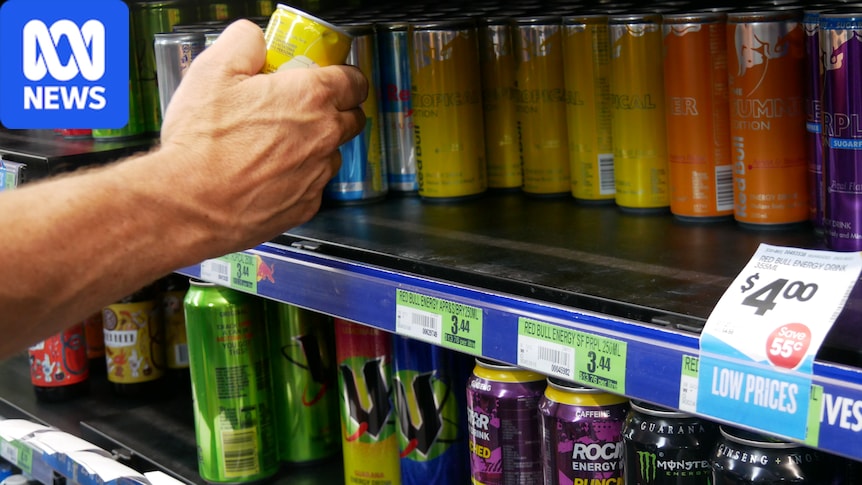
The British government wants to ban the sale of high-caffeine energy drinks to people under the age of 16.The ban would cover drinks, other than tea or coffee, containing more than 150 milligrams of caffeine per litre.Supporters of the ban say these kinds of drinks have been linked to sleep disruption, anxiety and poor concentration in children and teenagers.But how do they compare to coffee, tea and other beverages many people regularly consume?And what's the situation here in Australia?How much caffeine is in an energy drink?It can vary depending on the brand and the size of the can or bottle.However, the Australia New Zealand Food Standards Code says formulated caffeinated beverages, otherwise known as energy drinks, can't contain more than 320 milligrams of caffeine per litre.That works out to be 80 milligrams for a 250 millilitre can or 160 milligrams in a 500 millilitre can.How much caffeine is in coffee?It depends on the type of coffee you're drinking and how long it has been brewed for."As a rule of thumb, longer brewing times increase the caffeine concentration," the European Food Information Council's (EUFIC) website says.The council compiled a list of the caffeine concentrations in food and beverages based on a paper published in the European Food Safety Authority Journal in 2015.It's important to note how average milligrams of caffeine in a product varies from the amount of caffeine per serving — for example, the 53 milligrams of caffeine in dark chocolate might seem alarming until it's compared to the 7 milligrams in a typical serving size.ItemAverage milligrams of caffeine per 100ml or 100mgMilligrams of caffeine per average serving sizeEspresso coffee13480 (60ml)Dark chocolate537 (two squares)Filtered coffee4590 (200 ml)Instant coffee4590 (200ml)Black tea2255 (250ml)Milk chocolate172 (two squares)Chocolate milk (based on cocoa powder)1734 (200ml)Green tea1538 (250ml)Cola1137 (355ml)Decaffeinated tea38 (250ml)Decaffeinated coffee24 (250ml)Source: European Food Safety AuthorityWhy is caffeine bad for children?Caffeine is a central nervous system stimulant."Stimulants directly affect the brain," Gina Trapp, a professor of food and nutrition environment at Edith Cowan University, said."Energy drinks are inappropriate for children because of their lower physical tolerance for stimulants."In other words, the same amount of caffeine is likely to have a more marked effect on a child and teenager than an adult."Professor Trapp has a lot of experience researching energy drinks and young people, having co-authored several papers on the topic.She also said the high caffeine content in energy drinks made them addictive."Children have a smaller body mass, meaning they can experience higher concentrations of caffeine per kilogram of body weight," Jane Martin, the executive director of the Food for Health Alliance, said.The Food for Health Alliance is an advocacy body that works to improve diets and prevent obesity in Australia and is partnered with Cancer Council Victoria, Deakin University, VicHealth and Western Australia's Healthway."The high caffeine content and other stimulants in energy drinks can impact both physical and mental health," Ms Martin said."Energy drinks affect the nervous system and are associated with adverse effects including heart palpitations, sleep disruption, anxiety, restlessness and irritability."Sleep is particularly important during adolescence because young people require more sleep than adults to support growth, learning and mental wellbeing."Espresso coffees have a higher caffeine concentration to filtered or instant coffees. (ABC News: Sam Ikin)Does Australia have a youth energy drink ban?No.There are no federal laws restricting the sale of high-caffeine drinks to children in Australia.The extent of limitations on energy drinks for children are warning labels on packaging and advice for tuckshops."Australia already has measures in place aimed at protecting children from high-caffeine products," a spokesperson from the federal health department said."Energy drinks sold in Australia must carry a mandatory advisory statement that they are not recommended for children, pregnant or lactating women, or individuals sensitive to caffeine."Recent changes to the Food Standards Code have strengthened controls on caffeine in foods and beverages, including restrictions on the retail sale of pure caffeine as a food and additional controls on other high-caffeine products."The National Healthy School Canteens Guidelines advise against the sale of energy drinks in school canteens."The Australian Dietary Guidelines, published by the federal health department in 2013, say energy drinks are "not suitable for children".Does that go far enough?Ms Martin said Australia already recognised that energy drinks were "not appropriate" for children."Restricting the sales of these products to young people and children will offer much better protection than the current scenario of providing advice on the packaging and relying on young people to voluntarily avoid these drinks," she said."There is growing evidence supporting restricting sales of energy drinks to children and adolescents."But introducing an age-based sales ban in Australia would likely require separate Commonwealth or state and territory legislation."And energy drink manufacturers might complicate matters.Last year, a Coca-Cola Europacific Partners media release said Australia's energy drink sector was "booming"."The energy drinks category is growing in volume by 19.6 per cent year-on-year, with this strong trajectory expected to continue over the medium term," the company said."The pressure of industry opposition … around actions that will curtail sales and profits from this category may act as a barrier for governments to implement a ban," Ms Martin said.The ABC has contacted Coca-Cola and Monster Energy for comment.Australian Beverages Council chief executive officer Geoff Parker opposed the idea of a ban.The council includes Monster Energy, Coca-Cola Australia and PepsiCo Australia and New Zealand as members.Its website says its members voluntarily have agreed not to direct advertising for energy drinks towards children or sell energy drinks at schools.However, Professor Trapp argued energy drinks were "aggressively" marketed towards young people.Mr Parker said restricting the sale of energy drinks for under-16-year-olds would be a "quick headline"."[It] does not reflect the long-standing evidence and effective local regulatory arrangements designed to inform Australians," Mr Parker said."Implementing a ban similar to that proposed in England would not only be disproportionate to the Australian evidence base, it would also present significant practical enforcement challenges across the diverse retail environments in which these products are sold, without clear evidence that it would improve public health outcomes."Mr Parker said he supported Australia's existing food regulatory system's "strict controls on the manufacturing of beverages including energy drinks".He pointed to a recent review by Food Standards Australia New Zealand (FSANZ) looking into caffeine, which last year approved changes including new labelling restrictions for high-caffeine coffee beverages but did not recommend restrictions on the sale of energy drinks.The FSANZ report said the most recent safety assessment "did not identify any evidence that the permitted caffeine content of formulated caffeinated beverages [better known as energy drinks] or cola beverages should be changed"."FSANZ has not identified a risk that would justify amending the provisions for formulated caffeinated beverages."ABC with Reuters
The UK is banning high-caffeine drinks for under-16s. How does coffee compare?
Full Article
Original Source
Read the full article at Abc →KhanList aggregates and links to publicly available news content. We do not host full articles from third-party sources. Always verify important information with original sources.