
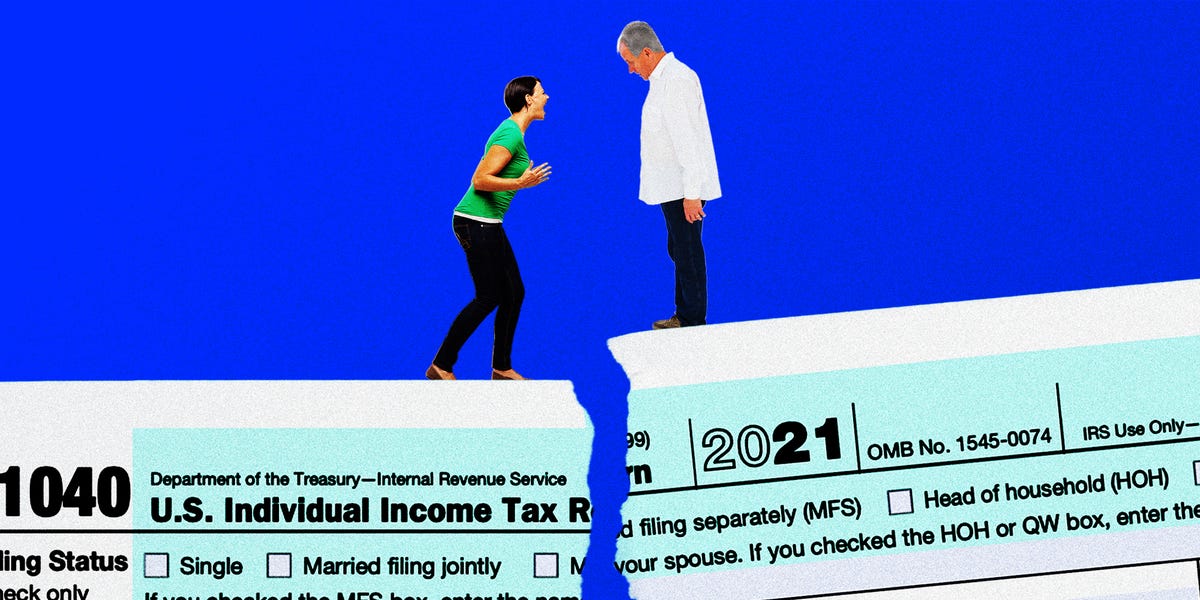
Getty Images; Tyler Le/BI Cuts for boomers, bigger bills for millennials: Inside America's new age fight over who pays taxes Getty Images; Tyler Le/BI Taylor Scriber, a millennial living in Texas, is trying to join the growing ranks of his generation and buy his first home. He's been scouring listings with his real estate agent, taking a few tours to see what suits him best, and estimating his potential costs, including property taxes.The final piece of that homeowning puzzle has been stuck in Scriber's craw lately. After reading recent headlines about property taxes in the Lone Star state being slashed for older residents and those with disabilities, he started to feel that he may end up shouldering the fiscal burden through his own payments with resulting rate hikes — and costing out worst case scenarios for what the cost of his future home might realistically look like, since so many homes have those abatements. After all, since Texas has no income tax, sales and property taxes are key in funding municipal services, like schools. So as revenue from older homeowners dries up and cities continue to face budget shortfalls, he expects his local government to make up for the cuts in other ways — including taxes on his home-to-be."You're stuck there, and you're looking at an inevitable property tax increase, because a group of people are voting to opt themselves out," he says. Almost 40% of homesteads in Texas pay no property taxes for school districts. That includes about 61% of older and disabled homeowners, up from 44% in 2024. Scriber's family and friends over the age of 65 all seem sympathetic when he brings up the issue — at first. They agree that increasingly foisting more of the cost of a functional society onto younger generations could be a problem, but then they start thinking further."They just kind of thought about it for a moment, and they were like, 'But I want my property taxes to be lowered,'" he says.A generational tax battle has begun to envelop the US. The current beef stretches far beyond timeless "kids these days" and "OK boomer" finger-pointing. It's turning one of America's rare forms of collective support — taxes and the social safety nets they help fund — into yet another individualistic debate, and it could have economic consequences for decades to come.For both the young and no-longer-young, the animus for the tax war comes from the same place: A sense of economic precarity.Older Americans spent decades imagining a comfortable, or at least stable, retirement with Social Security undergirding their personal savings. Instead, boomers' golden years are feeling much more precarious than they expected. For one, they're living on a less-than-hoped-for retirement income: Just over 57% of Americans over the age of 65 have annual incomes under $40,000, according to Business Insider's analysis of the Current Population Survey. Boomers were the first generation to hit the workforce as pensions faded, and their self-directed savings aren't as large as many of them had hoped. Add in rising costs, including hefty property taxes, and things are starting to feel very shaky. Even Social Security, long thought of as the solid lifeline of retirement, is looking less assured. Without congressional action, older Americans could see their benefits shaved in the coming years.For younger generations, the promise of long-term stability seems like a bygone idea. Just a quarter of 18 to 49-year-olds are confident in the future of Social Security, according to an AARP survey, and a separate Gallup poll found that 53% of the same age cohort think it's unlikely that Social Security and Medicare will be available in 10 years. They've hit a "career apocalypse," and their real income growth has dramatically slowed down. As the taxes to keep the social safety net from fraying are increasingly shifted toward them, it feels like a bum deal — especially as the benefits of their tax dollars seem murkier and murkier.The issue is in the balance of power: Both groups feel like they are floundering, but one is more politically potent. Boomers are more likely to be registered to vote than their younger peers: A Census analysis finds that voters ages 18 to 29 and those 30 to 44 were both underrepresented in the 2024 election, while voters 65 and older were overrepresented by 3.5 percentage points."Older people vote at higher rates than younger people. And as long as that's the case, lawmakers are going to be more responsive to the desires and demands of older people than younger people," Emily Ekins, an author of a report on Social Security sentiment from the libertarian Cato Institute report on Social Security sentiment, tells me. A mobilized, dissatisfied constituency holds a lot of sway, and that's played out in targeted carve-outs.Take the example of state income taxes: The left-leaning Institute on Taxation and Economic Policy finds that every state with a personal income tax has tax subsidies for seniors, and those subsidies are generally poorly targeted — meaning that higher-income seniors are paying less than lower-earning younger workers. That analysis finds that only 11 states offered credits and exemptions for private pensions, a key source of income for wealthier seniors, in 1977. By 1990, that number had grown to 21 states and hit 27 — a majority of states — in 2023."The plight of low-income seniors gets used as a Trojan horse to push through very, very large tax cuts for senior citizens broadly and often with a very large share of those cuts flowing to the best-off seniors who need them the least," Carl Davis, one of the ITEP report authors, tells me.Even when it comes to potential future changes, the generations are divided. A poll from the Cato Institute illustrates the divide with a single question: Would you favor or oppose raising Social Security payroll taxes to maintain current seniors' benefits, even if current workers would eventually get back less than they paid in? In other words, should people who are working pay more in taxes to ensure retired people get their benefits — even if those people shouldering the increased tax burden may not get "paid back" for doing so? A small majority — 52% — of those 65 and older favor the idea. On the flip side, 60% of 18- to 29-year-olds oppose the potential hike, as do 66% of 30- to 64-year-olds. It's a poll of finger-pointing: Older Americans want subsidies now. Their counterparts, who would fund them, don't want to hand over the cash.The tax fight is causing a bending and stretching of what Gerald Prante, an associate professor of business and economics at the University of Lynchburg, calls the U-shaped pattern of tax and government spending. In some parts of our lives, particularly in our prime-age working years, we receive less from government services than we pay in taxes. At other times, especially in childhood and old age, we get great value, with the government spending multiple dollars on us for every dollar we pay in.Americans under 25, for instance, often aren't paying that much in taxes because they are either still in school or have relatively low earnings. They directly and indirectly benefit from subsidies if they're in college, especially if they're at a state school. But things shift dramatically as we reach peak-earnings years. The post-college, pre-family generation, as Prante calls them, doesn't get much from the government. At the same time, this cohort pays the greatest share of taxes compared to household income. The high-tax, low-benefit group is only growing as birth rates fall and Americans marry later in life. Later on, programs kick in that push people up the other side of the U. For those with children, there are things like the Child Tax Credit and first-time homebuyer incentives. Taxes on this group are generally still high, but they're at least — ideally — accruing some wealth. Then there are seniors who receive generous benefits like Medicare and Social Security but pay little in income taxes, or have limits baked into their property taxes.The issue, though, is that more Americans seem set to bounce along the bottom of the U for longer. The things that would build wealth or buttress financial situations are increasingly out of reach, and the relief for those older Americans who do need genuine help is being extended to those who don't really need it.To peak earners like Justin Ober, a 47-year-old in Massachusetts, the older generation's push to roll back taxes is a rejection of the underlying logic that undergirds the U-shaped culture. He's not getting the same dollar-for-dollar value from taxes, but sees it as a straightforward public service. "There are a lot of things that I would probably have to pay a lot more for, and it would be a huge pain in my ass if they weren't being covered collectively through my tax dollars," he tells me.For older Americans, the calculus is different. It makes sense that they want to maintain their spot on the upward slope of the U, especially as Social Security alarm bells ring. But by trying to ease their own burdens, they are unwittingly bending the underlying system. The younger people I speak to like to point out that boomers who are 75 and older are the richest generation and continue to power the economy. So why isn't it unreasonable to ask whether they can help bear some of the burden, too? And thus, the battle continues.The issue in the generational tax war is that, absent political intervention or reckoning with current realities about who is asked to pay for what, it only gets more extreme. Older people, who are the country's most formidable voting bloc, will sign on to cuts that make their immediate lives easier. And younger people feel increasingly disenchanted by the idea of paying anything — a longer-tail legacy that could ripple for generations.Ober, the young Massachusetts Gen Xer, said he'd like to see some adults in the room to address tax and government debt issues."I think a senior citizen arguing against taxation is baffling unless they are independently wealthy and profoundly wealthy, not just well off, but wealthy enough to afford Western healthcare," Ober says."The temptation will always be to put a bandaid on it, but then that's just kicking the can down the road for the next generation after Gen Z," Emily Ekins, one of the Cato report authors, says. Lawmakers and experts need to get honest with Americans, she says, and tell them that everyone either needs to sacrifice a bit — or else the burden will just keep getting volleyed around.That's kind of nuts to get a tax cut and then functionally a tax raise to the rest of the population so you can hold an asset.Of course, there are exceptions to every rule. Millennials, despite suffering through the Great Recession and the pandemic-induced contraction, have seen their on-paper fortunes grow. On the flip side, there are boomers who might be wealthy on paper, but since their main assets are property, that wealth doesn't translate into liquidity.Wholesale attempts to resolve those structural issues, such as excising property taxes for older residents, are already having ripple effects. In Texas cities, for instance, legislators are grappling with budget shortfalls, and — ironically — contemplating hiking property taxes where they can. It's a rapid full-circle moment, and one that Scriber, the millennial homebuyer-hopeful, had been dreading."That's kind of nuts to get a tax cut and then functionally a tax raise to the rest of the population so you can hold an asset," he says.Amid all the finger-pointing stands boomer Allison Pickering, a 75-year-old retired educator in California who's been receiving Social Security for the last eight or so years. She rejects a generational divide."You can't blame an older person for having earned their living," Pickering says — and younger workers shouldn't be blamed for the socioeconomic cards they've been dealt.In her view, there's a simple solution: Rather than wringing out more taxes for younger workers, or having older workers fret about balancing their costs with dwindling Social Security, target an untapped base. Currently, Social Security taxes have a cap: everyone pays up to $184,500, and then stops, even if they're making a whole lot more. Lifting that payroll cap could help to resolve the generational tax debate that's instead been foisted into town meetings and budget addenda.Davis, the ITEP author, proposes divorcing taxes from age entirely: "I really don't think it's complicated. Your tax bill should be based on what you can afford to pay. It shouldn't be based on what year you happen to be born." Things like circuit-breaker measures — which are triggered when property taxes start eating up a certain percentage of homeowners' incomes — are one route to take.And when it comes to keeping programs like Social Security, Americans support policies that account for the nuances of individual situations. A National Academy of Social Insurance report finds that Americans across party lines are united in wanting to raise revenues, rather than shear benefits — including a package that would cap payroll taxes at the same rate now, but then implement them on earnings above $400,000, gradually raise the payroll tax rate for current workers, and bring down benefits for retirees with higher incomes. Taken together, it's a glimpse at generational harmony: Some taxes raised on younger folks, some sheared for wealthy older ones."It's imminently unfair," Pickering says. "And the burden does fall on the people who can least afford it — whether it's the elderly or the young people who are trying to get started." Business Insider's Discourse stories provide perspectives on the day's most pressing issues, informed by analysis, reporting, and expertise. Millennials Baby Boomers Real Estate More Texas Discourse Most popular Business Insider tells the stories you want to know about the world of business, technology, and finance Business Insider tells the stories you want to know about the world of business, technology, and finance Business Insider tells the stories you want to know about the world of business, technology, and finance Business Insider tells the stories you want to know about the world of business, technology, and finance Business Insider tells the stories you want to know about the world of business, technology, and finance Business Insider tells the stories you want to know about the world of business, technology, and finance
The ugly tax battle brewing between baby boomers and millennials
Full Article
Original Source
Read the full article at Businessinsider →KhanList aggregates and links to publicly available news content. We do not host full articles from third-party sources. Always verify important information with original sources.