
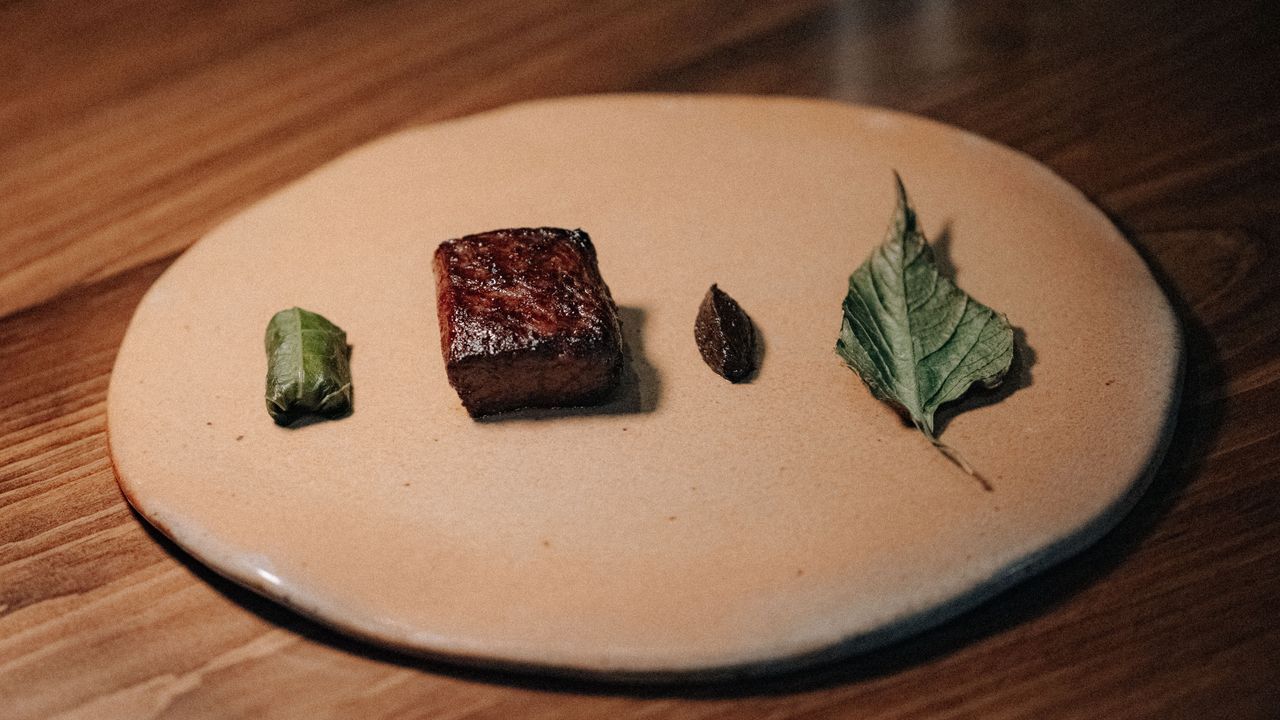
Traipsing through Tucson Mountain Park, a Midwestern blow-in might not identify much to eat. Plants armed with burs, barbs, and spines all but scream “do not touch.” For chef Aaron Lopez and June Chee, however, this prickly, dusty landscape stocks a pantry of possibility. The married co-owners of Ursa see the Arizona desert as a rich ground for foraging.Gray, tangled brittlebush, which the average Tucsonan walks or drives by almost daily, can be pressure-cooked, caramelized until black, and baked into cake. Dusty, sage-colored salt bush, when hung to dry, takes on an intensely umami, aquatic saltiness like seaweed. The sweet buds of the Seussian-green palo verde tree become briny, like olives, when suffused with lye.Don’t even get Lopez started on the dozens of cacti varieties that thrive here, which the restaurant sources from local grower Toadlet Farm and which Lopez harvests throughout the year. The restaurant processes the young and mature paddles, fruit and their seeds, buds, and flowers, which are then grilled, poached, cold-smoked, juiced, dehydrated, nixtamalized, or preserved into jam, wine, and vinegar.There are hundreds of edible plants in the Sonoran Desert. Ursa strives to showcase their potential, one 10-course meal at a time.“We treat Ursa as an art showroom, demonstrating to people what these plants can do, what sustainable means, and what was here before it got easy,” says Lopez. The idea was inspired in part by his Sonoran grandfather, Hector Lopez, who died in the spring. “[He] was the first person I ever heard say they’re proud to be from the desert,” the chef said.Photograph by Clay LyonUrsa began as a pop-up in El Centro, California, in 2023. Lopez and Chee moved to a historic brick building in downtown Tucson, re-opening their doors in October 2025. It’s a homecoming of sorts for the couple, who are both from the Sonoran Desert borderlands. They met in Hawaii, where Chee was working in clean energy and transportation. Lopez, meanwhile, spent roughly 18 years cooking in fine dining and modern progressive restaurants like Redbird and Orsa & Winston in LA, and Pai Honolulu. But he was longing for the desert.After helping a friend open a restaurant and hosting a few popups in Austin, Lopez and Chee bought a desert foraging guide, packed up their two dogs and began driving around the Southwest. It made sense to settle in Tucson, which was recognized by UNESCO in 2015 as a Creative City of Gastronomy for its continuous 4,000-year agricultural history and deeply rooted Sonoran Desert food traditions.“That’s a unique thing about being here, the connection from seed to plant to restaurant that we hadn’t been able to grasp before,” Chee says.Consider a recent course that Ursa built around tepary beans, in which the ancient, nutty bean is refried and topped with h:al squash that’s been lactofermented. The squash’s leaves are fermented to make Japanese-style kosho and its flowers are pickled, dried, crushed with dried saltbush, then tossed with barrel cactus seeds for a desert furikake. It’s served with grilled coins of chorizo made from Lopez’s great-grandmother’s recipe and housemade flour tortillas, to all be washed down with an amazake drink made from fermented wheat and goat fat. Don’t get too attached, however. Riffs owing to finicky ingredient availability occur here almost daily.Ancient corn sorbet.Photograph by Clay LyonRunning a restaurant using only ingredients foraged and farmed from within about eight to 10 miles means abiding by pretty intense guardrails. The only wheat used is pima club, an ancient soft white variety cultivated for centuries by the Akimel O’odham (Pima) people. Ursa does not use cucumbers, radishes or citrus.“We’re not trying to substitute anything, like, ‘How do we achieve cucumber? Let’s grab a cactus,’” Lopez says. “We have to throw everything out, really strip it down. Sometimes we have to let the ingredients be bitter or spicy. We have to put our egos aside and let the ingredient be the star.”For staff who didn’t grow up or learn to cook here, the learning curve at Ursa can feel a little like alighting on a new planet, even if certain flora happen to resemble prickly weeds in their own backyards.“We have these really cool moments in the restaurant where people are like, Oh! I have lamb’s quarter just growing in my yard!” Chee says of the spinach-like desert green that appears all over Ursa’s menu.A young Aaron Lopez with his grandfather Hector Lopez. Courtesy of Aaron LopezUrsa’s approach isn’t always easy for customers to understand, so the couple came up with a more down-to-earth option. This fall, the restaurant debuted a four-course, family-style Lineage menu for $75, alongside the existing 10-course Harvest menu ($150). There’s now a pozole course inspired by the family’s annual springtime tradition of roasting goat in agave leaves, barbacoa-style, and shredding it for soup, and a red masa tamal with glazed quail and yucca blossoms in mole made with burnt mesquite bread, a technique Lopez remembers from childhood.The idea took shape during Ursa’s extended summer break, as Lopez recovered from foot surgery and reflected on the loss of his late grandfather, the tenacious keeper of family traditions.“I feel so much closer to my ancestors and the land; we want Ursa to be less esoteric and more soulful,” he says. “The story of Ursa is partly of the desert, partly my family. Now we’ve advanced to the point where they’re symbiotic, and I can't tell them apart.”
The Tucson Restaurant Turning Cactus Into Fine Dining
Full Article
Original Source
Read the full article at Bonappetit →KhanList aggregates and links to publicly available news content. We do not host full articles from third-party sources. Always verify important information with original sources.