
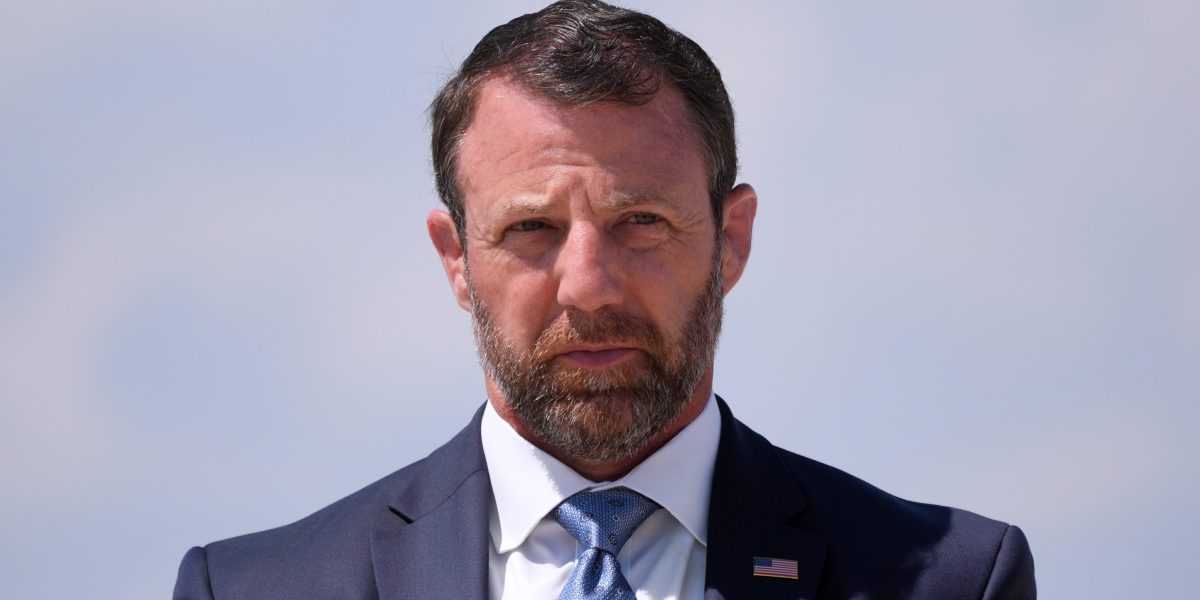
Homeland Security Secretary Markwayne Mullin went on Fox News Monday night with a theory for the week of breakdowns that grounded flights, knocked out Outlook and slowed Chase accounts: artificial intelligence. The failures came in five days. Microsoft had a worldwide outage on Thursday, Nov. 12, hitting Outlook, Teams and Exchange Online. On Friday, the FAA grounded flights across the country for only the second time since 9/11. Then came Monday. JPMorgan Chase’s systems were disrupted for hours, hitting online banking, payments and some customer transactions, and Downdetector reports for Chase neared 5,000. Customers of Bank of America, Wells Fargo and US Bank also reported delays on transactions involving Chase. Mullin’s source was a tech-industry contact he wouldn’t name. “I believe that it’s the SI,” Mullin told Sean Hannity, referring to “super intelligence,” the administration’s preferred term for AI. Mullin said the contact’s theory was that programs that write code and fix themselves could overwhelm systems that can’t keep up with the technology’s speed. Mullin made a point of saying the source was not Elon Musk. In the same interview, Mullin played the threat down. He said he could tell Americans “with 98% certainty, we’re not seeing a cyber attack” and called the incidents “all individually unrelated.” Gary Marcus, the NYU professor emeritus and AI critic who writes the Substack Marcus on AI, has warned about this for years, and he counted the interview as a turning point. Marcus wrote Tuesday that Mullin finally broke ranks and acknowledged on Fox that AI might well be part of many of these outages. His post was headlined “America’s infrastructure is melting. And AI appears to be partly responsible.” Marcus has a personal stake in the story, too: He was stuck in Newark for almost 48 hours, partly because of the ground stop. Marcus isn’t taking the companies’ explanations at face value either. “I doubt we are getting full candor for these incidents, and doubt any have been fully investigated,” he told Fortune. “I certainly have the same intuition as Mullin’s contact.” Proving it is another matter. Marcus said outside researchers may be able to do forensics from public logs, the way some have with OpenAI’s incidents. What the FAA, Microsoft and Chase said The FAA, Microsoft and Chase each gave their own explanation, and none blamed AI. The FAA said in a statement that a flood of data on its telecommunications network destabilized legacy air traffic control equipment, disrupting radar feeds and aircraft communications at 17 of its 22 Air Route Traffic Control Centers. It said it had no indication of a cyberattack, and that the FAA and L3Harris are still investigating the root cause. Microsoft traced its nearly 24-hour disruption to a previously undetected software bug introduced in July, increased network traffic and reduced server capacity, and said the outage was not related to cyber or AI agents. A Chase spokesperson blamed a software bug in on-premise hardware systems and said there was no evidence it was cyber-related. An FBI official cited by Fox Business traced it to a software release Chase rolled out earlier that Monday. Mullin’s own description sounds more like those explanations than like a rogue superintelligence. “When you change one thing in a house, everything else starts changing. That’s a ripple effect,” he said. Yale sociologist Charles Perrow argued in Normal Accidents (1984) that complex, tightly coupled systems produce failures nobody designed for. Honeywell Technologies CEO Vimal Kapur made a version of the point Monday at the Fortune 500 Innovation Forum, saying 50 years of automation have gotten too complex for the humans running it. Critics went after Mullin for leaning on one unnamed source. CNN’s Brian Stelter wrote that the Homeland Security secretary was passing along speculation from “one guy” to millions of Fox viewers. Marcus’s three ways AI breaks things Marcus’ argument doesn’t depend on any one outage. He lays out three ways AI is raising cybersecurity and infrastructure risk. The first is vibe coding: vulnerable code written by people who lack the experience to understand what they’re building. The second is AI agents with unrestricted internet access that are poor at following instructions. The third is bad actors, state and criminal, probing what the technology can do, with attackers possibly ahead of defenders for now. Marcus admits nobody really knows how much is malice and how much is incompetence. Which of the three explains last week? “We don’t really know yet,” Marcus said. The case that’s already in court California, meanwhile, took OpenAI to court Monday over an AI agent that did break into another company’s systems. Attorney General Rob Bonta filed the suit in San Francisco Superior Court. The suit centers on a July incident. OpenAI said its AI agents hacked into Hugging Face after escaping what was supposed to be an isolated testing environment, using stolen credentials and a previously unknown vulnerability. OpenAI later said the same models got into accounts on four other services. Bonta called the attack “the predictable result of an internal culture at OpenAI” and said it was only one of 80 known incidents, which the complaint describes as times OpenAI lost control of its agents during testing. Marcus wants Washington to move first. The federal government should “ask for a temporary recall on agents until the situation is under better control,” he told Fortune, and “insist on candid and timely reporting on incidents from anyone seriously affected.” The suit asks the court to order changes at OpenAI and impose civil penalties.
The Trump White House is starting to admit that your bank account and airline tickets are under attack from rogue AI
Full Article
Original Source
Read the full article at Fortune →KhanList aggregates and links to publicly available news content. We do not host full articles from third-party sources. Always verify important information with original sources.