
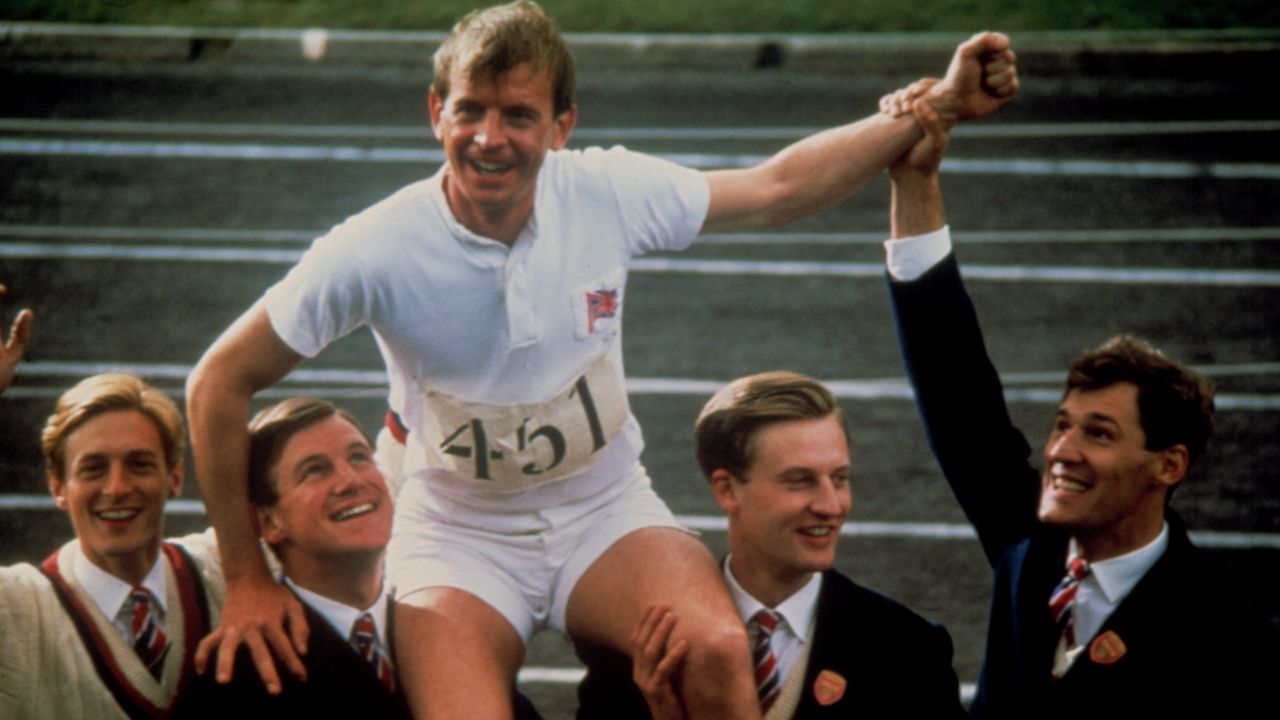
In Elsinore, quite possibly this year's most moving film, Andrew Scott gives a captivating, awards-worthy performance as the late, great Scottish actor Ian Charleson. Though he never became a household name, Charleson's star shone brightly in the early 1980s when he appeared in two consecutive Best Picture winners: 1981's Chariots of Fire and 1982's Gandhi."I'd rather die of Hamlet than die of AIDS," Scott-as-Charleson says in Elsinore, which opened in select theaters last week. This defiant line sums up the incredible coup de grâce that Charleson pulled off at the end of his life. When he began his valedictory stage run as Shakespeare's Danish Prince in October 1989, the 40-year-old actor was dying of AIDS. His face was so swollen with septicemia that the cast, crew, and audience at London's National Theatre were told he was recovering from a sinus operation."I begged him not to do Hamlet. I said to him, It will kill you, which it did," Charleson's friend Sean Mathias, an accomplished actor and director in his own right, told me. "The amount of energy it takes to play that kind of classical role, both physically and spiritually, would tire the most ardent athlete. For a man dealing with the onslaught of AIDS, it was almost impossible."But against the odds, Charleson turned in a monumental performance. In a review for The Sunday Times, theater critic John Peter described his Hamlet as "virile and forceful" and wrote that the actor "oozes intelligence from every pore." Charleson's performance was all the more remarkable because he was an eleventh hour replacement for Daniel Day-Lewis, who left the production early—quite literally, midway through a performance—because he was so haunted by Shakespeare’s gothic tragedy.Reg Innell/Getty Images"People still remember Ian's performance as Hamlet," says Andrew Scott, whose performance in the film captures Charleson in the tumultuous final year of his life. Elsinore's screenwriter Stephen Beresford believes it's fitting that no footage of Charleson's defining performance exists. "An important thing to remember about Ian is his extraordinary contradictions," he says. "He wants to be seen and not seen, to be known and not known." Charleson, in fact, was so publicity-averse—perhaps partly because he was a closeted gay man—that he walked out of the Chariots of Fire press junket.At the same time, he was simply an old-school British thespian who believed that the work should speak for itself. "Ian was incredibly passionate about this extraordinary part of Hamlet," Scott adds, citing the actor's devotion to his craft as a major incentive in his decision to join Elsinore. "But the chief thing [I love about him] is his courage and sense of humor."In Elsinore, we see Scott's Charleson share his AIDS prognosis with his Hamlet castmates. When he died on January 6th, 1990, just seven weeks after his final curtain call, it was also disclosed to the public at large. At the time, Charleson's close friend Ian McKellen told the British press: "It is rare for anyone in the public eye to say that they are HIV positive, let alone that they have AIDS. It is a tribute to Ian that he should ask for the cause of his death to be made public and it is the most marvelous offer of support that he could have given to other men and women all over the world suffering from the AIDS virus."Beresford, who wrote Elsinore's screenplay after extensive conversations with Charleson's friends, family, and contemporaries, told me that it was actually the actor's father, Jack, who made the decision to disclose his cause of death publicly. "The tabloids were already circling, so I think there must have been fear that it was going to come out anyway," suggests Beresford, who previously penned the 2014 film Pride, which told the true story of gay and lesbian activists who raised money for the families of English coal miners during their 1984 strike.Still, even if it wasn't carried out at his own behest, Charleson's posthumous contribution to HIV/AIDS awareness was very significant at a time when the disease was highly stigmatized and virtually impossible to treat. It would be another five years before HAART (highly active antiretroviral therapy) made the disease manageable.In the U.K., the actor has also been immortalized with the annual Ian Charleson Awards, which since 1991 has recognized the best classical stage performances by actors under the age of 30. Past winners include David Oyelowo, Andrea Riseborough, Paapa Essiedu, Rebecca Hall, and Jack Lowden, while Benedict Cumberbatch, Cynthia Erivo, and Jessie Buckley have all received runner's-up prizes or commendations. "Ian's name is legendary within the [British] theater because of what he achieved in Hamlet, and the awards were set up to keep his memory alive," Beresford says.Ron Galella/Getty ImagesIn Elsinore, we see Scott's Charleson wryly lamenting the fact that, though he starred in the Oscar-winning Chariots of Fire, "all anyone can ever remember is its theme music." In this stirring sports biopic, Charleson played Eric Liddell, a devout Christian who managed to win gold at the 1924 Olympic Games despite withdrawing from his best event, the 100-meter sprint, because the heats fell on a Sunday. Charleson also appeared in the following year's Best Picture winner, Gandhi, as an Anglican priest who supported the iconic title character's fight for Indian independence.Sadly, despite these back-to-back triumphs, Charleson never made it as a bona fide movie star. By 1986, he was reduced to appearing in Car Trouble, a crass British comedy about a man who falls in love with his new convertible. "He was very disappointed that film stardom didn't prolong itself," says Mathias, who believes that Charleson's sexuality denied him further opportunities in mainstream movies. "He wasn't out [publicly], but everyone in the business knew he was gay. And back then, gay actors just weren't given work in Hollywood."Consequently, and perhaps aptly given his predilection for the stage, Charleson found salvation in the theater. On June 25th, 1989, he appeared in a one-night only revival of Martin Sherman's seminal queer play Bent. This pointed production at London's Adelphi Theatre, which also starred McKellen, Ralph Fiennes and Richard E. Grant, was staged to raise money for The Stonewall Group, a newly formed nonprofit that went on to become the U.K.'s leading LGBTQ+ rights organization. Charleson portrayed Greta, a drag performer who changes into male-presenting clothes during the play.By this point, Charleson's torso was covered in lesions caused by Kaposi's sarcoma, a rare form of cancer common in AIDS patients. Mathias, who was directing the fundraiser, had screens erected on stage so that Charleson could change costumes out of view. "Ian said to me, But the crew can still see my body from the wings! So I said I'd get more screens put up," Mathias remembers. "But then he thought about it, and went, You know what? Fuck it! I always feel that was the moment, really, that he decided he would come out [as having AIDS]."Shortly after Bent, Charleson was asked by Hamlet's director, Richard Eyre, to step in for Daniel Day-Lewis. Dickie Beau, an actor and writer who paid tribute to Charleson with his one-man stage show Re-Member Me (and who appears in Elsinore as the drag activist Sister Belladonna), believes Bent is a "truly significant" part of his legacy. “Not only did it help to kickstart [the charity] Stonewall, but it said a lot about him that he was happy to play Greta, who isn't a leading part,” he says. "Ian McKellen once said to me that, as much as Charleson saw himself as a lead actor, he was also a company man."It's another of the fascinating contradictions that seem to make up Ian Charleson. Mathias says he was generally "quiet and private" and "very masculine," but also possessed a "wonderfully camp sense of humor." There's a poignant irony in his becoming the subject of a major motion picture, Beresford says, laughing: "Ian would have hated this publicity tour. I can guarantee that absolutely no part of him is watching us today!"For Scott, who embodies Charleson so beautifully that he’s considered an awards season frontrunner, Elsinore's purpose is simple: “I hope our movie continues his legacy.”
The True Story of Ian Charleson, the Trailblazing Actor Andrew Scott Plays in Elsinore
Full Article
Original Source
Read the full article at Gq →KhanList aggregates and links to publicly available news content. We do not host full articles from third-party sources. Always verify important information with original sources.