
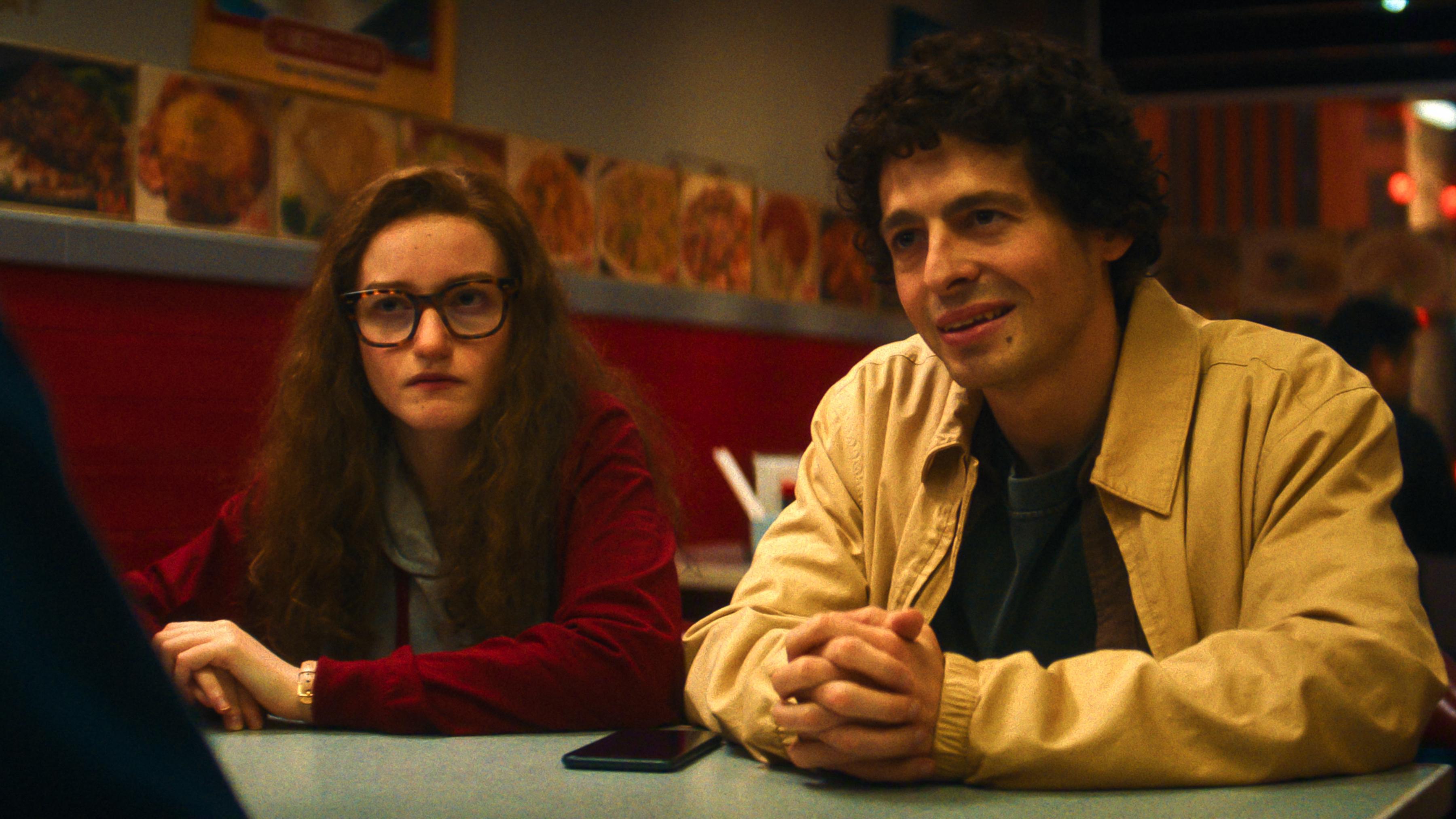
Like other entries in the growing genre of media about tech scandals and leadership crises, Netflix’s The Altruists asks how honest a visionary billionaire can be. Shows like The Dropout (in which Amanda Seyfried plays Elizabeth Holmes) and films like Artificial (starring Andrew Garfield as Sam Altman) imagine a more unrehearsed side of figures audiences have spent much time watching in the public eye, with viewers’ curiosity piqued by controversy and internal politics at their respective companies.The Altruists enters this category with a limited series about FTX founder Sam Bankman-Fried (Anthony Boyle), whose company was at one point the third-largest cryptocurrency exchange, and his partner Caroline Elison (Julia Garner), the CEO of Alameda Research, the crypto firm the money was funneled into. The series jumps between timelines to trace the hopeful upward momentum of Alameda and FTX’s first steps and the companies’ final months of solvency throughout 2022 before the pressure cooker of lies and mismanagement exploded and brought down the “Crypto King”. In the final episode, after news breaks that FTX defrauded customers to the tune of $8 billion, Sam elects to do a solo media tour taking partial blame for FTX’s reputational freefall. He stares into the webcam and reassures the world that the missing money will be recovered, months before he'd be indicted for mail fraud. (In 2024, he was convicted and sentenced to 25 years in federal prison.)Boyle plays Sam’s televised apology tour as a sincere confession to financial mismanagement, but also a confident gamble on his part to apologetically downplay the accusations until he can manage to replace the stolen funds. Throughout The Altruists, Sam's confidence that he can survive any pressure, skepticism, or sabotage grows both more desperate and more eerie; like other fictional media about tech CEOs, The Altruists aims to strike the balance between entertaining caricature and a portrait of alienated, powerful gamblers painted with psychological vividity. But the more time we spend with the show’s version of Bankman-Fried, the less stable any dramatic perspective becomes. Was Sam a financial genius, an asocial manipulator, or a rational philanthropist who tragically lost control? That’s left to the viewer to decide.The love story at the heart of FTXJulia Garner and Anthony Boyle Courtesy of NetflixIt may surprise many viewers expecting a techno-docudrama that The Altruists is, at its heart, a love story. The focus of the series is Sam and Caroline’s volatile relationship, which in turn fans the flames of FTX’s dysfunction and the negligence of its stewards. Those up to date on the FTX debacle know the affair ends in heartbreak; during Bankman-Fried’s trial, the defendant and the prosecution’s star witness both assigned blame to one another. Across eight episodes, the series juxtaposes the rise of FTX and Alameda Research—the crypto hedge fund that predated FTX by nearly two years—with their downfall, cutting between Sam and Caroline’s giddy, electric early days in New York and Hong Kong with their tense, paranoid scheming in FTX’s luxury Bahamas headquarters. FTX and Alameda are purportedly two completely separate entities, but the entwinement of the exchange and the trading firm raised questions about insider trading, or “front-running.” Despite Sam’s insistence that he has nothing to do with Alameda, a firm he in fact co-founded, the CEO quickly lapses when it comes to sticking to professional accounting and management boundaries.In the series, Sam and Caroline meet in an unusual interview setting: at trading firm Jane Street Capital, applicants are given a pile of poker chips and asked a series of probability games and trick questions, which Bankman-Fried reportedly excelled at. This is The Altruists’ way of dreaming up a fun, flirty meet-cute, where Garner’s Caroline demonstrates her eagerness to take enormous risks to maximize the potential reward. It’s an alarming reminder of how many financial disasters originally stemmed from someone merely thinking, “Go big or go home.”Sam and Caroline become romantically involved (the couple are textbook on-again, off-again, but Caroline’s reported polyamorous life is not depicted in the series) as Alameda’s foray into effective altruism grows and falters. “EA” is the philanthropic utilitarian movement that encourages charitable donations from enormously rich individuals, giving away the vast majority of their profits in a way that maximizes the impact of doing good. In the early days at Jane Street and Alameda, Bankman-Fried and Ellison bonded over their passion for effective altruism, but as early as 2018, EA leaders were warned that Bankman-Fried was too duplicitous and negligent to trust as a major EA donor. Nevertheless, he continued to donate as FTX’s profits soared—as part of the bankruptcy settlements, EA network Effective Ventures paid back the entirety of the funds received from FTX in 2022, totalling $26,786,503.In the series, Sam and Caroline articulate the faulty logic of escalation that united their interests in profit and philanthropy—if more good could be done with more money, his thinking goes, then the firm is justified in accruing a wild amount of capital, and Sam and Caroline are justified in their risky trades. EA puts a lot of faith in the judgment of altruists to discern how best to use their wealth to improve the world, and if there’s one thing we’ve learned from this genre, absolute faith in a tech CEO’s honesty and integrity is unwise. Take it from Bankman-Fried himself, who described the funnelling of customer money from FTX to Alameda as “a poor judgment call.”Betrayals among a tightknit groupAlex Lawther as Sam Trabucco and Anthony Boyle as Sam Bankman-Fried Courtesy of NetflixThe Altruists explains the fall of FTX not just through Sam and Caroline’s feuding and codependency, but also the perspectives of their tight-knit (but not polyamorous, as reported by publications and close observers) band of young executives. The series stresses how the exchange’s top brass were all close friends, presenting the lack of formal corporate structures—like an in-house accounting or human resources department—as reasons why a closely intermingled work culture flourished. But not only did the executives’ blind trust and fragile social dynamics cloud their judgment—Ellison testified that communication broke down between her and Bankman-Fried after they broke up in 2022—it also made it easy to see the deception that led to the exchange’s collapse and any subsequent collaboration with the authorities as mutually felt betrayal.Nishad Singh (Karan Soni) is Sam’s childhood buddy, who agrees to cover up the transgressions so long as it protects his innocent colleagues—especially the woman he loves, Claire Watanabe (Naomi Okada)—from the inevitable collateral damage. There’s Bankman-Fried’s MIT buddy Sam Trabucco (Alex Lawther), who views Sam and Caroline’s entanglement as an accelerant for the company’s poor business decisions. In the series, he discovers that Alameda had been automatically replenishing its capital with FTX customer money and Sam and Caroline have frivolously spent customer money. This is because FTX quietly exempted Alameda from its usual safeguarding protocols, which were designed to protect the crypto exchange from risky trades tanking the market. The Altruists paints these two longstanding friends of Sam as comparatively upstanding, but their non-fictional counterparts are far more opaque. While Singh admitted to participating in FTX’s fraud (and was ultimately punished with a hefty fine), there’s no evidence that he did so nobly to protect his friends and colleagues. Trabucco is an even more ambiguous figure: his sudden resignation as Alameda CEO months before FTX’s collapse and forfeiture of $80 million in assets to the bankruptcy estate is all defrauded customers had to go by, prompting an online manhunt for him in late 2022 that turned up few answers.It’s likewise difficult to tell how faithful The Altruists is in its depiction of the internal discovery of FTX’s fraud or its rapid collapse, but the intense dramatization extrapolates from some real facts. Former Jane Street employee Lily Zhang (Marianna Phung) comes to the Bahamas seeking seed capital for her crypto-trading firm Modulo Capital, but her suspicions of dodgy deals are confirmed when she learns the entirety of Alameda’s $400 million investment came from customer funds—which was confirmed in Sam’s trial by accounting expert Peter Easton. In March 2023, the FTX estate filed a motion to claw back $404 million in assets from Modulo.As the walls close in, FTX’s head of global luxury partnerships and Remington Arms heiress Lauren Platt (Maddie Hasson) flees to the Hamptons. Ryan Salame (comedian Matt Rife), CEO of subsidiary company FTX Digital Markets, assists in the search for $8 billion until he realizes Sam is a lost cause. He warns FTX COO Constance Wang (Madison Hu) that their leader doesn’t deserve their loyalty as he leaves; she soon follows suit. According to Wang, she spent hours persuading FTX’s biggest customers not to trigger a bank run before she saw evidence of the exchange’s gaping liquidity gap—hours before the story broke to the public. Not depicted in the series is the aftermath of Salame’s tenure at FTX; in 2023 he pleaded guilty to violating campaign finance laws and using Alameda money to make illegal political donations, and is currently incarcerated.The last holdout is Gary Wang, co-founder of FTX and the company’s star programmer. Actor Eugene Young plays Gary as an obnoxious edgelord who encourages Sam and Caroline to play it legally fast and loose, but finally cooperates with the authorities when he realizes Sam will go to his grave denying they defrauded their customers, either willfully or through negligence. Like Ellison and Singh, Wang pleaded guilty. He and Singh avoided jail time. Although Ellison cooperated fully with the investigation against Sam, the judge sentenced her to two years behind bars, noting the remarkability of her evidence but that he could not agree to giving her a “literal get-out-of-jail-free card” and hoped her prison sentence would deter future fraudsters. She was released in January 2026.Printing and questioning the FTX legendGarner and Boyle as Ellison and Bankman-Fried Courtesy of NetflixThe scandalous details of FTX’s collapse ran rampant across social media, for which X’s new owner at the time, Elon Musk, congratulated himself. The fact that Ellison practiced polyamory and that FTX leadership shared a Bahamas luxury penthouse led to many dubbing the company’s inner circle as a “polycule,” deliberately associating them with the ugliest stereotypes of non-manogomy: that they were weird, insular, and somehow corrupted. The Altruists goes a step further with Ellison’s documented nerdy love for Harry Potter (her Tumblr username is taken from a famous Potter fanfiction) and invents a history of writing original erotica using Potter characters—although not to humiliate her. When Caroline’s fanfiction is discovered and mocked, Sam sincerely and publicly defends her creative spirit.But while The Altruists goes to great lengths to counter inflammatory rumors surrounding FTX’s downfall, other characterization choices would benefit from more scrutiny. Reports of Sam’s compulsive gaming at work, or his low opinion of social and intellectual pursuits that he found tedious, conflict with the image of a quirky, energetic leader driven by passion and ideals, best represented in a late-night hotel-room soliloquy that Sam delivers to EA founder Will McAskill (Jack Greenlees) after the Scottish philosopher declines to recognize Alameda as an Effective Altruist company.Arguing that the story of FTX was essentially a thwarted love story may be a decent narrative gambit, but it verges on contrivance, as when the series ties Sam’s reckless spending on music festivals to trying to win back his fellow social outcast soulmate. The Altruists is strangely confident it understands what Bankman-Fried was thinking throughout his career, but the extent to which The Altruists relies on blunt emotions driving Sam's risk-seeking feels like the easy way out, dramatically. By all accounts, Bankman-Fried was eccentric, withholding, and self-deprecating; a memo he wrote to Ellison explaining why they shouldn't be in a relationship said, “There’s a pretty decent argument that my empathy is fake, my feelings are fake, my facial reactions are fake.” Do these words amount to confession or avoidance? The words of someone who thinks he’s not good enough to love, or someone who picked an effective method of getting his situationship off his case? The Altruists never entertains this ambiguity; it risks too much by taking the fallen visionary at his word.
The True Story Behind The Altruists and the FTX Scandal
Full Article
Original Source
Read the full article at Time →KhanList aggregates and links to publicly available news content. We do not host full articles from third-party sources. Always verify important information with original sources.