
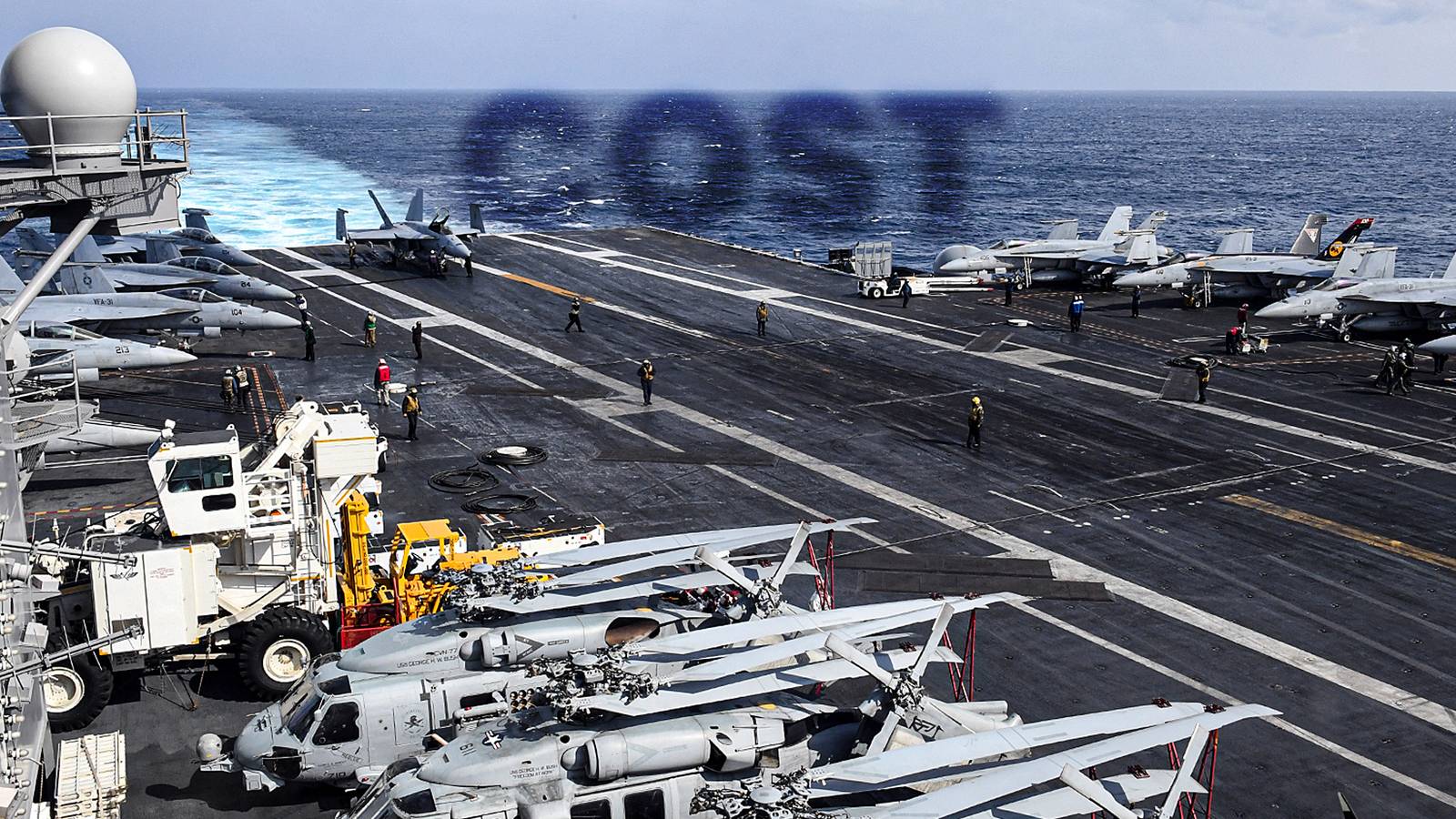
Published Oct 5, 2026, 12:01 PM EDT Luke Diaz is a freelance military writer with experience with active duty experience in the US Navy as well as defense and industrial engineering. He is a former Naval Flight Officer who performed tactical air control on the carrier-based E-2 Hawkeye. It comes as no surprise that the US Navy doesn't advertise the daily price tag of operating a Carrier Strike Group on deployment at sea. Yet, based on publicly available information from the Pentagon, the rough estimate is a staggering $6.5 million a day. That implies a basic bill of roughly $1.95 billion for a 300-day deployment of a supercarrier like the USS Gerald R. Ford (CVN-78) and its entourage of smaller vessels. When the Ford shattered records with its recent 326-day sprint away from Norfolk, Virginia, that daily rate pushed the estimated cruise total past $2.12 billion. Still, that figure oversimplifies the unglamorous, budget-shredding realities of real-world naval deployments. Everything from laundry room fires to catastrophic plumbing failures and delayed shipyard visits compound the wear and tear. Then there is the strategic effect of an overstretched fleet that is just 11 carriers strong. The multi-billion-dollar question is how much of the true operational bill is buried beneath that neat and tidy daily price estimate. Measuring The Daily Strike Group Bill Credit: US Navy The $6.5 million-a-day benchmark actually traces back to a critical March 2013 paper written by Captain Henry Hendrix titled "At What Cost a Carrier." Published by the Center for a New American Security, the study tried to prove that these floating airfields were becoming financial suicide and too vulnerable to survive the modern era of missile warfare. To settle on that number, Hendrix didn't just count fuel, which a carrier technically doesn't burn. He crunched the total, multi-decade life-cycle expenses of an entire strike group. That includes its carrier air wing of 60 to 80 airframes, five surface warships for escort, a fast-attack submarine, and the 6,700 sailors crewing it all. When Brown University’s Costs of War project dragged Hendrix's math into the present, the sticker shock got even worse. A 2025 paper adjusted that legacy rate for inflation, vaulting the estimate to a brutal $9.05 million a day. By this math, a standard 300-day cruise balloons to $2.72 billion. Using And Abusing The Armada's Capital Ship Credit: US Navy The Ford’s grueling 326-day marathon spikes to $2.95 billion, adjusted for inflation. Yet, every single one of these figures is just an independent calculation using theoretical prices. The Pentagon itself remains dead silent, refusing to publish an official accounting. A third, more recent yardstick emerged earlier this year when the Center for Strategic and International Studies took a hard look at the Navy's intense campaign against Iran. The study broadly evaluated naval operations under Operation Epic Fury. They estimated that active combat operations burned through $15 million every day. Because that number blankets the entire regional fleet rather than isolating a single CSG, it cannot be neatly divided into a per-ship breakdown. So, leaving room for error, the evidence suggests a routine deployment costs somewhere between $1.95 billion and $2.95 billion. Diverting The Ford Class To Global Crises Credit: US Navy When the USS Gerald R. Ford sailed out of Norfolk, Virginia, in June of last year for a standard European cruise, reality shattered the spreadsheet. By October, the Pentagon abruptly diverted the carrier, steaming it down to the Caribbean to spearhead the maritime ops targeting Venezuelan president Nicolás Maduro. Four months later, the Ford was retasked again, ordered across the Atlantic to the Middle East and the explosive waters of the Red Sea. By the time the cruise ended, the Ford had crossed the Atlantic four times, coordinated airstrikes across two continents, and launched hundreds of combat sorties while its escort destroyers burned through millions of dollars in defensive missiles. Defense Secretary Pete Hegseth admitted to Congress that explosive, real-time crises forced his hand, ordering back-to-back extensions after intense, behind-closed-doors clashes with Navy leadership. That flies in the face of traditional CSG employment and naval strategy as refined by the USN over decades of combat ops since before WWII. The Navy's master strategy dictates that a nuclear carrier should never slide past a strict seven-month deployment cap. Under the Optimized Fleet Response Plan, each of the military's 11 carriers is locked into a staggered 36-month rotation of training, maintenance, and deployment to avoid breaking the fleet rotation and creating a capability gap. How A Standard Cruise Became 326 Days At Sea Credit: US Navy The Pentagon's marathon cruise broke modern records. On April 15, 2026, the Ford sailed past the brutal 295-day deployment record set by the USS Abraham Lincoln during the height of the pandemic, officially logging the longest continuous deployment by a certified carrier strike group in over half a century, according to USNI. Still, the Ford didn't quite eclipse the historic 332-day record set by the USS Midway in the Gulf of Tonkin during the Vietnam War; the Ford’s relentless 326 days at sea pushed the hull and its crew into uncharted territory. The other caveat is that Abraham Lincoln recently claimed the title for the longest period at sea without a port visit. At over 300 days, its deployment may narrowly fall short of overtaking the Ford before it finally returns to San Diego. As the trailblazer of an entirely new class of supercarriers, the USS Gerald R. Ford was engineered to completely rewrite naval doctrine, but its hyper-advanced design radically altered the financial toll of an extended deployment. The ship carried a staggering $13.3 billion price tag. That is a massive leap in cost compared to the $8 billion spent on the final Nimitz-class carrier, the USS George H.W. Bush, as Voice of America wrote. To justify that astronomical investment, naval architects promised a 33% surge in combat lethality. While a Nimitz-class hull maxes out around 120 aircraft sorties a day, the Ford was projected to launch 160 daily sorties using its digital electromagnetic catapults. Workforce estimates for this floating fortress range from 4,500 to 5,000 personnel. Operational Toll And Long-term Fleet Impacts Credit: US Navy The brutal reality of operating a lead ship is that maintenance teams are flying blind to a certain degree. Underway, the only way to repair the ship is using what's been loaded or what can fit in the hold of a Carrier Onboard Delivery plane, the COD. For example, the ship’s highly complex vacuum wastewater system, which handles waste for roughly 650 onboard toilets, quickly morphed into the fleet's most infamous engineering nightmare. When the system repeatedly failed mid-cruise, independent analysts estimated that the Navy was forced to burn through a shocking $400,000 a day, flushing the lines with specialized chemicals to keep the ship habitable. Top brass later told the Senate Armed Services Committee that sailors improperly operating the equipment caused the toilet crisis rather than a fundamental design defect. If the failure is purely operational, it demands a massive, unplanned reinvestment in crew training. Either distinction provides little comfort for the budget. Fire Damage And The Shipyard Domino Effect Credit: US Navy A devastating fire broke out in the Ford's industrial laundry room on March 12 while it was trawling in the Eastern Mediterranean. 600 sailors were forced to leave their berthing, the supercarrier had to quit its station for emergency shore repairs, and the fire raged for an incredible 30 hours, filling deck corridors with poisonous smoke. The mechanical repercussions were evident, despite conflicting stories of whether the crew escaped with minor injuries or experienced severe smoke inhalation. The entire CSG was pulled away from its Middle East mission, and about 100 slots were totally destroyed. However, the actual financial and strategic damage from this incident goes much beyond burned bulkheads. By blowing past its scheduled return date, the Ford shattered the Navy’s master maintenance calendar, triggering a dangerous domino effect across America's heavily overtaxed and backlogged shipyards. The nuclear carrier fleet has withered down to just 11 hulls, down from 15 during the Cold War. Today, the defense industrial base has zero margin for error. Top lawmakers are already demanding answers on how the shipyard can possibly absorb the damage, as sister carriers like the USS Dwight D. Eisenhower and USS Harry S. Truman are already clogging up the dry docks in Norfolk, Virginia, waiting for their own over-schedule repairs. Credit: US Navy The grim reality of America's overextended naval strategy emerged on July 7, when the USS Gerald R. Ford eventually limped into the Norfolk Naval Shipyard, as USNI covered. This was the first time a Ford-class supercarrier had ever visited a public shipyard for maintenance, and the cost would be enormous. These hyperextended deployments are referred to by defense watchers as self-inflicted wounds. A nuclear vessel is not a blunt weapon. Its intricate machinery deteriorates more quickly the longer it is pushed at sea. The next carrier in line is delayed, and another crew must remain deployed even longer because of this enormous wear and tear, which further lengthens the shipyard schedule and exponentially raises the final repair expense. By forcing the Ford into a similar marathon, the Pentagon has pushed its finest asset to a dangerous operational breaking point. It is a threshold the military cannot afford to cross again without permanently shattering crew morale, sabotaging sailor retention, and leaving America's global defense lines dangerously thin.
The True Cost Of Keeping A US Navy Supercarrier Deployed For 300 Days
Full Article
Original Source
Read the full article at Simpleflying →KhanList aggregates and links to publicly available news content. We do not host full articles from third-party sources. Always verify important information with original sources.