
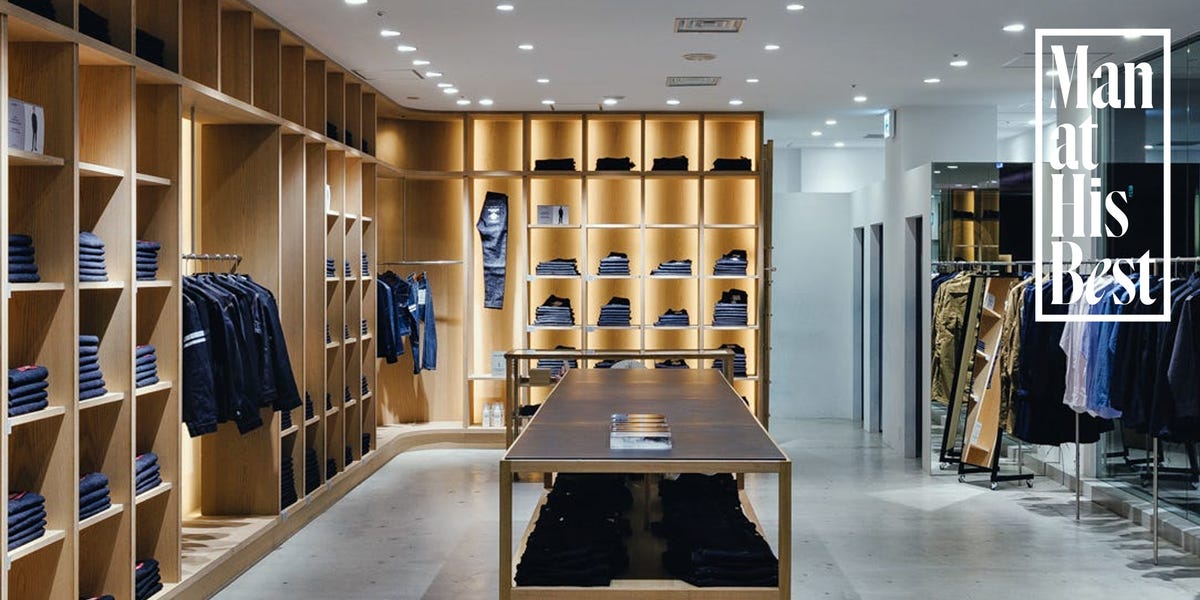
7 min readA ponytailed man in head-to-toe denim orbits me a third, then a fourth time in quick succession, like his eyes are twin asteroids and my waist a powerful gravitational force. When he stops, suddenly, he calls out, “Thirty-two!” and asks, “Button or zipper?”I should’ve expected this sort of wizardry when I entered Momotaro Jeans Aoyama, a Tokyo outlet of the highly esteemed Japanese denim purveyor. Though it’s housed on the second floor of a mall just three-quarters of a mile’s walk from overstimulating, people-packed Shibuya, this tiny shop feels tranquil, purposeful, reverent. Dark indigo pants are folded and piled neatly in wooden cubbies along the walls; thick jackets hang gently from floating racks. Such a scene differs greatly from my earliest jeans-shopping memory.In my early teens, on an Easter Sunday trip into New York, my mother shooed me into the Times Square Levi’s to buy my first big-boy pair. I never wore jeans. I attended Catholic school for much of my youth, so most mornings I was stuffed into stiff, ugly khakis. In rebellion against forced formality, I’d sport sweatpants or basketball shorts outside school hours.Craig T Fruchtman//Getty ImagesOne of my first jeans-buying experiences was at the Levi’s in Times Square. I wouldn’t recommend it, even to my arch nemesis.Naturally, this appalled my fashionable mother, who wouldn’t live with herself if she dropped her teenage son off at coed social outings wearing swishy Adidas track pants. But why was her remedy to hit a retail store in the busiest neighborhood in America on a holiday weekend? Trying on fur coats in hell would be comparably pleasant.We dodged shoppers yanking slim-cuts off floor displays and dug through unkempt mounds of unfolded denim until Mom found a few sizes in a few washes and forced me into the back changing room to try ’em all on. Of course, I huffed and puffed. Of course, I whinged and complained. But I left with a pair of medium-wash straight legs that at least wouldn’t look embarrassing on a first date.In the nearly two decades since, as my interest in menswear has graduated from begrudging to professional, mass market clothing has plunged in quality but spiked in price. Consumers are faced with a harsh reality when buying new: Either replace your decaying polyester-blend garments every few years or buy pricier, sturdier stuff from reputable manufacturers. I diverted towards the latter path a few years ago when I purchased a $150 heavyweight cotton hoodie from American Giant. (Though that may not seem like much to an Esquire reader, it was quite the jump for a J.Crew Factory sales-rack goblin like me).Alexander Spatari//Getty ImagesMomotaro Jeans Aoyama is less than a mile from the ever-mobbed Shibuya Crossing.I learned of raw, selvedge denim a year later, when a buddy who’s into menswear sent me a Reddit post depicting a pair of jeans standing up all on their own. This was the beauty of raw Japanese denim, my friend told me, which is manufactured in the spirit of heritage American workwear from a time when durability was paramount. Heavyweight. Premium dye. Selvedge, meaning it’s woven on old-school looms from high-quality cotton. (You can also buy cheaper, significantly less-impressive Japanese denim, but we’re talking about the reputable specialists here.) I was intrigued until he mentioned how many hundreds of dollars they cost thanks to import fees and general U. S. financial fuckery. But if I were ever on a trip to Japan at a time when the U. S. dollar was stronger than the yen? Maybe I could swing a pair.In September, I was invited on a work trip to Tokyo, and finally, my chance presented itself. When I landed at the Narita International Airport, all I could think about was trying on stiff, uncomfortable jeans—talk about a different mindset than that of teenage me in Times Square.After a week of tight itineraries, I finally sneak away on my very last day and make my way past the stanchions lining the perimeter of the Momotaro shop. I read online that some folks wait up to 30 minutes to enter; luckily, there is no queue when I arrive.A handful of employees stand silently behind a broad counter, one of them the man with the ponytail, who approaches me when he sees me checking out the brand’s #100 Standard Straight jeans in 14.7-ounce denim, which is a measurement of weight per square yard of fabric. Instead of asking for my size, he does the circling bit described earlier. I reply to his follow-up question with “zipper,” and he shows me to a narrow changing room towards the back of the space and asks me to remove my shoes. Japanese etiquette. He arrives with two pairs of the very jeans I was checking out. I try them both on, but they don’t feel quite right.Chris HatlerMy jeans from Momotaro fit slightly higher on the waist and are straight through the leg.“Anything thicker?” I ask, trying to overcome the language barrier between us. My Japanese is rudimentary; his English is solid in bursts, but not completely fluent.He returns with a straight-cut pair from Momotaro’s classic line that’s 15.7 ounces, but it has a button fly, which I struggle mightily to close. Alas, there are no zippered pairs of this kind left. Yet of the three, these fit the best around my waist. I’m puzzled, until I look closely at the tags. These classic button-flies are a 32, but when I return to the standard zippers, I notice he has accidentally brought me a 31—way, way too tight on the crotch—and a 33, a hair too loose.His eyes widen apologetically when I point out the error, and he rushes back to the stocks to ensure I get a 32 in my hands. They fit absolutely perfectly. Done and done. He’s relieved.And just like that, I’m ready to walk out a satisfied customer. This is how I’m used to buying jeans, after all. You try ‘em, you like ‘em, you buy ‘em, and if you get home and they’re not quite what you thought they were, you return ‘em. But as I will soon learn, there’s more to it at Momotaro. My guy has me put them back on and step out once more.“Baggy or not baggy?” he asks of how I’d like my jeans to appear.“Not too baggy,” I reply.In front of a mirror, he squats down and folds the bottoms of the legs up to just about my ankle line and slides a transparent clip over the surface to mark its place. An in-house tailor will hem them for me. I change back into my other clothes, and after he explains as best he can how to properly take care of my jeans. I shouldn’t wash them too often, but when I do, I should fasten everything and turn them inside out. Oh, and keep them separate from other clothes, because the indigo will definitely run. That’s part of the fun; the jeans are designed to fade handsomely over time based on how and when I wear them. A personalized pair, if you will. Don’t ever dry them in a machine, though. Take ‘em out, smooth the creases, and hang to dry in a cool, dark place.He hands me a little box with a lifetime guarantee card and explains that if I’m ever back in Japan and need a repair, they’ve got me covered.Chris HatlerThe deep indigo of these jeans will fade over time, with more wear and washes.A second employee guides me across the hall to a second storefront where payment and hemming take place. After I show my passport to receive the 10-percent tax reduction for tourists, I swipe my card. $211. That’s it?! By shopping here, I essentially chop one-third off the price listed on the Momotaro U.S. website. I’m told to return in 15 or so minutes once the hemming is done, so I dash to a café downstairs for a matcha over which I reflect on my experience.Whenever I buy anything over a Benjamin, I immediately get buyer’s remorse. That American Giant hoodie? I spent a good few days lamenting that the sleeves were slightly too long before I talked myself out of a return. And yet, when I pick up my Momotaro jeans once they’re ready—they’re bagged neatly and wrapped in plastic to protect them from the day’s ceaseless rain—I feel beyond cared for. When I finally return home and wear them out, I don’t fear that I maybe should have purchased a smaller size in case they stretch—they’re not supposed to—because my jeans fit perfectly. They’re right in proportion with my body, sit higher than I’m used to but quite comfortably, and style well with graphic tee and light jacket.Maybe I’m shopping at the wrong stores at home. Maybe I need to raise my price floor to get that kind of service. Or, maybe, we’ve lost something here in the U. S. that’s now only attainable overseas. Maybe I need to get back on a plane to Tokyo ASAP and hit all the stores I missed—Hinoya, Japan Blue, The Flat Head—then take the shinkansen to Osaka and get myself some really thick boys from Iron Heart, where 25-ounce denim is the gold standard.Or, maybe, I should just enjoy the jeans I have now, wear them in nicely over the next decade until they’re washed to sky blue and softer than a lamb’s ear. I can look forward to passing them down to whatever kids I have one day. It’ll save us a trip to the Times Square Levi’s.
The Transformative Experience of Buying Japanese Denim in Japan
Full Article
Original Source
Read the full article at Esquire →KhanList aggregates and links to publicly available news content. We do not host full articles from third-party sources. Always verify important information with original sources.