
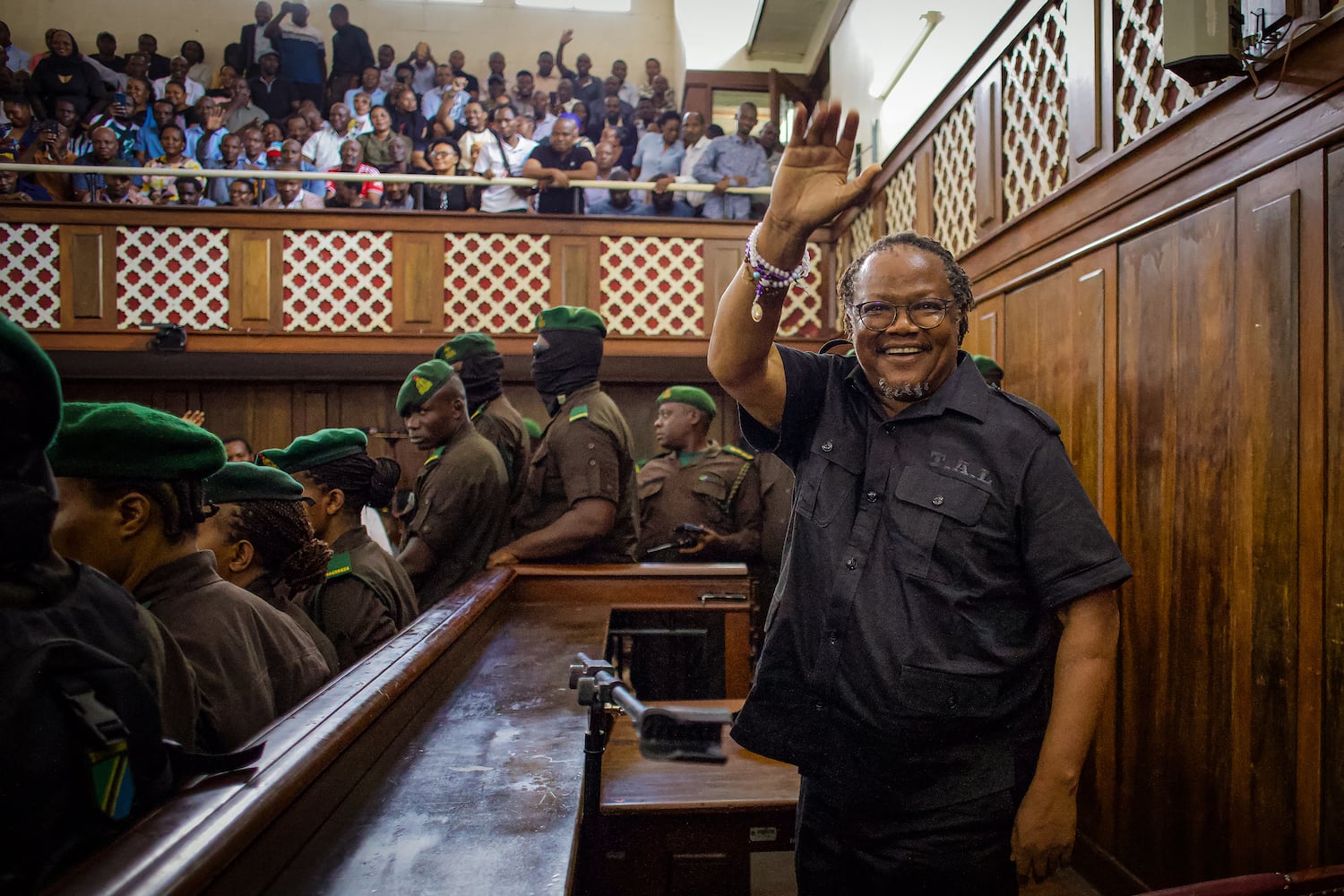
Welcome to Foreign Policy’s Africa Brief. The highlights this week: Tanzania’s opposition leader is sentenced to prison, the African National Congress suffers historic losses in South Africa’s local elections, and the Ethiopia-Sudan rift deepens. One year after Tanzania’s disputed October 2025 presidential election, the country remains in a political crisis. Incumbent President Samia Suluhu Hassan ran largely uncontested, winning 98 percent of the vote after the country’s electoral body disqualified her main opponents. Her second term began with a deadly crackdown on protesters by state security forces that saw more than 1,000 people killed, according to rights groups. Since before the elections, prominent opposition figures have been charged with treason, allegations that they strongly reject. Among them is Tundu Lissu, the leader of opposition party Chadema, whom authorities blocked from running against Hassan last year. On Friday, Lissu was sentenced to four years in prison for “incitement” but acquitted of treason. “History will record how the court searched for a lesser charge simply to keep me in prison,” read a post published by Lissu’s team on his X account after the verdict. Fellow Chadema party member John Pambalu was charged with treason last month. Following Lissu’s verdict, Chadema on Sunday accused police of holding 10 of its leaders and members for “prolonged periods” without bringing them before a court, alleging torture and forced confessions. Rights groups, including Amnesty International, labeled Lissu’s trial “a deeply flawed process” and called on Tanzania’s government to “end the misuse of treason” and other laws to silence government critics. Tanzanian activists report a continuous wave of state-sponsored intimidation and abductions since last year’s election, allegations that the government denies. In July, authorities arrested more than 130 people over planned anti-government demonstrations—before they took place. The government had banned political rallies the previous month. “Young people are wandering around with no place where they feel they can speak out. When they do speak, they face intimidation. They are threatened and told they could disappear, be abducted, or face various other forms of harassment,” said Gasper Kagonda, a prominent Tanzanian content creator, at a July conference on the country’s political landscape. Much of Kagonda’s TikTok channel is devoted to anti-corruption activism. One year on from the post-election violence, Tanzanians are no closer to accountability. Even casualty figures are still in dispute: In April, a government-appointed commission of inquiry said that it documented at least 518 deaths and more than 2,000 injuries during the unrest, a fraction of the numbers estimated by rights groups. The commission also placed most of the blame on protesters. The government withheld its full report from the public, drawing criticism from Amnesty International and the United Nations Human Rights Office. Hassan then ordered a second commission of inquiry in August that is still underway. Critics say that both commissions have failed to engage with victims’ families. “There has been no justice or accountability for the hundreds of victims of enforced disappearances, extrajudicial killings, arbitrary arrests and those subjected to torture and other cruel, inhuman and degrading treatment,” wrote a group of U.N. experts last month. Tanzania’s weakened opposition continues to resist Hassan’s growing authoritarianism through legal appeals and underground movements. But with her mandate secured through 2030, it is unlikely that she will face major domestic opposition during the remainder of her term. The international community is unlikely to speak out, either: Amid new discoveries of natural gas deposits in Tanzania, foreign powers appear to be prioritizing critical minerals investment and energy security over human rights. A U.S. government-backed consortium is negotiating an agreement to invest more than $500 million in a nickel mining project in Tanzania. The Tanzanian government is also nearing a previously stalled $42 billion gas deal with Norwegian energy firm Equinor and British energy giant Shell. U.S. multinational ExxonMobil also has stakes in the project. These investments are mistakes, argued Kenneth Mohammed in the Guardian. “The world cannot celebrate Africa’s economic rise while ignoring the blood staining the streets,” he wrote last year. “Tanzania’s tragedy is not an isolated event—it reflects the broader struggle for democracy across the continent.” Thursday, Nov. 12: Ghanaian Finance Minister Cassiel Ato Forson presents the country’s 2027 budget. The U.N. Security Council renews its mandate for the U.N. Multidimensional Integrated Stabilization Mission in the Central African Republic. Sunday, Nov. 15: Cape Verde holds presidential elections. Africa at COP31. This year’s U.N. climate change conference, known as COP31, began this week in the Turkish city of Antalya amid global heat waves, floods, and droughts. Africa is the source of just 4 percent of global carbon emissions, despite being home to 17 percent of the world’s population. Yet the continent faces an outsized impact from climate change. Deadly wildfires ravaged forests across Algeria, Morocco, and Tunisia earlier this year, while seasonal floods displaced thousands of people in Nigeria and Ghana. Led by Ghana, African countries are negotiating as a unified front at COP31. As the world’s biggest historical fossil fuel polluters backtrack on their previous emissions targets and commitments to mobilize $300 billion annually on climate finance for developing countries by 2035, African nations have focused on securing equitable climate finance. The African bloc wants to ensure that countries meet their previous financial commitments, especially to the Green Climate Fund, which helps finance climate resilience and green energy access projects in developing countries. Next year, the U.N. climate summit moves to Africa, with Ethiopia due to host COP32. South Africa’s election. The African National Congress (ANC) won less than 31 percent of the overall vote in local elections held last Wednesday in South Africa. It was the party’s worst result ever and a further sign that the country’s political landscape is fragmenting. The ANC’s main rival—the largely white-led and pro-business Democratic Alliance (DA)—gained nearly 25 percent of votes. Former President Jacob Zuma’s far-left party uMkhonto weSizwe came third, with about 10 percent. As predicted in last week’s newsletter, in many cities, no party won a majority. In Johannesburg—where the DA won nearly 35 percent of the vote to the ANC’s 20 percent—leaders will now need to decide on a coalition government that may include different combinations of the ANC; DA; and a smaller party, the center-right ActionSA, which came third in the city with 16 percent of the vote. U.S.-Congo peace deal. The Democratic Republic of the Congo has urged the United States to deliver investments promised under a peace-for-minerals deal after the joint steering committee overseeing the countries’ strategic minerals partnership met in Paris last week. The United States brokered a peace deal between Congo and Rwanda in 2025 that granted U.S. companies “exclusive” mineral extraction rights in Congo. “Our requirement is to move from signed agreements to real investments,” Congolese Economy Minister Daniel Mukoko Samba said on Thursday Congo wants the partnership to focus on local mineral processing and ending the conflict in the country’s eastern region. Congo has increased its copper exports to the United States since the deal was signed. But U.S. companies have faced legal hurdles in implementing the agreement from Chinese and European organizations, which have voiced concerns over international law. Also at issue: The deal has not been approved by Congo’s parliament. And it has sparked complaints over its suspension of informal artisanal mining in the country. Ethiopia-Sudan rift. Ethiopia and Sudan expelled each other’s diplomats and closed their consulates last Wednesday, the latest episode in an escalating spat between the two neighbors. Sudan accuses Ethiopia of backing the Rapid Support Forces (RSF), a paramilitary group fighting Sudan’s military in the country’s civil war. Ethiopia accuses Sudan and its allies, Egypt and Eritrea, of backing rebels in its Tigray province. (During the height of the 2020-2022 Tigray civil war, Sudanese troops moved into the border area, leading to localized clashes with Ethiopian forces.) All countries deny the accusations. Meanwhile, Sudan’s de facto military government filed a formal complaint with the U.N. Security Council and the African Union last week accusing Ethiopia of allowing the RSF to launch devastating drone attacks from its territory. The risk of a proxy war in the Horn of Africa is growing. Why Kushner and Witkoff Keep Failing by Stephen M. Walt The Beginning of the End of Trumpism by Ravi Agrawal Where Democrats Can Thwart Trump’s Foreign Policy by John Haltiwanger Historic appointment. Morocco’s King Mohammed VI appointed Fatima Ezzahra Mansouri as the country’s first female prime minister in September after her party won general elections earlier that month. In Foreign Policy, Ilhem Rachidi argues that while Mansouri may have limited powers compared to the king, her new role is still symbolically important. “If she succeeds in shaping policies that improve Moroccans’ lives and support gender equality, she may very well leave her mark on a country that is striving to modernize even as it has long leaned conservative,” Rachidi writes. UNESCO bids. In the South China Morning Post, Jevans Nyabiage reports that Beijing is providing financial backing and technical training to help African nations combat underrepresentation on the UNESCO World Heritage List. African sites account for just 9 percent of UNESCO’s 1,273 total locations, while Europe and Asia are home to the vast majority of global listings. China’s initiative is anchored by a $1 million fund established by Quanzhou municipal authorities in March 2025, which supports nomination dossiers and conservation capacity-building across the continent.
The Tragedy of Tanzania
Full Article
Original Source
Read the full article at Foreignpolicy →KhanList aggregates and links to publicly available news content. We do not host full articles from third-party sources. Always verify important information with original sources.