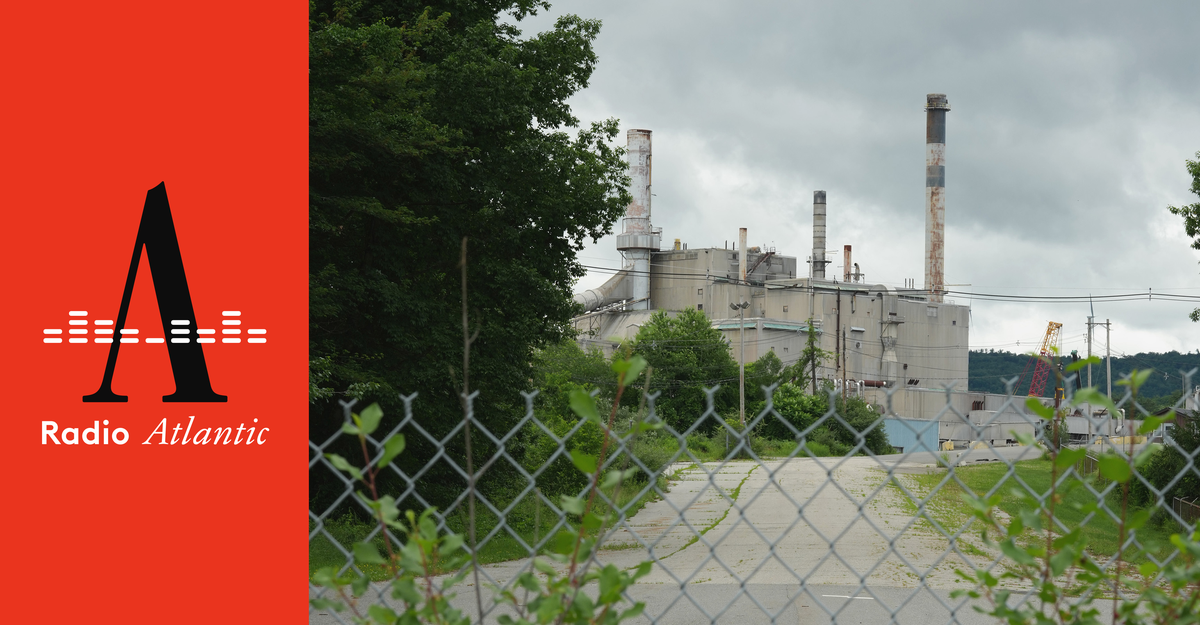
Subscribe here: Apple Podcasts | Spotify | YouTube | Overcast | Pocket CastsOpposition to data-center construction is the bipartisan issue of the moment—70 percent of Americans are against construction in their communities. Recently, New York passed the country’s first statewide data-center-construction moratorium. Maine was supposed to have been the first.For this week’s episode of Radio Atlantic, I traveled to Maine to understand why one tiny town killed what would have been America’s first data-center moratorium.The following is a transcript of the episode:Hanna Rosin: This is Radio Atlantic. I’m Hanna Rosin.The people-versus-power showdown of the moment revolves around data centers—a tech giant racing to build one near a town versus the people who live there.I’m sure you’ve seen videos of a town meeting somewhere, in Louisiana or Texas or Iowa—a longtime resident outraged by local leaders who are capitulating to Amazon or Meta or Google. Near me in Northern Virginia is the largest cluster of data centers anywhere.This week, we have a story from reporter Ethan Brooks, where the battle lines in this war between data centers and small towns are playing out in a really unusual way. Ethan will take it from here.Ethan Brooks: The first time Katlin Hilton saw the old, run-down farm on Smith Road in Chesterville, Maine, she knew that this was the place.Katlin Hilton: I drove up by myself one day, and I just—it was the middle of February. It was –5 [degrees], and I just thought it was so beautiful. And I was like, “That’s everything we’ve wanted.”Brooks: She bought the farm with her husband in 2022, and they went to work. They planted corn, potatoes, and onions; fought rats and weeds; slayed a weasel in the chicken coop with an axe.[Background farm noise]Brooks: Four years later, when I visited, there was a new roof on the house, a fire pit, and a flower garden. There was Katlin’s daughter, who had stolen my microphone and was now whispering something into it.Daughter: I love chickens!Brooks: There was lots done, and lots left to do. Then, one day this March, Katlin saw a headline. The town next to Katlin’s, a town named Jay, had plans to build a data center.Hilton: I was really shocked to hear about that. We border Jay. It’s only a mile down the road, is the Jay line. So I just started researching.Brooks: If you were to search data center in March 2026, you’d find a lot of credible information about dangerous pollutants in the air in Memphis, vanishing groundwater in New Mexico, massive electrical bills in Virginia and Illinois, noise pollution in Texas, and on and on.And now a data center was coming to Maine, the first in the state, just five miles away from Katlin. She worried about how a data center might affect the environment, and what it might do to her farm.Hilton: So I reached out to Melanie and sent her an email, and she literally called me in 20 minutes.Brooks: Melanie Sachs is a member of the Maine House of Representatives. Sachs told Katlin there was a bill she’d proposed that could stop the data-center project.[Music]Brooks: It was a statewide moratorium, coming up for a vote in just a couple of weeks. The moratorium would put a stop to large-data-center-construction in the state of Maine until 2027. The bill was called L.D. 307, and it would kill the project in Jay.So Katlin got to work. In the afternoons, while her daughter napped, she wrote letters and emails. One letter she sent to 165 people in the legislature, manually copying and pasting each email address. She signed her emails, “Make today wonderful,” and then she waited.Bernie Sanders: A moratorium on the construction of new AI data centers is not such a radical idea.Brooks: Katlin wasn’t the only one campaigning against data centers. Across the country, a weird coalition had formed. One that included both Bernie Sanders and Steve Bannon—Steve Bannon: All they’re trying to do is to ram it down your throat.Brooks: —Alexandria Ocasio-Cortez—Alexandria Ocasio-Cortez: Saying no to these data centers being built.Brooks: —and Matt Walsh.Matt Walsh: And really the ultimate message to these people is, “Well, you’re screwed. You’re on your own. Too bad. The data centers are more important.”Brooks: 16 days later, the Maine moratorium passed, with Democrats and Republicans supporting the bill.Hilton: So I was super excited, and a lot of my friends were like, “Yeah, good job.” And they’re like, “You never know. You could’ve been a big reason why they voted for that.”Brooks: For Katlin, this was an amazing outcome, and not just for her state.Hilton: I was seeing all these different posts on social media praising Maine saying, “Good job, Maine. You’re the only state in the country that has put a moratorium forth to not allow data centers for now.” And so people were celebrating.Brooks: Similar ideas had been proposed in a handful of other states, but none had passed a state legislature. Maine was the first place—anywhere—to ban new-data-center construction.Ten days later, Governor Janet Mills, a Democrat, posted a letter to her office’s website. She said: “I am hereby vetoing L.D. 307.” Mills had killed the moratorium.Melanie Sachs: We had thousands of people—and I know this—thousands of people contact her office, saying, “Please let the bill go through.”Brooks: This is Melanie Sachs, the state representative who proposed the moratorium.Sachs: Let’s have protections for 1.4 million Mainers. Don’t give that up just for this one project.[Music]Sachs: I’m still astonished. I may be naive, Ethan, but I’m still astonished that this happened.Brooks: The reason for the governor’s veto wasn’t because she’s an AI evangelist—she isn’t—or that she had a problem with such a sweeping measure. In her letter, she wrote, “A moratorium is appropriate.”She vetoed it because one town, Jay, the town next to Katlin’s farm, wanted and maybe needed this data-center project. In particular, she had received letters from the town’s leaders, urging her to veto the moratorium and save their data center. One town of about 5,000 people had squashed the moratorium for the entire state of 1.4 million Mainers.Hilton: I was really upset. I’m like, “Are you kidding me? Are you kidding me? Did she really have to go and ruin this for the whole state because of Jay? And now we’re gonna have to deal with this data center.”Brooks: Opposition to data centers is the singular unifying issue in American politics in 2026: 70 percent of Americans oppose data-center construction in their community. In Maine, it’s 72 percent.Melanie Sachs’s bill would have been America’s first moratorium. But it felt like more than just a legal milestone. This would have been the first meaningful limitation on the power of companies like Google and Microsoft and X and OpenAI that can sometimes feel limitless—the power to build the infrastructure they want, and through that infrastructure, the future they want.And now, because of Jay, there would be no such limit.This spring, I drove up to Jay to understand why a town would not only accept a data center in its backyard, but why they would pursue it at such great expense.Brooks: Before I visited Jay, I had a handful of theories about the town’s support for this data-center project. The first one was: Maybe most people in the town didn’t actually support it, because most people didn’t know about it.Patrick Hopkins: I heard “data center,” and I’m like—and I just kind of went, “Oh, in Jay, really?” Resident: I don’t think anybody knew. And then all of a sudden, there’s this whole conversation about data centers, and it’s like, “Whoa, slow down here. What are you talking about?”Brooks: Secrecy is a tactic being used all over the country to get data centers built. Developers get town leaders to sign an NDA and only reveal the full scope of the project when it’s too late to do anything about it. When other towns have found out about secret data-center plans, there has been serious backlash. But not in Jay.In Jay, there was some skepticism. There were a lot of questions, some heated exchanges in the town Facebook group (it’s called “The Jayborhood”). But very few people researched the project and tried to stop it. One guy started a petition, then gave it up after a 30-minute conversation with the developer. So, yes, the project had moved forward in secret, but most people in Jay didn’t seem to care.Here’s another theory. This one’s about the people in charge: Jay’s town leadership is on the older side. They were the ones who chose this. They wrote to Governor Mills and influenced her decision to veto the moratorium. What if the elders of Jay, less likely to deal with long-term consequences, were the ones for the data center, but the rest of the town wasn’t?The same week that the news of the project broke in Jay, a town council in Festus, Missouri, approved a $6 billion data center. A week later, the town voted out all of the incumbents who had voted for it. Maybe there was a similar revolution brewing in Jay.But most people I spoke with, the ones that had an opinion at all, they were in favor—the Republican representing Jay’s district in the Maine legislature and the 28-year-old Democrat running to replace her; people of different ages, of different political leanings. That divide between the leaders and the rest of Jay wasn’t a thing.If that wasn’t it, maybe it was because in Jay, for the most part, you can build whatever you want.[Music]Brooks: One day, I was out walking in a residential neighborhood in Jay. On my right were the usual family houses—one to two stories, one after the other—and then tucked between two houses was a bowling alley. As far as Jay is concerned, you can build a data center much in the same way you can build a bowling alley next to someone’s backyard.I thought the town might be against moratoriums on principle, data center or otherwise. But then I found out that Jay has a moratorium all of its own. They banned pot shops, which are all over Maine but not in Jay. So Jay’s support for this data-center project wasn’t a fluke. It wasn’t secrecy. It wasn’t a divide between town leadership and the town. It wasn’t opposition to a statewide moratorium. What it was has everything to do with the specific place, the piece of land, where this data center will go.Around the country, AI data centers are replacing forests and farmland—fertile soil maintained by farmers for decades, dug up, filled with cement. But in Jay, the data center would go into the site of a paper mill.[Music]Brooks: Well, not a paper mill exactly—the paper mill. The mill is the heart of Jay. At its peak, it employed 1,500 people. One resident told me that without the mill, Jay would have no reason to exist.A few years ago, in the blink of an eye, Jay lost its reason for existing, suddenly and violently. Then it went searching for a new one.One thing I heard in Jay is that if I wanted to understand how the town feels about the mill and this data center, there was something I needed to know about Maine. Hopkins: There’s two Maines. There’s two Maines.Brooks: That’s Patrick Hopkins. He’s a carpenter from Jay. The first Maine is “Vacationland”: the coast, lighthouses, lobster. It’s more of an idea than a place. It’s not just the coast; it’s Rangeley, Bethel, Belgrade Lakes, anywhere there’s a big, beautiful lake or a big, beautiful ski mountain. It’s picturesque, photogenic, rugged in the way that shows up on Instagram reels. And then there’s Jay.Jay has no giant lake, no rugged coastline. Rugged, yes, but in a different way. Call it the other Maine.Hopkins: Maine’s called “Vacationland.” I mean, it’s kinda called that for a reason, right? Like, people want to vacation here, but they want to go vacation in places that are beautiful, right? Like, you don’t wanna go on vacation and then stare at a paper mill.Brooks: When Cody Jacques was a kid, growing up in Jay, he loved to stare at the paper mill.Cody Jacques: It looked like a city at night—the scale of the mill and all the lights, all the towers. Everything had lights on it. So, like, we’d always joke around and say, “Oh, there’s Portland, Maine, on the river, you know?”Brooks: Out of all the people I spoke with in Jay, it was Cody’s strange story, the way he’s navigated working in two economic eras that look nothing alike, that finally made everything click. Cody is 32 years old. He was born and raised in Jay, and in April 2020, when everything changed in his town, he was working at the paper mill.Brooks: How did you end up going to work at the Androscoggin Mill? Jacques: I was working as a lobsterman on scallop boats down on the coast of Maine. When you work on the fishing boats, you go out when the weather allows you to go out, and your schedule is what the captain makes it. So it’s just, the paper mill offered benefits. It gave me a little bit of opportunity to kinda have a retirement, have some health insurance, and kinda have a more regular, steady job.Brooks: By all accounts, holding down this type of manufacturing job in 2020, in America of all places, is kind of a miracle. Cody had a 401(k), paid time off, and the opportunity to rise up the ranks. That April, Cody had the week off, but he spent the last four days at the mill anyway, studying for a promotion. The same year that Open AI released GPT 3, Cody was at the mill with a clipboard and a booklet, studying.On the morning of April 15, he got a call.Jacques: They called me that morning to come in, but I didn’t wanna come in ’cause I’d already worked most of my week off.Brooks: So he stayed home. And a bit later, his phone buzzed with a few texts from friends.Jacques: And they’re like, “Hey, you know, what’s going on in the mill?” And I thought to myself that maybe they’re just trying to apply because I—they were hiring at the time. So I was like, “Hey, no, you just gotta go on the website and apply.” They’re like, “No, the mill blew up.” I’m like, “What do you mean it blew up?”Brooks: Vicki McLeod, Cody’s boss at the mill, also wasn’t working that day.Vicki McLeod: Another friend of mine who was working, she called me up and she said, “There’s been an accident at the mill.” Jacques: So I remember I called my stepdad and was like, “You know, what’s going on?” Whatever. He wasn’t working either, and I told him what I heard. He’s like, “Nah, there’s no way. That’s not possible.”[Music]Brooks: You can’t really fault Cody’s stepdad for the disbelief here. There’s plenty of great reasons to think “the mill blew up” was impossible.First of all, the mill site is about 500 acres. The buildings cover 15 football fields, among them, two 166-foot-high towers. It would be a lot to blow up. Second, it’s been in operation since 1965. That’s a 55-year-unexploded streak.But more than that, the mill blowing up just couldn’t be possible. Even in 2020, the mill was still the heart of Jay. It was the town’s biggest employer. And the taxes that came in from the mill paid for the police, the fire department, trash pickup. The mill was there in every part of life in Jay, and the consequences of losing it would be almost too much to imagine.The dashcam footage, recorded from a truck around 11:55 a.m. on April 15, shows the mill in the distance. What you can’t see is a weld, one of thousands sealing what is essentially a giant pressure cooker beginning to fail. One moment there is blue sky, and the next—Truck-radio chatter: Calm down! (Indecipherable.) There’s been an explosion in the mills. The fucking mill just blew up.Brooks: —a black column hundreds of feet high. The scale of the explosion, it’s hard to comprehend.Truck-radio chatter: Holy fuck.Brooks: Brown-sludge spatters on the truck’s windshield thick enough to block the dashcam.[Music and background noise from dashcam]Brooks: Cody and Vicki both jumped in their cars. They had friends and family working that day.Jacques: I mean, there’s smoke everywhere. There’s helicopters. There’s, you know, there’s fire rescue. You know, everybody in town’s running around, going crazy. So I called my stepdad again, and there’s the A digester and the B digester. And I’m like, “Well, I don’t see either of those.” He’s like, “There’s no way. There’s no way.” I’m like, “Well, I’m looking at it right now, and, you know, they’re gone. They’re completely gone.”Brooks: The two towers where Cody worked, the ones he had stared at a kid and imagined as the towers of a city, were gone.Jacques: I tried to get into the mill, but the road to get into the mill was blocked off by police. Nobody knew if it was gonna be a rescue effort to find bodies or, you know, what was going on. McLeod: My husband was working, and so I called him and I said, “Are you okay?” And he said yes. He said, “It’s not good.”Brooks: Somehow, inexplicably, there were no deaths. When I asked people in Jay how an explosion of that magnitude could claim no lives, mostly they said it was the grace of God.McLeod: Nobody was hurt. And we all praised God a little bit and, yeah, I came home that night and I remember thinking, you know, Thank you that everyone’s okay, but now I gotta figure out what I’m gonna do with the rest of my life. Jacques: For kind of the heart or the center of the mill to blow up is pretty much game over. I had a feeling that I would probably never step foot back in there again, and I never did.[Music]Brooks: From above, the land that holds the mill looks more than a little like a molar under X-ray—a peninsula surrounded on three sides by a river. Since the explosion, the site has been a sort of physical and economic cavity for Jay. The town is putting its hopes on setting things right by placing a data center directly into that hole, replacing the symbol of the old economy with the new.They’re not the only ones. Last year, President Trump directed the EPA to identify brownfield sites, old industrial sites like this one, that could be converted for data-center use. Jay’s project is a kind of test as to whether that can really work.When I asked people in Jay why they supported this project, a lot of them said that the answers are all in this building.Lucien Richard: So this is an overview of the facility. Brooks: Yeah. Richard: Like you said, you drove around. It’s fairly large.Brooks: Lucien Richard is the guy responsible for turning a paper mill into a place where a data center can go. He also worked at the mill for decades.Richard: Well, we’ll take a walk through the paper-machine buildings. Basically, my time’s your time, so whatever you wanna see. If you—Brooks: Before the explosion, the mill ran 24/7. From town, you could hear it, and sometimes Jay would reek of sulfur. Inside the mill were dozens of workers—mechanics, electricians, maintenance workers, and operators.Richard: When we were up and running, it would be nothing for it to be, like, 95 or so degrees up here. Yeah. We’d be sweating. You wouldn’t be able to hear me talk. I wouldn’t be able to hear you talk. We’d be hollering at each other. Summer, you’d go outside to cool off.Brooks: Now it’s deathly quiet. Walking around in the mill, it was immediately clear why Elon Musk wants to put data centers in outer space. The paper-machine rooms are dark and cold and seem endless.Brooks: Did it look much different before demolition down here? Richard: Oh, yeah. So this kind of looks—Brooks: But there were still signs of what the place used to be. Lucien pointed out a mural on one of the walls, a wooden boat full of puppies looking out at a row of ducklings.Brooks: Where’d this mural come from? Richard: We had some pretty talented people that used to work here.[Music]Brooks: The case for the project in Jay rests on the existing infrastructure of the mill. The reason the Trump administration is pushing to convert brownfield sites for data-center use is because operating industrial machinery requires immense power, as does operating a data center.According to the developer, the site is already allowed to pull a lot of power from the electric grid. He plans to add solar panels and use the hydroelectric power that’s already on site.Elsewhere in the country, power plants are struggling to keep up with demand from data centers. The cost of electricity, especially in areas near data centers, is super high—high enough to become a serious election issue this year, and high enough for Google, Microsoft, and Open AI to sign a pledge this spring to keep costs down for everyone else.The pitch, then, is that the project in Jay will exist in a kind of walled garden—it would generate much of its power on-site and pull no more from the grid than the mill did just a few years before the explosion. The argument for water use runs along the same lines: Especially in states like Arizona, data centers strain the water supply in a state that is very dry. Maine is wet.Richard: So basically, these are the pumps that would pump water from the river up to the mill.Brooks: Lucien showed me the water-treatment plant on site, another vast room. The paper mill used to use about 35 million gallons of water from the river per day. The developer says the data center would use 1 percent of that. Lucien wondered out loud if they might need a smaller pump.These numbers, they come from the developer. He is from Maine, by the way. His client is called Sentinel. They’re one of the big companies in the data-center construction world.And it’s important to say: There’s a high degree of uncertainty in this proposal. Some of the language used by the developer—like there would be, quote, “no environmental impact” and, quote, “The project is all positives and has no negatives”—is plainly false.Much of the rest of it is just unknown. Maine has environmental and power regulations like everywhere else, but no specific playbook for data centers. The reason the Maine legislature—Republicans and Democrats—passed the moratorium in the first place was so they could make a set of rules before development starts.A data center in Jay might end up looking like what the developer is pitching. Or it might look very different.Richard: The concern people have about electricity and water, I understand it for, let’s say, downtown Lewiston, Farmington, Bangor. They don’t have the infrastructure set up. This place is gonna operate, could operate, all on its own.Brooks: The mill, or its absence, seems to be the reason why Jay is willing to accept a level of uncertainty that other towns are not. On every point, this is how the argument goes: A data center can’t be as loud as the mill, can’t smell as bad as the mill, can’t pollute like the mill.Richard: It’s the perfect fit. You need lots of water. We used to use lots and lots of water. You need lots of power. We used to use or make lots of power. It’s a natural fit. All you gotta do is get over the people’s fear.Brooks: Using the past in this way, as a means of justifying the future, it’s an imperfect science, especially with the layer of nostalgia covering everything. For Katlin, on her farm, this sort of argument just doesn’t make sense. The present, without a mill or a data center, is clearly better for the environment than the past.On the other hand, the mill has been closed for six years. Jay needs something. The mill is a handy benchmark for what they’re willing to tolerate.Richard: Let me just get out of it. You want the light on or off?[Music]Brooks: When I was touring the mill with Lucien, the thing that stuck with me was that mural he showed me—the boat full of puppies.The developer’s plan is to clear the space until it’s empty, and then some trucks will roll up, servers will be plugged in, and the building will start humming.If all goes well with the plan to turn this mill into a data center, that mural will be a sort of cave painting one day. Maybe some AI-powered robot will roll past and wonder what possible efficiency might have been gained by painting a boat full of puppies on a wall in a workplace.In 2020, when the pulp mill exploded in Jay, over 500 people worked there. Not long after, it was zero. That’s a shock that’s hard to measure in a town of about 5,000.For Cody, it meant that his plan to work his way up at the mill, fund the 401(k), and live a life that looked a lot like his grandfather’s wasn’t going to happen.Brooks: I mean, you were saying earlier that it felt like a stable thing, a career, a job you could have for a while. Jacques: Yeah. It was stable. I could picture, you know—I was training for the next job, you know. I was gonna get the big raise, blah, blah, blah. To, all of a sudden, now, you know, what the heck are we gonna do here? [Door opens] Trevor Doiron: Hi. How are you?Brooks: When I visited Jay, I spent an afternoon with Trevor Doiron.Doiron: I’m running for state House here in Jay. Neighbor: This neighborhood is full of Doirons.Brooks: Trevor was a few years below Cody at Spruce Mountain High School. He’s 28 years old, and he’s running as a Democrat to represent Jay’s district in the state House. He supports the data-center project.Doiron: Well, I grew up right the next street over.Brooks: When Trevor is out campaigning, when people open their doors to talk to him, what he sees worries him.Doiron: I’ve seen some pretty scary things. I mean, people living with holes in the floor, using the stove to heat the house, people doing their best to get by but putting themselves in grave danger because there’s no good jobs; there’s no way to earn a really honest income.Brooks: The town itself is now the second largest employer in Jay, behind the high school. The third largest is Hannaford, a grocery store. Maine has the oldest population in the country. Jay is older than the average in Maine.Doiron: Like, a lot of the services for the elderly, it’s like, the elderly are the ones providing the services for other elderly people. We’ve got the food pantry over here. We got a guy; he’s great—92 years old, and he goes every Tuesday.[Music]Doiron: Fills the boxes. But he’s not gonna be able to do that forever. Like a year from now, who’s gonna be filling the boxes at the food pantry? Who’s gonna be delivering the meals to the seniors who can’t get out and do their shopping or cook for themselves? It kinda feels like a silent sense of resignation.Brooks: This, then, was my best theory as to why Jay fought for its data center: desperation. The town needs something, anything, to stay afloat.After the mill closed, Cody and his girlfriend had their first kid, a daughter. Cody needed to work, needed to provide for his family. He heard from a friend that if you could get in as a union electrician, there was work and the pay was good. He took an aptitude test, became an apprentice, and before too long, he had a new career.Jacques: Went up to camp with the family for Labor Day weekend, and then I got in my truck and drove down to Niagara Falls because they had this job that was called Lake Mariner data center, and I had no idea what a data center was. I just knew that it was a good opportunity.Brooks: Cody, a few short years after the mill closed, made a new career as an electrician working in data centers.Jacques: So I really had no electrical background. Just worked at the paper mill and kinda knew that I didn’t want a place to just blow up on me and next thing I know, I lose my job.Brooks: The debate around data centers around the country often comes back to jobs. Maine’s governor cited jobs as a central reason for her veto of the moratorium.Ad: I grew up here, and I wanted my kids to be able to do the same.Brooks: Meta recently spent $6 million on an ad campaign linking data centers and jobs.Ad: We’re bringing jobs home.Brooks: Specifically, Meta is talking about full-time, long-term jobs.Ad: For us, and for our next generation.Brooks: I figured the promise of these full-time jobs was central in the town’s support for its data-center project, especially with the sudden loss of the mill. When I asked Tom Saviello, the county commissioner, it seemed like his ambitions went well beyond jobs.Tom Saviello: You build that, and they will come, just like Field of Dreams. We need technology to change this place and how we operate. And if this is our opportunity to jump on that technology, let’s ride the horse, and then give us a chance to figure out: What do we do next? I can see something here. I can’t tell you what it is.Brooks: The developer has said he expects the data center will employ 125 to 150 people full-time. He also says there will be 800 to 1,000 temporary construction jobs to get the data center up and running.But the evidence so far does not look good for those long-term jobs. A data center of the size being proposed in Jay might only employ 30 to 50 full-time staff. And who knows what those jobs will look like in the future. Given all the Field of Dreams talk, I figured Tom had high hopes for these jobs. But as we spoke more, I heard something else.Saviello: I don’t care if it’s 10 jobs. I don’t care if it’s 100 jobs. We used to employ, when I got here, 1,000 workers—good salaries, good benefits. There aren’t very many employed now. So even one is more than zero.Brooks: Over and over, I heard a version of this—not some vision of Jay returned to its former glory, but humbly, The mill is a big place. It’s just sitting there. It should be something.Richard: I mean, look at the space. If you can put something in here, why wouldn’t you? It’s here. McLeod: I loved that place. I’m the person that goes to work every day happy ’cause I love my job. So to see it be a shell of nothing, you want something there. Jay wouldn’t be Jay without the paper mill that we had. You know, you don’t wanna see Jay just be nothing.Brooks: I had this idea that to survive, Jay needed anything. But what I heard in these conversations was different.First of all, there’s a positivity on AI that I didn’t quite expect. Vicki is excited about what it might do in medicine. Cody mused about how it might help with his daughter’s education. And second, a lot of the people I spoke with wanted to get in the weeds with me on energy infrastructure. In interview after interview, they talked to me about cooling systems, hydroelectric dams, water tables, and retention ponds, and decibel limits.McLeod: Maybe we understand the workings of the industry and know that it’s gotta come from somewhere. It’s not magic. I mean, it’s like electricity. It’s not magic, you know? Brooks: Yeah. McLeod: Somehow it’s gotta be made. You might not like solar, you might not like wind, you might not like water, you might not like nuclear, but you like power. So it’s just like, I don’t love solar fields, but I love electricity. Brooks: Mm-hmm. McLeod: I don’t love wind farms, but I love electricity.Brooks: For Jay, the question wasn’t so much “Why should we have a data center here?” It was “Why shouldn’t we?”[Music]Brooks: This moment, the rapid-fire building of the infrastructure for AI, is one of the largest capital expenditures in human history. In many places, that means destroying farmland, polluting, and putting immense pressure on the grid— sometimes achieved through secrecy, pressure, and manipulation. Other times, towns offer incentives.In a recent article about Jay and rural data centers, Anthony Elmo, who studies economic development, said of rural towns: “They don’t have the resources to negotiate. They don’t know what to ask for. They don’t have the legal expertise, and they don’t feel like they have the leverage.”I think Jays knows plenty. The town offered no tax break and stood to make about $6 million in property taxes, something like three-quarters of the town budget. When I asked what might come of such a massive windfall, Trevor Doiron told me he didn’t know—that would be up to the people of Jay.When they talked about jobs, no one had any notion of appearing in a Meta ad. They said one is better than zero and reminded me that “temporary construction jobs” are full-time work to union electricians like Cody.Brooks: In an earlier era, his dad’s generation even, Cody wouldn’t have to choose between a good salary and being with his family. But now he does.Jacques: I’ve been given this opportunity, so I feel like I’m gonna kinda seize that opportunity, you know. These companies are just paying massive amounts of money, and I’d be a fool not to chase it.Brooks: Cody drives all over the country, most recently about eight hours to Niagara Falls, and stays on the job for weeks at a time.Jacques: This Lake Mariner data center is being funded and backed by Google. They know guys like me and guys like other guys in the country are gonna come to chase that money. These tech companies have the money to pay us accordingly, and sometimes we can get them to do it.Brooks: When he’s traveling for a job, Cody lives in an Airbnb with a bunch of other electricians, also traveling, also chasing data-center money away from home.At the mill, Cody told me work felt like being in a family. They made meals together, spent holidays together, and then, he went home to his actual family. Cody’s new life, though, it’s a sort of exchange. He spends more time with his union brothers, who live all over the country, than he spends with his actual brother, who works in a restaurant near Jay. He does this so he can send money home for his girlfriend and their 4-year-old daughter.[Music]Brooks: Recently, Cody was working six or seven days a week. Somehow, the project was already behind schedule, which meant he wouldn’t have time to go home.Jacques: I was working at the data center, and it was gonna be about eight weeks that I was gonna be gone from home, and after about the fourth week, I really was just getting homesick. You know, I wouldn’t call it despair, but you’re like, All right, I really just miss what’s familiar to me. So I pretty much told them, like, “I’m not gonna make eight weeks without seeing you guys.”Brooks: So Cody and his girlfriend made a plan. She was in Jay. He was in Niagara Falls. Albany was halfway, so they decided to meet there just for a day.Jacques: I beat them to the hotel, and I remember my girlfriend and daughter pulling up, you know. My girlfriend rolled my daughter’s window down. I just remember kind of being elated to see them, you know, just kind of like a sigh of relief, just grab them and hug them and kind of forget about everything else for a few minutes there, and it’s just good to kind of be around them.[Music]Jacques: We spent 24 hours together, and then, you know, my girlfriend and daughter got back in the car and drove to Maine, and I got back in my truck and drove back to Niagara Falls. We’re a young family. I just bought a house. I’m putting an addition on my house. I’m trying to build a garage. Working a job, unfortunately, in Jay, Maine, you’re not having a new truck, a tractor, a snowmobile. You know, you’re not necessarily living the American dream that we grew up hearing about.Brooks: What’s exciting for Cody is that a data center in Maine might mean Jay could have the best of both worlds.Saviello: They deserve it here. They’ve been through turmoil, whether it be the blow-up or whether it be the shutdown. It’s been turmoil here, but they’ve survived. And this has got a chance for them to even do better. Like I said, in Field of Dreams, “Build it, and they will come.” People will be working, and the town will prosper.[Music]Brooks: On June 11, less than a month after I visited, the town of Jay posted to its Facebook page with commenting disabled. The data-center project had been put on indefinite hold because the company behind it, Sentinel, had backed out.I called a lot of the people I spoke to when I was there. Most were disappointed, and most weren’t totally surprised. The data center was just the latest on a long list of things that were there one day and gone the next.[Music]Brooks: This episode of Radio Atlantic was edited by Theo Balcomb. Production help Jacob Smollen. Fact-checking by Yvonne Kim. Rob Smierciak engineered and provided original music. We also had music from Breakmaster Cylinder. Claudine Ebeid is the executive producer of Atlantic audio, and Andrea Valdez is our managing editor.I’m Ethan Brooks. Thanks for listening.
The Town That Wants a Data Center Next Door
Full Article
Original Source
Read the full article at Theatlantic →KhanList aggregates and links to publicly available news content. We do not host full articles from third-party sources. Always verify important information with original sources.