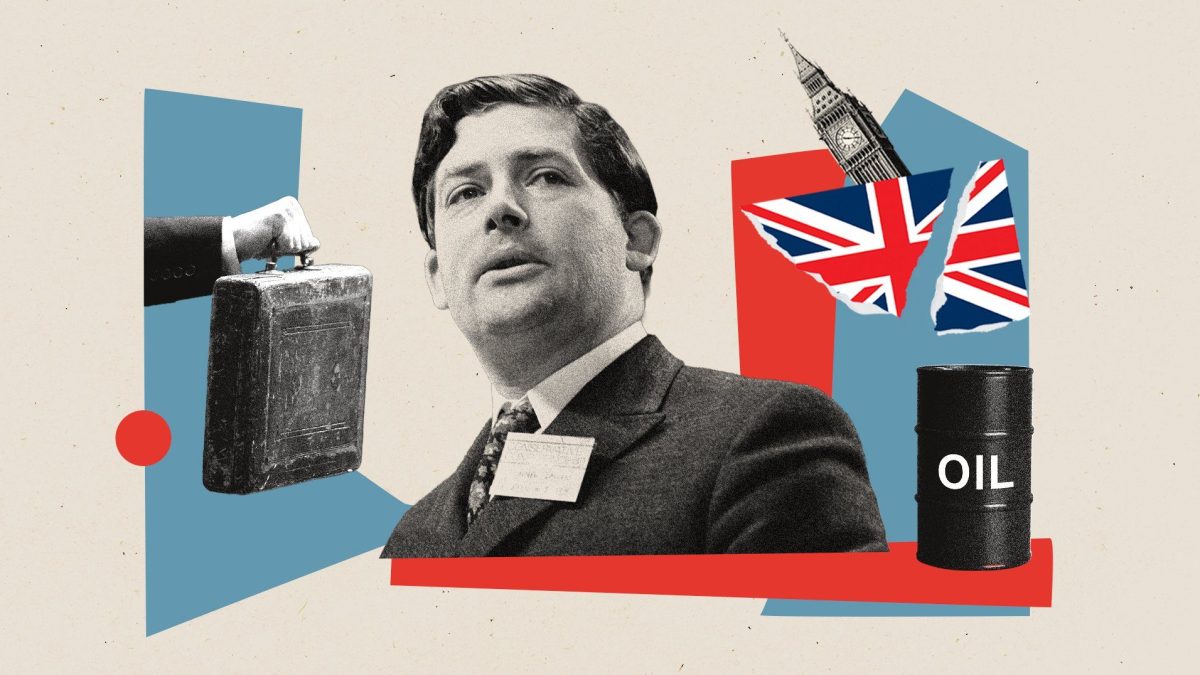
Who broke Britain? Welcome to The i Paper’s opinion series in which experts and writers debate the issues that concern them about modern Britain. • You won’t know James Bevan, but you should know what he did to this country• Boris Johnson wrecked Britain. But this man left even deeper scars• The hardcore socialist whose ruinous idea is why Liz Truss became PM• Martin Lewis: the money-saving expert… who accidentally cost Britons billions• The American woman who ripped the heart out of Cadbury• The shadowy maverick who pulled Labour’s strings… and sunk Starmer• Steven Bartlett: the glorified PR man quietly making Britain worse• The anti-sex, anti-fun godmother of Nimbys who gummed up modern Britain The incoming prime minister Andy Burnham has said he wants to “end 40 years of neoliberalism”, which saw a “draining away of economic, social and political power”. One of the chief architects of that process was Nigel Lawson. Lawson, an immensely influential figure who held a range of posts in Margaret Thatcher’s government in the 80s, gave away, sold or mismanaged untold swathes of that power. Britain is still paying the price for his mistakes today. “Our policies aimed at a conscious break … with the entire post-war consensus,” Lawson recounted in his memoir The View from No. 11, “to change the entire culture of a nation from anti-profits, anti-business, government-dependent lassitude and defeatism, to a pro-profit, pro-business, robustly independent vigour and optimism.” Well that was the rhetoric. Far from being pro-growth, the 1980s witnessed lower growth than the apparently “anti-profits, anti-business” 1970s. And the proceeds of growth from the 1980s was more unequal than ever, as inequality increased by a third, homelessness grew and unemployment soared above three million. And that was just the immediate impact of Lawson and Thatcher’s disastrous policies. Their legacy is still with us today in stagnant growth, higher utility bills, and in deep inequality consolidated by a grossly unfair tax system. The policy most associated with Lawson’s time as chancellor (he served also as energy secretary and financial secretary to the Treasury) – is perhaps the “Big Bang” of deregulation in the financial services sector. Lawson and business secretary Cecil Parkinson believed the City should manage its own affairs through self-regulatory organisations. Consumer and mortgage lending rules were also loosened, and building societies were allowed and encouraged to become banks. Northern Rock was one of the building societies than demutualised to become a bank – and in 2007 delivered the first bank run in the UK in 150 years, kicking off the banking crash from which the UK economy has yet to recover. In 2010 a contrite Lawson told Radio 4 that the UK banking collapse was an “unforeseen consequence of [his] stock exchange reforms”. He reflected that the banks “are so big that they cannot be allowed to fail, because the consequences would be so great and therefore you have to bail them out at the taxpayers’ expense – and that is what we have done at absolutely huge expense”, describing the system for the banks as: “Heads I win, and tails the taxpayer loses.” That phrase sums up Lawson’s policies – business wins, the taxpayer loses. Whether it’s the banks, utility companies, or private landlords: they win and we lost out. North Sea oil revenues really came on stream in the 1980s, providing a windfall for the Thatcher government and for Lawson as chancellor. Norway too had benefited from the discovery of oil in the North Sea, but while the Norwegian government recognised this was a one-off boon, Thatcher and Lawson treated the oil revenues as a permanent fixture – using the fiscal headroom created to slash taxes for corporations and the better off. The Norwegians set up a state-owned oil company and a sovereign wealth fund to invest the proceeds (which they did from 1996). That fund today is worth in excess of £1trn. They captured the wealth and invested it for the future. Today 93 per cent of the gas and oil from UK’s North Sea oilfields have been extracted, their revenues squandered and ownership in the hands of multinational corporations. Among the several state-owned companies privatised by Thatcher and Lawson were British Petroleum, British Gas and the British National Oil Corporation (established to explore, extract, refine and distribute North Sea oil). In 2018 a paper by the centre-left IPPR think-tank “Our Common Wealth” found that “if a [UK] fund had been created from the North Sea oil revenues in the 1980s, it would be worth over £500bn today”. That might solve a few of our current investment problems. Those revenues were instead squandered on tax cuts that disproportionately benefited the highest earners and corporations. Under Lawson the highest rate of income tax fell from 60 per cent to 40 per cent, (the basic rate dropped more modestly from 30 per cent to 25 per cent). Other taxes on the rich, like the investment income surcharge, were entirely abolished under Lawson. Corporation tax plummeted from 52 per cent to 35 per cent, with Lawson writing in his memoirs that “the burden needed to be shifted from companies … to individuals”. But the scope and rate of VAT increased, applying under Lawson to things like hot takeaways. By the time Thatcher left office, the poorest were paying a larger share of their income in tax than the richest. Income for pensioners and social security claimants fell in real terms as the earnings link was broken on pensions and some benefits were frozen. The state pension fell sharply relative to earnings, while freezes and cuts to other benefits reduced the real incomes of some of the poorest claimants. Another source of revenue banked by chancellor Lawson were the proceeds of multiple privatisations. “I believed that it was important to privatise as much as possible as quickly as possible,” wrote Lawson, readily conceding that, “in advance of every significant privatisation, public opinion was invariably hostile to the idea”. The i Paper has long been running a campaign to “Save Britain’s Rivers” which have been polluted extensively by privatised water companies, with toothless regulators doing little – as bills for consumers soar. Lawson paved the way for privatisation by separating the environmental and regulatory responsibilities, writing off billions of debt, injecting £1.5bn of cash and then selling the commercial businesses on the cheap. As Lawson casually states in his memoirs, “once it was clear the regulatory and environmental responsibilities would remain in the public sector, privatisation never looked seriously at risk”. In the years since water privatisation, bills have risen more than 40 per cent above inflation, and not a single new reservoir has been completed. Ofwat, the regulator of water companies in England and Wales, announced in 2024 that companies will be allowed to increase their bills by a further 36 per cent above inflation by 2030. Whether on water or energy, we now pay a privatisation premium: our water bills have risen substantially, while our electricity bills are among the highest in Europe. Meanwhile the spoils are captured in low-taxed corporate profits and shareholder dividends. In his latter years Lawson became a vocal climate change denier, and campaigner for Brexit – while commuting to the House of Lords from his French farmhouse. Never mind the hypocrisy of campaigning to leave the EU while weekending in your European home, Lawson (the chancellor who gave away control of energy, water, airlines, council housing and more) was campaigning on the slogan: “Take Back Control”. No one gave away more control than Lawson – and it broke Britain.
The Tory who sold off Britain’s greatest assets – then told us to take back control
Full Article
Original Source
Read the full article at Inews →KhanList aggregates and links to publicly available news content. We do not host full articles from third-party sources. Always verify important information with original sources.