
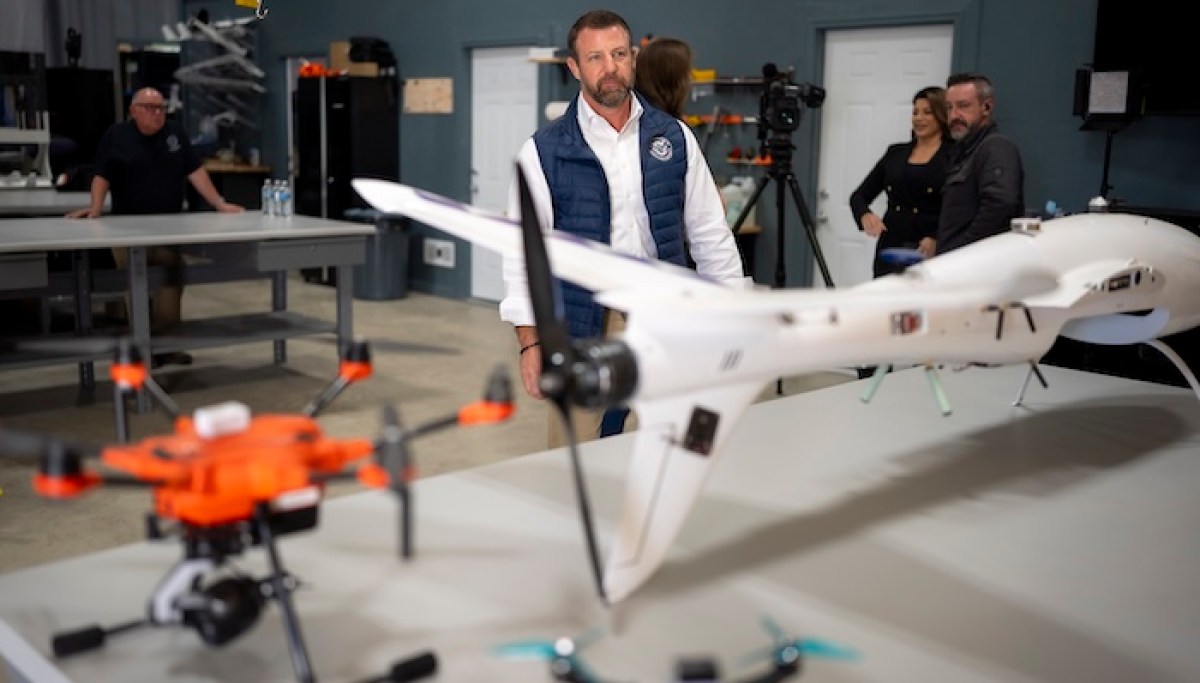
A day before the Federal Aviation Administration’s nationwide ground stoppage last Friday, Homeland Security Secretary Markwayne Mullin traveled to his home state of Oklahoma to stop in on the department’s Kinetic IV Counter Unmanned Aircraft Systems Test Event at the Choctaw Nation of Oklahoma Emerging Aviation Technology Center.DHS tested several different types of emerging technology to stop incoming drones or drone swarms during the two-week-long exercise, but the primary focus was on kinetic interceptions, where an interceptor is fired at an incoming drone with the goal of hitting it and having both explode on impact.“The bulk of these were devices that will accelerate and impact the UAS system,” Pedro Allende, Undersecretary for Science and Technology, told Pentagon Posture. “So direct kinetic impact. There were a couple of net-based interceptors. So fly behind or around, deploy a net, capture, and bring it down to the ground safely.” Secretary of Homeland Security Markwayne Mullin observes a Counter-UAS Kinetic IV demonstration at the Choctaw Nation Emerging Aviation Technology Center in Stringtown, Oklahoma, Nov. 12, 2026. (DHS photo by Tia Dufour) DHS uses a lot of electronic mitigation tactics for their counter-drone defense, “but being able to kinetically mitigate is a tool that we would like to bring to the arsenal in the event that the other more conventional approaches are not meeting the mail on a particular scenario,” he explained.The center, known as the “Daisy Ranch” test site, is on the Choctaw Nation of Oklahoma reservation, and it’s the only tribal-owned FAA-designated drone testing site. The facility sits on more than 44,000 acres of tribally owned land under sovereign jurisdiction in southeastern Oklahoma, running along the state’s borders with Texas and Arkansas. While this exercise was the fourth of its kind, this was the first time it was held at Choctaw Nation’s EATC.When Mullin represented Oklahoma in the Senate, he helped pass the regulations that made Choctaw an eligible choice.“He set the legislation in place that allowed the Emerging Aviation Technology Center at the Choctaw Nation to serve as a federally designated testing site,” Allende said of Mullin.DHS does not have the exact same counter-drone needs as the military due to different operating environments. For example, it has to work with the FAA to safeguard commercial air travel from non-law-enforcement drones, as well as from anything law enforcement uses to stop one.DHS is responsible for keeping people safe from threats at large events, like sporting events, concerts, parades, rallies, and more. Event organizers, where there are large gatherings of people potentially at risk, can submit a notice to DHS’s Office of Operations Coordination, where OPS will then apply a risk-based methodology and assign them a Special Event Assessment Rating. Secretary of Homeland Security Markwayne Mullin, not shown, observes a Counter-UAS Kinetic IV demonstration at the Choctaw Nation Emerging Aviation Technology Center in Stringtown, Oklahoma, Nov. 12, 2026. (DHS photo by Tia Dufour) “I think you know the domestic use and the use to protect the forward operating base is pretty different,” Allende said. “I think if you look at scenarios for SEAR events, you know, national security events, it’s important to bring down the threat, but it’s also important to bring it down in a way that mitigates potential impacts to folks that may be below.”If you’re talking about a stadium, you don’t want to bring that over people,” Allende added. “The collateral damage is something we want to minimize, mitigate, and frankly eliminate.”Sporting events as possible targets There were several large events over the summer — America 250, the World Cup, the Freedom 250 Grand Prix, and UFC Freedom 250 — that largely proceeded as scheduled without incident, as DHS had hoped.During the World Cup alone, DHS brought down about 2,000 drones and confiscated 700, Allende explained. Law enforcement had put up strict no-drone regulations near stadiums and fan zones, which were designated areas fans could watch games outside of the stadiums.With those events over, attention has already moved to the upcoming major ones, like the 2028 Summer Olympics in Los Angeles, California.“We’re already all working together to make sure that LA ‘28 is secure,” Amy Szestak, special agent in charge of the Secret Service’s Office of Administration, said on a panel during a GDIT Emerge event last week. “The relationships are in place to have those conversations, whether it’s resourcing or just, ‘how would you do this,’ or ‘how would you handle this from a large event perspective?’”Not every sporting event garners as much attention as those do. A majority of the NFL play their home games in outdoor stadiums, and it’s the same way in Major League Baseball. There are a lot of games in these stadiums every year, but these, too, are sadly all possible targets.“I think it really depends on the rating of the event and the resources available. Obviously, we’re not in a position to protect every event,” Allende said. “The reality is that this is a a game of resources, collaboration, working with the private sector, DHS, the owners and operators of events, the owners of the football teams. We all have the same interest in protecting Americans in attendance, and I think there’s going to be a balance where I think you’re starting to see some private sector entities taking on the drone protection mission… of their own accord in coordination with our teams.”PENTAGON POSTURE — CAO’S CONFIRMATION HEARING PROVIDES RARE PUBLIC ACCESS FOR SENATE LAWMAKERS TO ASK ABOUT IRAN WAROne of the main areas of continued development for the drone industry is bringing down production costs. Drones, especially the smaller ones, are viewed as attritable — or cheap enough that losing or destroying them is not a financial burden but expected. Like bullets, one-way attack drones or drone interceptors are most often viewed as one-time-use equipment. So, there will be an evergreen push to make them cheaper as the technology evolves.“I think the threat evolves, and so we have to evolve with it. And I think being nimble, aware, and almost zealous in finding out what that next thing is going to be is going to be key to the success of this mission,” Allende said. This is Pentagon Posture, written by senior defense reporter Mike Brest. You can follow me on X at @mikebrestdc, my email address is mbrest@washingtonexaminer.com, and I can be reached on Signal at mikebrest.80. Send tips, suggestions, calendar items, or just talk sports with me. If you aren’t already subscribed, do so here, and if you are, sign up a friend!
‘The threat evolves, and so we have to evolve with it’: DHS tests counter-drone weapons on reservation with focus on kinetic options
Full Article
Original Source
Read the full article at Washingtonexaminer →KhanList aggregates and links to publicly available news content. We do not host full articles from third-party sources. Always verify important information with original sources.