
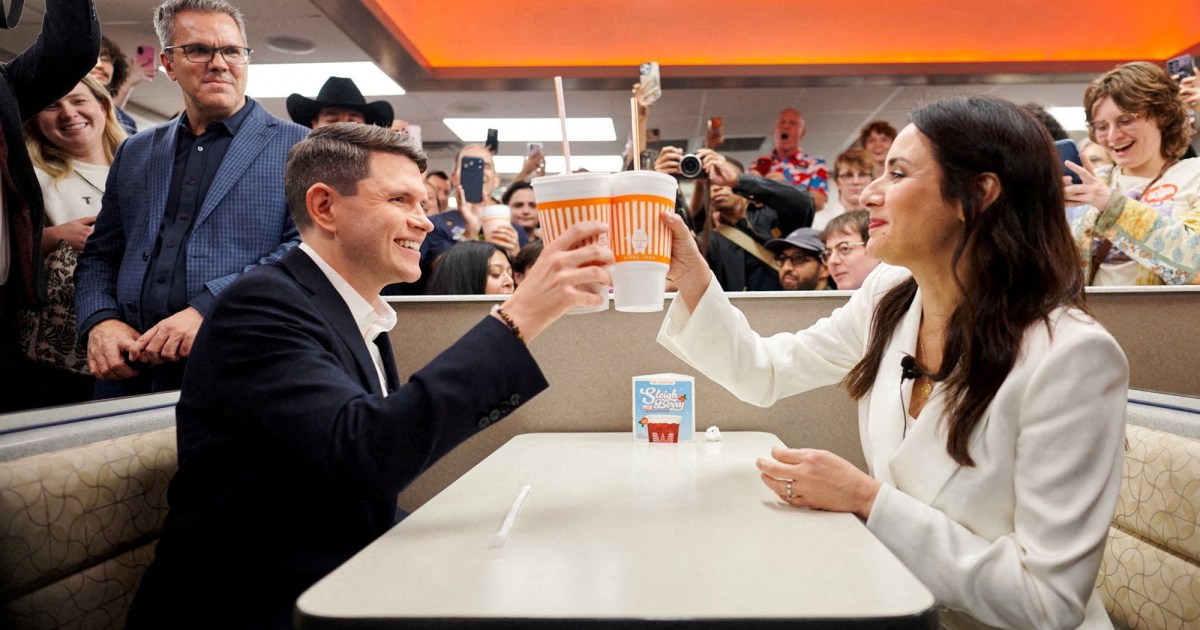
Get your news from a source that’s not owned and controlled by oligarchs. Sign up for the free Mother Jones Daily. “And the rain descended, and the floods came, and the winds blew, and beat upon that house; and it fell: and great was the fall of it.” — Matthew 7:27 “I hate the corpses of empires, they stink as nothing else. They stink so badly that I cannot believe that even in life they were healthy.” — Rebecca West “Defend Bo French like the Alamo.” — Jack Posobiec A long time ago, back in Mexico, a distant relative of mine met La Llorona and died of fright. This kind of thing occurred more often in those days than it does now, although it did not exactly happen every day. He encountered a woman in white out on a path one night, alone in the silver-mining country where they lived, and was never the same when he returned—just withered away, they say, as if the light had gone out of him. I don’t know much more about it than that. But I’ve sometimes wondered what his face looked like in those final days, as he processed his encounter with that tormented spirit. Late on Tuesday night, watching Ken Paxton address his supporters after conceding the Texas Senate race to James Talarico—effectively handing Democrats control of the Senate, humiliating the world’s richest man, ending three decades of unbroken Republican dominance, and remaking the map that has anchored American politics for a generation—I wondered if it might have looked a little bit like that. Make no mistake: Blue Texas is a seismic event in American politics. I know this because I can count, and because Republicans have always said it would be, when they were not too busy gloating that it would never happen. Elon Musk warned that Talarico would usher in the end of the American experiment. Ted Cruz said that “if Texas falls, everything changes.” Texas has fallen now, in almost every conceivable way. Gina Hinojosa defeated three-term Gov. Greg Abbott. Democrats are poised to flip all 17 statewide offices that were on the ballot and take control of the Texas House of Representatives for the first time since 2002. They could net one seat in Congress from a map Republicans just redrew to flip five. Democrats went into Election Day cautiously optimistic. They ended it with the single most shocking set of results, at scale, that I have seen in my lifetime. In the weeks to come, there will be efforts to rework what just happened into more comfortable and familiar frames. In some corners of X, they are probably already underway. It was a bad year. Paxton, in particular, was a bad candidate. But Republicans ended up with a bad year, and frankly a whole bunch of bad candidates, because of processes that Republicans set in motion months, years, and decades ago. Texas Democrats broke the map. Texas Republicans broke themselves. This was about so much more than the Senate race. But let’s talk about it for a minute, because it’s instructive. Paxton was a frequent subject of discussion in the most expensive Senate race in American history but a mostly passive participant in the campaign itself. He refused to debate. He spent a significant amount of time overseas and at resorts. He partied with fugitives in Dubai, and with a woman who is not his wife. No, not the one who got a job with a donor Paxton was impeached for doing favors for—the one he was in London with on the Fourth of July when a tourist accused him of trying to take his phone. On at least one occasion, Paxton appeared to have showed up fresh from the golf course, in an untucked Four Seasons Orlando polo shirt. Political expert here: Candidates don’t usually do this. Paxton raised very little money, and some of what he did raise came at an intimate closed-door gathering in Washington, DC, where his comments were recorded and slowly leaked, like a bag of flour the mice had gotten into. Every few days you’d get another secret tape—Ken Paxton talking about cutting Medicare, Ken Paxton venting about Donald Trump, Ken Paxton complaining that Beltway insiders ran his campaign, Ken Paxton talking about how he’d gotten a 60-day sentence for a child molester. Whoops, that last one was at a public event; maybe he should have golfed more. Elon Musk warned that Talarico would usher in the end of the American experiment. Ted Cruz said that “if Texas falls, everything changes.” Texas has fallen now, in almost every conceivable way. Instead of traditional fundraising, Paxton’s campaign was almost entirely funded by super PACs, which were in turn funded—to the tune of $212 million—by Elon Musk. It was a better fit than either of their previous marriages, anyway. Paxton did not exactly go out of his way to dispel Talarico’s warning that Musk was trying to buy “his own personal US senator.” In the final days of the race, his office announced that it was suing one of Musk’s chief rivals, OpenAI, over unsafe business practices, while Texas Monthly reported that Texas officials were considering selling an entire state park to Musk so that he could expand the footprint of his private space company, which is next to his private town. That was what they went with in an election defined by affordability and corruption: a trillionaire and a crook. Losing the plot doesn’t begin to describe it. How did they end up here? On a Saturday in late October, after getting escorted out of a Paxton rally in Rockwall for filming the free donuts in the back (they were never going to catch the leaker with that approach!), I spent the better part of an afternoon about 30 miles west, in Dallas, at the campus of Southern Methodist University, to consider how this era of Republican rule in Texas began. There was a brisk game-day crowd at the George W. Bush Presidential Center. When I settled in to watch the introductory video in a small theater, only a handful of empty seats remained. The museum is a memorial to the things that buried us. Condoleezza Rice narrates a video that addresses the “many critics” and makes the case, one last time, for what she will never ever call torture. A Florida butterfly ballot sits behind glass, near a TV that shows James Baker making the legal case for Bush–Cheney. There is an interactive exhibit where you can sit in a command center and see how you’d do responding to Hurricane Katrina. The Bush Center will not make you miss him. Not even close. But it also offers a snapshot of his party at an increasingly unrecognizable moment in its trajectory. The model Oval Office is un-bedazzled, and there’s a Tom Lea painting on the wall that depicts the Rio Grande passing through roughly the spot in the Big Bend where Trump just tried to build a wall. The opening video features pro-democracy demonstrations in Ukraine. Large exhibits inside focus on bipartisan education reform and the work of USAID. The WASPy appeals to service and “compassionate conservatism” that infused Dubya’s speeches seem to be written in a kind of obsolete vernacular, wholly unfamiliar to anyone who watched Donald Trump stump for Ken Paxton by touting Jon Husted’s ass. The man who defeated Ann Richards in 1994, and who cemented one-party rule in the state during his presidency, billed himself as the “education governor.” He touted his bipartisan credentials and won nearly half of the state’s Hispanic voters in his reelection campaign four years later. Bush modeled a particular kind of Republican Party—pro-business, pro-tax cuts, pro-immigration (to a point), and at least nominally pro-education. I don’t have to tell you how that all turned out (don’t worry, the Bush Center won’t really tell you either), but you can’t help but look at it and think about what animates the Republican Party in Texas today. What I saw in Texas this year, though, sounded different from the campaigns I’ve watched fall short before. Democrats had evolved. Look upon the slate that lost last night and you can see the products of an assembly line that stopped working but that no one had the inclination to fix. If anything, the incentives are quite strong to just keep making defective toasters. The losing candidate for Railroad Commission was a Rhodesia-posting bigot who called for 100 million people to be removed from the country—and every major Republican candidate endorsed him. The losing candidate in a Republican-leaning House district in West Texas—who also posted about Rhodesia—hosted a YouTube show about guns and referred to babies as “cum trophies.” In February, the family of now-defeated Republican nominee for comptroller Don Huffines literally bought Jeffrey Epstein’s ranch. We’re getting a bit far afield from presidential library territory. As Texas boomed and grew more diverse, its leadership increasingly turned inward, fixated on power grabs and donor service and culture wars and well-funded primary challenges. In 2023, rural Republican lawmakers defeated a donor-backed voucher bill. Before the next election, a billionaire from Pennsylvania gave Greg Abbott $12 million to replace them, and the legislature tried again. By this fall, the Texas GOP was running against the Texas boom itself, with Paxton serving as an attack dog against businesses that crossed his party and conservatives closing ranks behind Bo French, the aforementioned nominee for Railroad Commission, after he complained that the presence of Indian Americans at a football game was a sign of societal decline. This was too much for Karl Rove, but the party had long since moved on from people like him. The MAGA influencer Jack Posobiec put it simply: “Defend Bo French like the Alamo.” Texas Republicans couldn’t see where all this was headed, but Democrats could. The story of last night was how the state’s historic losers had evolved, too. After the 2016 election, as national Democrats dispatched crash investigators to speak to white people in diners about what mattered to them and why, I looked at the map and saw something else. There had been a blue undertow in Texas. Congressional districts that had been carved up to vote Republican had swung sharply away from the party. A big suburban county outside Houston, Fort Bend, had suddenly flipped. I drove around the state and had coffee with Rep. Beto O’Rourke at his kitchen table in DC, where he told me that the math didn’t really make any sense but he thought he could beat Ted Cruz. We put the story on the cover, with the headline: “Want to Stop Trump? Texas Is the Key.” Well, it was rough going there for a minute, but here we are. This was not a prediction, mind you. The point was not that a blue Texas was inevitable, but that Texas was. We were just so far past the point of writing it off as a red state that did red-state things, like some large and mutant Oklahoma. (A very interesting state, actually.) Texas was the future. There was no world in which it did not determine what America would become. It was younger and far more diverse than the country as a whole, and it was growing at a faster rate than almost anywhere else. Every year the median American voter was inching further and further away from Eau Claire, Wisconsin, and closer and closer to some subdivision in Collin County. To break out of the era of American politics we had just entered, you had to figure out what kind of politics and what kinds of candidates might finally get through to the people who would decide these elections. Because if you did not solve for Texas, you would be tormented by it forever. That was always a possibility, too. The theory of how you might solve it has evolved over time. There used to be this sense that a moderate, business-friendly kind of Democrat would have to do. Why not? It works in North Carolina. When liberals and their money, awash in the dream of large-scale organizing, began to look more closely at the prospect of flipping Texas in Obama’s second term, they adopted a somewhat different theory of the case—that there was a sleeping giant electorate that just needed to be awakened, a hidden Obama coalition. I sat in a conference room in DC in 2013 and watched a group of people who had just reelected the president walk reporters through the math. Texas was “never a Republican state, it’s just a George Bush state” was out. “Texas is not a Republican state, it’s a non-voting state” was in. If Wendy Davis chose a particularly catastrophic year to test this thesis in 2014, it genuinely felt pretty close to coming true four years later, when O’Rourke came within less than three points of beating Cruz. Democrats flipped 12 seats in the Texas House. They took full control of most of the state’s biggest counties, contested the suburbs, and rebuilt their bench with a hungry and diverse slate of political newcomers. One of them was elected to the US Senate last night. Another—Jon Rosenthal, a mechanical engineer who’d co-founded an Indivisible chapter in Houston—just won a seat on the Texas Railroad Commission. That was the high-water mark for a while. What resonated in Trump’s first term aged like milk in the Biden years, and the belief that maximizing turnout would necessarily redound to the party’s benefit, or that unabashed progressivism was what the silent majority really wanted, didn’t hold up great either. Democrats still repeated the mantra, of course, but it was more out of defiance and muscle memory than pure belief. What I saw in Texas this year, though, sounded different from the campaigns I’ve watched fall short before. Democrats had evolved. Talarico and Hinojosa made the case against Republican rule in a ruthlessly disciplined and uniquely relevant way. Their messages were essentially the same. Hinojosa told audiences that “we pay more and we get less” because “we are all paying the Greg Abbott corruption tax.” Talarico told voters that “we have an affordability crisis because we have a corruption crisis.” Their prescription was a populism that was not rooted in doctrinaire lefty politics, but that simply put a name to the squeeze people were feeling and told you who to blame. There were also some compromises. The tenor of these races was not the same as it was eight years ago. Identity was not absent from the Texas results by any stretch—the backlash to Callais, a rejection of the mass racial profiling of Latinos, and a revulsion at rising anti-Asian bigotry all played a part here—but the contours were different. Hinojosa practically never mentioned that she would be the first Latina governor of the state. Once known as a progressive legislator from a “blue dot” city, she told me that the culture war was unwinnable and avoided abortion rights almost entirely. How that plays out when Democrats control the government remains to be seen. But the party’s avoidance of culture-war issues made the Republican fixation on them all the more glaring. Democrats changed, even in the ways they finally opted not to, happily backing “pocketbook” moderates in districts where progressives had once dreamed of taking over. Sometimes you have to go to war with the Henry Cuellars you have. In its final days, the Texas GOP waged an extensive war on metaphor. Organizers brought a real live elephant to their convention this summer, and it pissed on the floor. Paxton announced a bus tour that was originally scheduled to end at the Alamo, the place where everyone died. Red Texas fell, in the end, as all great empires eventually do, in bits and bobs and sudden clangs. The myth that sustained it lost its shine. People started to die of the things they shouldn’t have. Their rulers became consumed by the struggle to control their borders, and their people. “Fewer had more.” And then one day, as a favor or on a whim, out of boredom or out of spite, a mad emperor tried to send his favorite horse to the Senate.
The Texas Miracle
Full Article
Original Source
Read the full article at Motherjones →KhanList aggregates and links to publicly available news content. We do not host full articles from third-party sources. Always verify important information with original sources.