
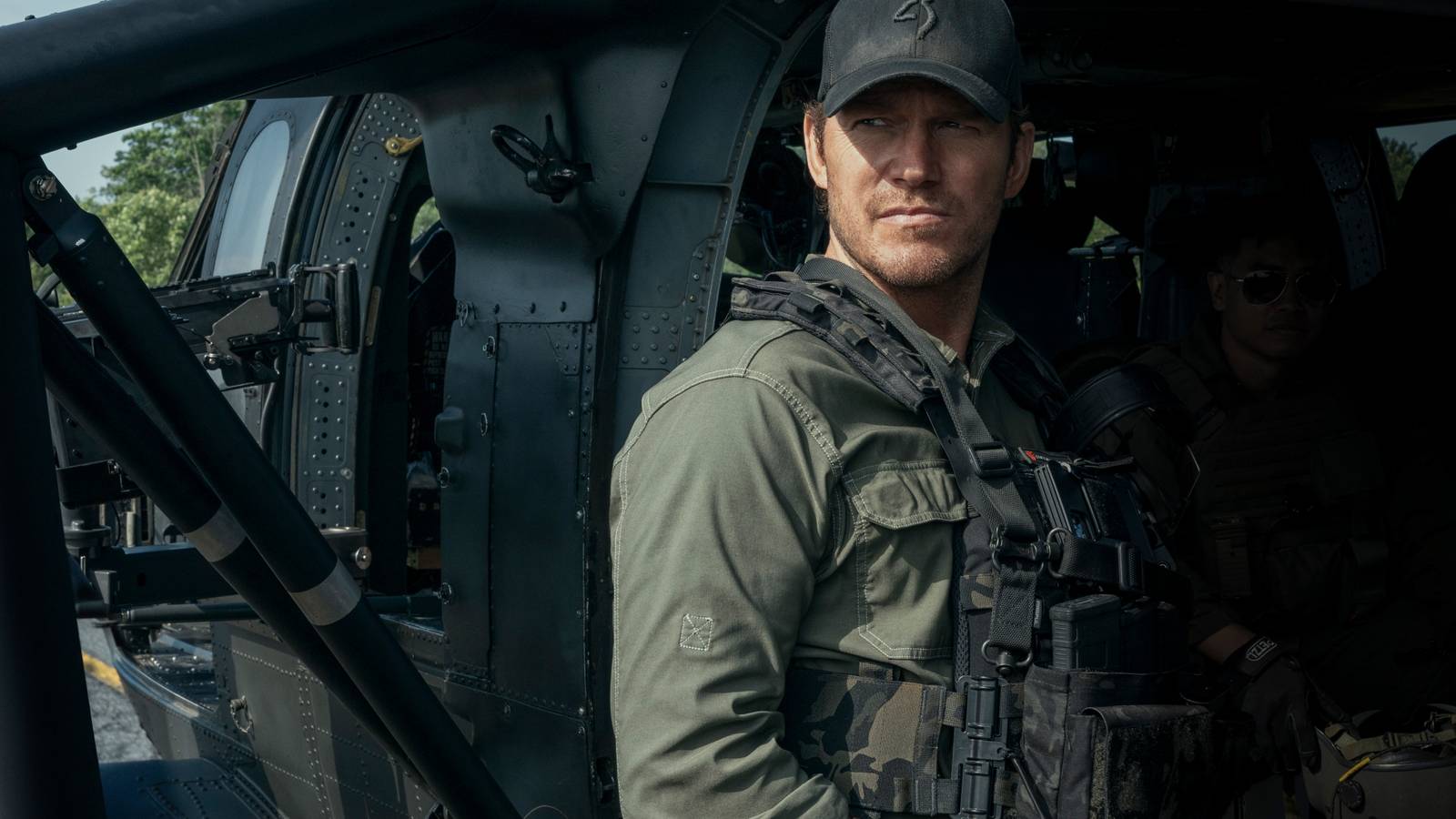
Published Oct 19, 2026, 2:21 PM EDT In our exclusive cover story, The Terminal List's cast, showrunner, and author talk us through the return of Prime's explosive action thriller. Inside The Terminal List Season 2: Chris Pratt On Reinventing James Reece & Building A Bigger Universe Four years after Chris Pratt's James Reece completed his kill list, The Terminal List is finally back for Season 2. In the years since the hit Prime show's debut, Jack Carr's cinematic universe has already expanded with prequel series Dark Wolf, and now the main show is taking Reece's story in an entirely new direction and similarly international path. Based on Carr's second novel, True Believer, Season 2 brings Reece back into action as he continues to reckon with the ticking time bomb in his head and the ghosts of his past. Reunions are in order too, as Dark Wolf characters Lieutenant Raife Hastings (Tom Hopper), Major Mohammed "Mo" Farooq (Dar Salim), and Jules Landry (Luke Hemsworth) are making the step up, while Constance Wu is also back as intrepid reporter Katie Buranek. The upcoming season, which debuts on Prime Video on October 21, has been a labor of love, and the message that repeatedly comes up is one of authenticity. The Terminal List feels like more than an exercise in entertainment: it is a meticulously crafted machine, relentlessly prepared, and focused on honoring not only Carr's novels, but the military personnel who have responded so positively to it. But how do you build on The Terminal List and Dark Wolf's success? As with everything in this calculated universe, it's just a matter of being precise. It's a military operation, and the eight explosive episodes that will take us back into the fractured mind of James Reece are the result of a vast creative operation. For our exclusive cover story, ScreenRant's Liam Crowley interviewed The Terminal List star and executive producer Chris Pratt, showrunner David DiGilio, author and co-creator Jack Carr, military advisor and executive producer Jared Shaw, and returning stars Tom Hopper and Luke Hemsworth. Together, they take us through the creative risks, the expansion into global locations, and the extreme tactical preparation of bringing The Terminal List back to screens. Step One: Re-Inventing Chris Pratt’s James Reece With Reece’s hit list completely checked off by the end of Season 1, the most pressing question was simple: what drives a man like James Reece to continue moving forward when everything he fought for is gone? For Pratt, returning to the character after four years wasn't without its difficulties: “Jumping back into a character after that amount of time comes with its own challenges." From the outside, at least, finding that psychological driver for Reece is an even bigger challenge, and that forms the core emotional spine of this season. Reece has lost his purpose. "It's very clear in season one what his motivation is, what his purpose is: vengeance," Pratt reflects. You can expect to see a different version of Reece: “It's a guy whose body has not died yet, but whose spirit seems to be willing to let go. But what I know about these characters, the more I spend time with these Navy SEALs, is that they don't have the quit button. They don't ring the bell. That's the difference between them and most people.” Pratt paints a picture of stubbornness trumping a lack of purpose, and confirms the first episodes will see Reece searching for that reason to keep living. “He no longer serves his country, and the apparatus that made him a wanted man now needs him, but they can't control him or rely on him. I think in the first episode, it's just survival, just getting to the next X. And then in the second episode, it's like his purpose is just to find some semblance of life and be a warrior in a garden. And then in the third episode, which is where the conspiracy and the purpose of the rest of the season takes off, he's given an opportunity to clear his name and try to gain some semblance of life back by working for the CIA. And so the purpose is something he's always floating around, and he's always chasing the stars." There is, of course, also the issue of Reece’s ongoing medical condition: the brain tumor that presents a complex psychological dilemma for the former SEAL commander. There’s been no medical miracle between seasons, and the tumor will play a significant part in Season 2. As the trailers reveal, Reece is still struggling with hallucinations, allowing Taylor Kitsch's Ben Edwards to return while forcing Reece to relive his traumatic past. It’s a curse and a blessing, particularly when he’s presented with more information that completely changes things. Pratt describes two phases of Reece's condition in Season 2: “There's unmedicated, untreated, and then being able to treat it. And then ultimately, Reece learns that the bodies of his men were exhumed, and they realized that most of these tumors would've been operable. And so there's an 85 percent chance this type of tumor can be operated on. There's an opportunity for the Agency to say, 'Hey, listen, if you play ball here and help us out, we will then give you this operation that might heal you.'" An old-fashioned Faustian bargain. Reece is living in a traumatic new reality, alongside his hallucinations and other complications, but when his self-imposed exile comes to an end, things change again. Everything takes on a more fundamentally existential spin. “Once he's back on mission, he's back on his medicine, he's able to subdue those symptoms. And then the question is, at the end, does he have anything left to live for? Does he want to live?” “That was really the arc of the character through the course of the season, was determining whether or not at the end, should he make it through against all odds and save the day and be given the opportunity to have a new lease on life? Is there anything left for him to live for? And does he want that?” Reece’s current medical condition has a tragic upside; even if the tumor is killing him or comes at an unthinkable cost, it’s also a means to connect with what he lost: “part of him wrestles with the idea that if he gets rid of these tumors, maybe they have led to these hallucinations and these confusions and these images of his family and his men. Does that mean that he'll lose contact with them? And so that was something to play as well. He wasn't sure he wanted to be healed, because at least with the symptoms of this tumor, he was able to see his wife and daughter periodically.” For Carr, it was paramount to honor Reece’s experiences in the first season. His odyssey across the sea, shown as part of the marketing and the reason for Pratt’s radical new look at the outset of Season 2, is a means to avoid frustrating the audience by simply dropping him back into action immediately. Carr describes Reece’s journey as his learning to live again: “I thought it would be disingenuous to the reader to just drop him into Mozambique or drop him into Morocco or wherever it was going to be and go off to the races and just pay homage to the first season or the first book, what he was dealing with in there with a sentence or two. He has to deal with the fact that he's going across the ocean. He has to deal with that in Mozambique. He has to deal with it in the season of the show. Readers who have read Savage Son will know the resolution or how that plays itself out. But it certainly is still something that he's dealing with very actively in the pages of True Believer and on the set of the show. So it's certainly there." Step Two: Giving Reece A New Team For The Terminal List Season 2 At the end of The Terminal List Season 1, Reece has allies, but he doesn’t really have a team. Edwards is gone, his relationship with Buranek is shattered, and he’s on his way to Mozambique. And as much as he makes an excellent lone wolf, The Terminal List works best as an ensemble piece, and happily, some familiar faces are back. Season 2 is, of course, more than just a continuation of the exceptional first season; it also builds directly on the expanded lore introduced in 2025’s Dark Wolf. Connecting the stories of both shows means expanding the universe and changing the character dynamics, not least because the success of Dark Wolf presented an opportunity to give the audience more of what they loved. Dark Wolf was never a bonus: for Pratt, it was an operational necessity, because of how important Raife Hastings, in particular, is in True Believer. “From the producerial side, it was essential that we introduce some of these characters in Dark Wolf. This season is an adaptation of the second book, True Believer. And in that book, which works really well on the page, there are all these flashbacks for Raife Hastings and James Reece to have history.” Expanding that backstory in just 8 episodes of Season 2 would have proved challenging. “You're learning about them. It's them in college and them on these elk hunts, and they call themselves Blood Brothers. And so you get all of this great story to help develop their friendship.” Dark Wolf provided Pratt with the chance not only to give us more of Ben Edwards, but also to organically introduce Jules Landry (Luke Hemsworth), Mo Farooq (Dar Salim) and Raife Hastings (Tom Hopper) before they become instrumental in Season 2. DiGilio underlines the same point: “Backstory is a really hard thing to achieve well in a thriller genre as you have constant momentum and push forward. We knew Dark Wolf would be utterly essential to introduce these characters. We had to know them. We had to understand where they were coming from in order to understand where we find them in Season 2.” According to DiGilio, Dark Wolf also allowed for an organic shift in genre from a tight vengeance story to an expansive, globe-trotting espionage thriller. “That was your taste of that transition. Jack had always written this book to be a moment where James Reece moves out of this deeply personal quest for vengeance and this kind of psychological thriller into this globe-trotting search for someone he had worked with, Mo Farooq.” The second season puts Farooq firmly in the crosshairs, and Reece’s relationship with him proves key: “Reece is really the only person who knows Mo well enough and who has the ability to think where Mo might be, where he might be going. He becomes part of this machine with the CIA, with special operations, with the very things that had turned against him, and he has to learn if he can trust that machine, that organization again." Step Three: Give Terminal List Fans More Of What They Love DiGilio says Dark Wolf’s reception revealed the pleasant surprise that there were other characters the creative team fell in love with that they wanted to bring back as a result. Without compromising the show’s faithfulness to the source material, they found willingness to embrace the difference between the Jack Carr literary universe and the Jack Carr cinematic universe. “We have the ability to dive into characters in a different way than they appear on the page, or in the case of Dark Wolf, to create characters that share that DNA and then explore them more throughout the shows. Fans will see a few of their favorites from Dark Wolf showing up during the season as well." One of those favorites, as already mentioned, is Tom Hopper’s Raife Hastings. Hopper reveals that the time jump from Dark Wolf meant dialing into who Raife Hastings has become since his operational days, after six or seven years out of the game. “The big thing I wanted to do with research into was learning who are these guys when they have to go into the normal world and operate in, for lack of a better word, a regular job? And who is Raife in that world?” The new Raife is a fish out of water, struggling to operate, but still committed to the ethics and morals he had in the military, and that doesn’t always translate. “Sometimes that just doesn't work like that in the real world.” “I think the big thing with Raife is that he's a truth seeker, and that's why he and Katie combined so well in this season. They're both very similar kinds of people, really, and they protect the people that they care about. In terms of the adjustments I had to make, it was really just about figuring out who Raife is outside of that operating world." As well as the new class, some of Reece’s old teammates still have a presence. Edwards is back, but so too is Jared Shaw’s Boozer. "This season, unfortunately, we're back into the present timeline, and Boozer's not with us other than flashbacks and all." He gives us a little more insight: "The audience will see a scene with Boozer in this one that I've already warned my mom; she may not want to watch that scene. It's a pretty dark, rowdy moment, but to be able to live in that moment and experience that, and in the scene playing opposite Pratt as Reece, it's a powerful scene. It's quick, but it's powerful. And so just an opportunity to sink my teeth in a little bit more on the Boozer role." Boozer isn’t in the second book, but the message here is that the cast balance has undergone changes that feel reactive. As DiGilio notes, "Raife Hastings is a perfect example, by the way. He is barely in book two. We saw the connection between the fan base and Tom/Raife coming out of Dark Wolf. There was so much chatter about him. We expanded Raife's role in Season 2 and really built a conspiracy that Raife and Katie can chase down together. That's an example of how we look at the cinematic universe slightly differently than the book universe. The book gives us these incredible characters, but sometimes the connection between the fans and these characters presents us with totally new storylines to follow." That approach has the backing of the author, as Jack Carr enthusiastically supports this expansion: "There are some that are just mentioned a few times in True Believer that have bigger roles. But of course, everybody wanted to see more of Raife Hastings. And of course, Tom Hopper just crushes. When I post anything about Tom Hopper on social media, 100 percent of comments are applause and there's usually 5 percent saying that he should be the next James Bond. He gets a bigger role in this than he has in the book." Luke Hemsworth’s Jules Landry also gets more screen time after he worked so well in Dark Wolf: "My character is almost a footnote in True Believer. He comes in for half a chapter or a chapter and then leaves. I was very lucky to work with Jack and Dave to really lean into fleshing this guy out, making him feel authentic, but also have a point of difference to everyone else. It's what you always hope for. You always want more; you want more scenery; you want more meat. It's a really cool vindication and a reminder that I'm on the right path some way or another. I don't have to go back to floor sanding and digging holes just yet." And while he’s involved, Taylor Kitsch’s presence was missed, particularly by his Dark Wolf costar Hopper: “We built such a great friendship on and off the set, and not having him there to go through those experiences was tough for me as Tom Hopper, because I missed him being there all the time.” That dynamic might play into Raife’s emotional backstory, too, and Hopper says the brief reunion when Kitsch was on set for Reece’s early hallucinations of Ben helped his performance: “Raife is still dealing with all of that. He's still dealing with everything that happened with Ben, and we are making the pretty educated assumption, and I've had it that way in my head, that he never saw him again.” Dark Wolf’s ending saw the two men splintered after Raife walked away, though it was revealed he sat on overwatch for Ben from a distance: “That was the end of their friendship, that was the end of their brotherhood, and I think he's always had that lying very heavy on him, but then ultimately he was kind of right with what happened." What Raife Hastings & Jules Landry Bring To The Terminal List Season 2 As well as revealing the uncomfortable reality of Raife’s life removed from teams, Hopper eloquently lays out his character’s unique psychology. "The Mitulivu, which translates to the calm one. That's a fundamental part of Raife's character and where he's from and the way he's been raised and being a hunter and that sort of steady, calm, calculated, long vision of everything.” If Reece was defined by moments of explosive violence and emotion, Raife is a different animal, though Hopper underlines that “there are moments of fire.” “What I love about getting to play Raife is that kind of raging river underneath that I'm always pushing down, pushing down, pushing down, pushing down, but it's wanting to come up all the time. It's always there, but the fun of it is getting to keep it down and keep him calm because at some point he's going to pop. So he has a few moments this season where we get to see that, and it's really fun to bring that out because it's legit when it comes." For Luke Hemsworth, playing Landry provided a crucial opportunity to inject vibrant personality and humor into a heavy narrative. In Season 2, Landry has progressed and is leading a team for the shady Ground Branch — the same organization that recruits Ben Edwards at the end of Dark Wolf — and Hemsworth sees him as someone far better at manipulating than he perhaps lets on. “He's actually using this form of humor as deflection to lower people's guards to get inside, whether that works or not is another question. But he's obviously very successful at getting people to do things that are morally and ethically questionable, which is what you want through these roles. You want this, you want the time, you want the space to explore what it is for this guy to actually exist. It's like he's watching things from third person a lot." He also confirms he and Pratt share some incredibly intense scenes, for which Pratt charitably gave him space to play: “I was really touched, and I was very thankful that he stood back enough to really give me the freedom to open up.” There’s another entirely new face Hemsworth thinks everyone will love as much as he did, newcomer Gabriel Luna, who plays Freddy Strain, a former SEAL and current Ground Branch officer: “I became really close with Gabriel Luna, who again is just one of the most beautiful humans out there and just an absolutely wonderful talent. I love everything that he puts into that character. I think he's the linchpin of that whole series. I think he's just the heart and the soul.” Step Four: Adapting True Believer (& Deciding What Needed To Change) Can book fans expect to see a faithful adaptation of True Believer? Jack Carr, who is pragmatic about the reality of adaptation, says that generally, it's "pretty dang close. When you have eight episodes, about an hour each, and when you're telling this type of a story, it's pretty close, about as close as we could get. I couldn't be happier with how it turned out." But the challenge of bringing Carr's work to the screen is his eerie history of geopolitical prescience. Written years prior, True Believer featured storylines involving an impending conflict in Ukraine that has since become real-world history, requiring the creative team to cleverly adapt the narrative for present-day 2026. "If you go through his body of work over the past 10 years, the dude is consistently making predictions that come true," Pratt notes on Carr's writing. "When True Believer came out as a book, there was no war in Ukraine, but the premise of the book was that Russia was looking to invade Ukraine. And at the time that it came out, you're like, 'Oh, that's a little farfetched.'" Not so farfetched now. “That was something we had to adjust because the war was already happening, and we're trying to set this in contemporary America with the Bill Maher podcast and the Jocko Podcast and the various other trending algorithm-driven media sources saying, 'Where is James Reece?'" The Terminal List is designed to be grounded in today, in 2026 America, and another part of real world history plays into Reece’s complicated legend: “There was this sort of Luigi Mangione-type of cult worship around this guy, but then there's also a bunch of people who look at him as being truly a terrorist and an assassin and somebody who should be put in prison.” The specific details of a potential war in Ukraine had to change, though some details remain. David DiGilio recalls the exact moment the team mapped out this structural shift came in Budapest during Dark Wolf’s filming, where the creative team, including Carr, sought to tackle that very question. Instead, “peace in the Ukraine war becomes the goal, and the endgame to this conflict becomes the goal.” Beyond updating geopolitical realities, Season 1's massive success gave the team the creative currency to take even bolder swings with on-screen action and shock value. "I think if you look back at season one, there's a moment in the midpoint of that season that shocked viewers," DiGilio explains. "It's a moment where James Reece pulls out a tomahawk and does something that is pretty insane, pretty graphic, but rooted in his character.” That notorious moment required Pratt to personally convince Amazon to trust the creative team. As DiGilio recalls, “I remember Chris having to literally talk to Amazon and say, 'Trust us with this.'” The audience reaction justified it all: “We rooted it in everything that had happened to his character, and it's one of the moments that fans really talked about. They were like, 'Oh my God, I didn't think they'd go there.'” You can expect to see more like that in The Terminal List Season 2, with that goodwill in DiGilio and Pratt’s copybook: “To take stuff like that off the page and put it on screen and execute it, it requires a lot of faith. And certainly this season, we had a lot more trust, and we wanted to take bigger swings. I will say it's probably episode six this season where fans will see something they're not quite expecting." Carr goes a little further, confirming that earning the studio's trust unlocked classic moments straight from the page, including one that might just top Reece’s bloodiest kill: “The higher-ups at Amazon allowed us to take those risks in Season 1, and they paid off. We got to take more of those risks with Season 2. When we first announced that True Believer was going to be adapted next, one of the first comments was, 'Oh, they're never going to do X.' And it's a scene in there that people who have read the book will remember. It involves some piano wire. And that was one of the first comments. And so all I can say is, yeah, tune in." Step Five: Turning The Terminal List Season 2 Into A True Globe-Trotting Adventure The Terminal List Season 2 is about escalation. Where the first season was a domestic tale of revenge, the new season expands the canvas into a massive international espionage thriller. Over and over again, authenticity comes up as a priority for the creative team, and to retain that, the production eschewed reliance on digital backdrops, taking the cast and crew on an exhausting, multi-continent shoot. "I was just talking to someone on my team, Jane, who does my makeup, and she was like, 'I'm so glad we do that. I feel like no one gets to do that anymore,'" Pratt shares. "We did a big international TV show that felt very much like a big-budget movie.” The team went to North Africa, South Africa, London, and Canada. “It feels international; it feels big.” Expanding out beyond Reece also completely changes the storytelling dynamic. He was, in Pratt’s definition, an “unreliable narrator,” and this time, it’s very different, leading to a shift in the show’s genre, but not in its makeup. “Reece doesn't even really know what the heck's going on in his own life and whether or not he's potentially the one who killed his family. It's really dark. You're trying to find the story through that darkness. I think in the second season, we don't have that same apparatus.” “It doesn't fully switch genres because it's still a thriller, but it moves out into the world of spycraft and espionage and globetrotting stuff. Still, authenticity is our north star, and we weren't trying to make a big cliché spy movie slop. We really wanted this to be rooted in the actual lives of CIA spies and Ground Branch Navy SEAL operatives and people who really do this work because they are real.” There’s that word again: authenticity. Pratt says the commitment meant shooting Season 2 was incredibly complicated, with three different productions essentially on the go at the same time over the course of around six months. “It was a serious undertaking. Not only do you have James Reece's story, but unlike Season 1 where I'm almost in every single frame of the whole show, you have these B, C, and D storylines happening with Katie and Raife, and then you have our subplots with our bad guy, and there's just a bunch of different sh*t happening all over the place, and so it was wild.” It was a grind, with episodes written as others were being produced. Not cutting corners has its advantages, of course. DiGilio talks about how this physical commitment serves as the show's primary visual foundation, evoking how cinema has the power to take its audience to places they’ve never been. He, too, prioritizes in-camera authenticity, warmly talking about taking the crew to South Africa to double for Mozambique, working with Frog Squad - “one of the best aquatic units in the world” - for Reece’s ocean adventure, and visiting incredible areas of safari wilderness. He calls it a “four-year labor of love, a full year of production through three different production centers with smaller shoots, satellite shoots off of that." He’s also keen to clarify that The Terminal List does have an incredible visual effects team who handled the storm that opens the season for the sake of safety. For the actors, immersing themselves directly into these real environments elevated their performances. "What I love about the fact that this show does this is that when you're shooting there, the smells and the air and everything, it's all there," Tom Hopper notes on filming in Morocco. "There's no imagining this world. You are in it. You're there, and what it's like to be an operator in those environments. We're so lucky that we get to travel around like that on this show. It's high production value, and as actors, it's a gift really to get to go to those environments." Luke Hemsworth echoes that sentiment while describing the tight-knit bond formed on the road. "I'd never really experienced this, going to another country and distilling everything that you love into a little suitcase and trying to get by with the four or five t-shirts that you have for three months. What happened, I think, is that you inherently are with a whole bunch of people in the same position, and you can't help but gravitate towards each other and become a little family. And so nights become about working out together. All those spare moments become about eating, but about exploring the foods in these towns. Hopper's a big food guy, so we would eat our way around Toronto. Gabe loves the tequila. We would find all the tequila bars we could, explore the city that way. And then we got to Morocco, and I've never been to that part of the world, and it was just an absolute explosion, saturation of the senses, sights, the smells, the amount of people." The Most Important Step: The Terminal List Is Built By Veterans The Terminal List universe is built on an unyielding commitment to military authenticity, something that was also central to Dark Wolf, as explored in ScreenRant's previous exclusive cover story. Former SEALs are involved in writing, directing, producing, and tactical advising, while Pratt and his team enforce rigorous standards that elevate the action far above standard Hollywood fare. Executive producer and tactical advisor Jared Shaw outlines his strict training philosophy for the cast. Shaw took a more hands-on advising role for Dark Wolf and Season 2, taking over from Ray Mendoza. "Authenticity is key. And so with the actors on the training side, I always try to implement the crawl, walk, run process. And depending on their comfortability and previous training, and building the foundation with these actors, first and foremost, getting them comfortable. Some aren't comfortable with weapons.” Authenticity requires comfort. Shaw advocates a “no stupid questions” policy, he says. “Everything from houses to vehicles, all of is built on a foundation. It's no different with tactics and learning how to manipulate a weapon and make it become part of you. If the foundation isn't there, it's going to be very evident. And so being able to spend that time with them, build that foundation, and really have them understanding the why of what we're doing. If they can understand the why, they can implement the how.” There is a line, however. No matter how committed the series is to making as authentic an experience for watching veterans as possible, Shaw upholds rigorous commitment to one tenet: “There's certain things that I can't, and I won't, show, tactics-wise that could possibly put our men and women downrange still in the fight in any kind of danger, but we'll show them up to a certain level.” Shaw’s duty is to make sure the actors are so well-trained that their movements no longer look like choreographed action on the screen. He says the response from the military community has been a point of pride. "The numbers that we had of military veterans in front of and behind the screen was really awesome to see," he says. "And one that sticks out for me heavily is the fifth episode that was written by Kenny Sheard, who was a former SEAL, directed by Ray Mendoza, who was a former SEAL. I was a producer on it as a former SEAL, all based on a book written by Jack Carr, who is a former SEAL. I don't believe that's been done anywhere that I know of. I don't say that to pat ourselves on the back. I say that as a testament to Dave and Chris and Antoine and Kat for pushing to really try to nail that authenticity, and that's a big swing that they took, and it's really cool to see." It helps that the cast are just as committed to creating the best they can. “They were all willing to play ball. Everybody put their time and effort in. I can't speak enough good about the crew, and it's been that way every season as we've been blessed always to have a crew that goes above and beyond. They give everything they have in trying to capture just the authenticity and trying to capture what Jack puts in his books.” It’s got to the point, Shaw says, that they’re not acting anymore. “They're really just doing it. And that, to me, is the difference when I watch other shows. It's evident to me when an actor is just performing the choreographed moves. They're just flowing through a house and taking down rooms and doing what they're supposed to be doing.” He’s worked with Pratt for a long time, having first met him on Zero Dark Thirty, and then answering his call to come in for Jurassic World. The results of their collaboration are very clear in The Terminal List Season 2, but it’s clear it’s an ongoing process. Relentless preparation: high-quality output. “Over the progression of the seasons, I have been able to continue to refine my process to ultimately help them. We're just streamlining our process, which then really helps out on the performance side of the actors and making it all look as authentic as we can. I'm a student always and trying to learn how to be better and to teach better.” In seeking to find Raife, Tom Hopper turned to real ex-SEALs to match their experience. “The difference in this season was talking to them about when they're no longer operating. And a big part of that that I wanted to put across from talking to all these guys, these ex-SEALs and ex-servicemen, was missing it. You're looking for a mission; you want something.” Raife’s storyline this season actively embraces what he calls the helplessness of not being able to be active anymore. You get some idea of that in Shaw’s furious commitment to making sure The Terminal List is exactly what he, Carr, and all the ex-SEALs need it to be. The Next Step: What The Future of The Terminal List Looks Like Even with Season 2 to play out, the Terminal List team is far from finished. There’s already a long-term blueprint that stretches out well beyond the next 8 episodes. "When we started with Season 1 of The Terminal List, Chris basically said, 'Look guys, we're not just making a show. We're actually going to build a universe out of these incredible books and characters that Jack has given us,'" DiGilio reveals. That led to the creation of what the creatives call their 10-year plan, and fans of Pratt’s tortured hero can rest assured he’s at the heart of everything, as the showrunner affirms: “In that 10-year plan, there was the idea to always keep the James Reece flagship as the central spine of this universe. And I think, knock on wood, we'll be hearing some good stuff about continuing that.” If the show follows the trajectory of the books, the next chapter will be Savage Son, the third book, which was released in April, 2020. DiGilio knows how good that source material is, just as you do: “For instance, the fans of the novels know how good Savage Son is. It's the most contained of his books and just an adrenaline f--king thrill ride of a book.” Pratt, too, talks with confidence about the next steps, and it should be music to fans’ ears: "We're really stoked about it. I don't know if it's too early to say, but we know exactly what we're going to do next. This is not the last you'll see of these characters, not the last you'll see of James Reece. There's a ton of books left to do. It's obviously a huge undertaking, and it's one at a time, but I like the idea of going in order through the books." Tom Hopper has his own reasons for wanting to see Savage Son brought to the screen, not least because it was the first Jack Carr book he read. “I fell in love with it. It was my introduction to Raife. I would love to bring that to life. I think Savage Son is such a fun book and has such great moments.” It helps that it would expand on his character’s involvement: “Obviously, I'm biased because it has a great Hastings family storyline within it… I just think the world is only just being plucked at right now. There are so many more layers to peel off, and I feel like Raife is an onion with many layers that is ready to be peeled.” “We've only just started to learn about Raife, really, so it'd be interesting to have opportunities to go deeper into that." That expanded focus isn’t just limited to what’s shown in the mainline Terminal List books. One character who is important in Season 2 is Tom Reece, father of James and star of Carr’s 2025 novel Cry Havoc, which is set in 1968, when the elder Reece was a Navy SEAL sniper during the Vietnam War. DiGilio confirms we’ll see some of James’ relationship with his father: “Jack wrote a really cool book set in Vietnam about James Reece's father, who I think is part of the mythology of season two. Jack has flashbacks in book one and book two to James' time with his father. We lean into that, let's put it that way." Could Tom be the focus of a spinoff? It certainly seems the expanded universe will take in more projects like Dark Wolf as DiGilio lays out the blueprint: “We have characters, just a plethora of characters that are becoming so connected to the fan base that we start to ideate what if we do this character has a spinoff, or that character has a spinoff? So that stuff sits out there as well.” For Jack Carr, who gets to see his literary world evolve into a sprawling, interconnected cinematic universe, that spinoff idea is also compelling: "I would love to go right into Savage Son, of course, but we'll see. We're talking to Amazon about exploring all sorts of different characters.” He confirms “active conversations” and reveals his own blueprint for the Reece Shared Universe includes a few spinoff ideas that he’s been meaning to get to writing. Interestingly, there’s clearly an idea of reciprocal storytelling with the screen side of his world: “That's what was very intentional on my part in the show. I wanted to plant the seeds for characters that I could write about in the future that I'd be interested in exploring. So the whole James Reece's side, his dad and grandfather specifically, and the same thing with Raife Hastings, his dad, and grandfather. I would have two different lineages to explore going forward. So that was very intentional on my part, and we'll see what happens, but there's a lot to explore." As long as those family trees keep growing backward and forward, The Terminal List fans could end up with more than just the ten years of stories. The Terminal List Season 2 premieres on October 21, 2026, on Prime Video.
The Terminal List Season 2: How Chris Pratt's Hit Series Was Reinvented
Full Article
Original Source
Read the full article at Screenrant →KhanList aggregates and links to publicly available news content. We do not host full articles from third-party sources. Always verify important information with original sources.