
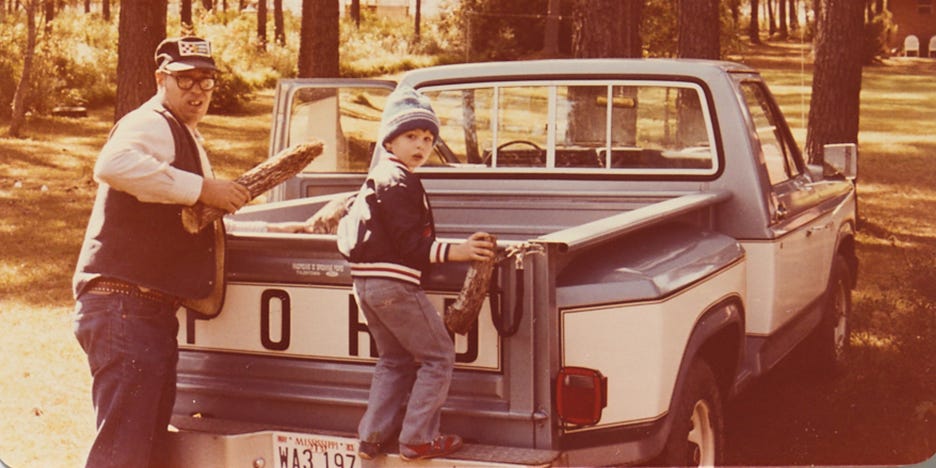
I lived in the same house from the time I was a small child until I was eighteen years old, but I never noticed the two battered shoeboxes that my father kept in a white wooden cabinet in his bedroom. My parents’ TV sat right in the middle of the built-in shelving. Above it were albums full of family photographs and my dad’s family Bible. Below it were two open-door cabinets. Inside, the shoeboxes. Every child knows there is a zone of privacy in their parents’ bedroom, a place where they keep things that don’t concern you, that pre-date you. So I never noticed them. But I wonder, knowing what I know now, if it’s also the case that some things can’t be found until a person is ready to find them.It was September 2022, when I was forty-four years old and my father, Victor Plohetski, was seventy-eight, that he told me about the shoeboxes. I arrived at his house—my house, the one I grew up in—and began what was, at that point, becoming our ritual. I met him in the living room in his oversize recliner, a chair he rarely left anymore. I unpacked my recorder and turned it on. I pulled out a yellow legal pad. I composed the questions I wanted to ask.I am a journalist by training, a journalist in my soul the way my father was a roughneck. For a month, I had been interviewing him, determined to understand more about his life. I wanted to answer a question that had plagued me since I was a boy: Why had there been such an unclosable distance between us?I grew up in Tylertown, Mississippi, a small dot on the state map with about nineteen hundred people and one stoplight, and spent most of my childhood on forty acres just south of town. I am gay, and as a child I was eager for people to like me, mostly because in that time and place being gay often led to taunts, ridicule, or worse. I remember adults—teachers, friends’ mothers, others in our town—using the same word to describe me: tenderhearted. I was keenly perceptive and deeply curious, and I wanted to understand the people who shaped my surroundings, in pursuit of safety and acceptance.My father was none of that. He was shut down, closed off, and sometimes easily angered. I was a frequent target. When he thought I was acting like a “sissy,” he added an a to my name: Tonya. When I fell in love with New Orleans, eighty miles to the south of Tylertown, for its spirit of openness and acceptance, he ridiculed me for embracing “the land of fruits and nuts.”It has become popular, especially among gay men, to cut off your family, to go “no-contact.” I never cut my father off, but for years I did something not far from it. Going no-contact is framed now—and I’m sure on some level, for the two decades that my father and I exchanged only niceties and small talk, that I saw it this way too—as a form of healing or self-protection. I understand that logic, but as a journalist it always sat uneasily with me. What I know how to do is the opposite: to ask questions that push past discomfort and bias and fraught relationships to peer into the complexity of the people underneath.Courtesy Tony PlohetskiAuthor Tony Plohetski and his father, Victor, in March 2019.I became a journalist in part because of my father. I liked that journalism allowed me to ask probing questions, to get at the heart of a person, and his was the most mysterious heart I knew. Behind his layers of emotional insulation, I sensed deep pain. And yet, although I have interviewed many challenging subjects—a grieving father who tragically forgot his eighteen-month-old son in the backseat of a hot minivan; a police officer who accidentally ran over and killed his partner, a young mother—I had never asked these kinds of questions of my father.But now, here I was. In the last year of his life, I interviewed him properly, like the subject of one of my stories. I wanted to unearth his formative experiences and try to understand how they impacted who he was as a father. I recorded our conversations. I looked through old photos. I turned over my own past anew.On this day, I decided to ask him about his parents. We had been at it for only a month, and this was one of the first times he warmed to the questioning. He loved talking about his mother, Elizabeth, and his father, Anthony. He loved talking about their love. That is how, almost as an aside, he told me about the shoeboxes.“There are letters,” he said.My journalistic intuition told me I had stumbled upon something important. “What?” I asked.“I have their love letters,” he told me, gesturing toward the cabinet under the television. And then, almost as soon as that was out of his mouth, he told me that after he passed, I was to immediately burn them.When I learned my father was dying, I was on my sofa at home in Austin, my dog Calvin at my side and my computer in my lap. It was late July 2022, and I was in the midst of one of the most consequential stories of my career—the bungled law-enforcement response after a gunman slaughtered nineteen children and two teachers in adjoining classrooms in Uvalde, Texas. As I was methodically retracing how officials concocted and disseminated a false story of police heroism after the shooting, my phone pinged with a frantic text from my older sister. Our father had contracted Covid-19 pneumonia. We didn’t know then that this would be his last illness, but we knew it could be bad. He had a long résumé of medical ailments that included leukemia, heart failure, diabetes, and high blood pressure. Doctors were admitting him to the thirty-five-bed hospital in Tylertown.I had spent the previous two years shielding my father from the virus from Austin, 550 miles away. I shipped masks with the University of Mississippi logo—I knew repping Ole Miss, his favorite football team, guaranteed he’d wear them. And I made sure he was one of the first in the state to get a vaccine, pulling over on the side of a freeway to urgently book his online appointment as rumbling big rigs whizzed past.Now that my fear of his getting the virus had become reality, I quickly formulated a long-distance care plan. Over the next twelve hours, I negotiated for him to move by ambulance from Tylertown to a bigger hospital along Mississippi’s coast, three hours away, where my brother-in-law was a physician. I abandoned a weekend getaway that I desperately needed in order to decompress from draining Uvalde coverage and raced to see him, cycling through limited visiting hours with my mother and sister. When I left on a hot and humid Sunday afternoon to return to Austin, it was with an unexpected feeling of relief: He was set to go home the next morning.That night, I shot up in bed at 2:45 a.m. when the phone rang. Our dad’s heart had suddenly stopped, my sister told me through tears, and doctors and nurses were doing CPR.He had already defied death so many times that I’d lost count. Along with his medical ailments, he had simply lived hard. In addition to spending thirty of his seventy-eight years working on an offshore oil rig through scorching days in the Gulf of Mexico and ferocious summer tropical storms, he worked on towboats in the Mississippi River and managed the family cotton gin in the 1960s. Even after he retired from Shell Oil Company, he kept tending to our family land, sweat dripping from his cap-covered bald head as he steered his beloved John Deere tractor.So when I got on another plane to Mississippi, I knew my father was beginning an inevitable march to the end. That was when I decided it was time to finally get to know him.The hospital released him a few days later, but he returned home badly battered, on oxygen and unable to walk without help. He gazed daily from his leather recliner onto our land, determined to return to the Deere.I staffed my parents’ house with caregivers and visited often, perfecting the routine of a nonstop Friday-afternoon flight to New Orleans, an eighty-mile drive north across Lake Pontchartrain, and two nights in my old room. On Sunday evening, I would return to Austin. In between, we talked every single day.Courtesy Tony PlohetskiThe author’s paternal grandparents, Elizabeth Brumfield and Anthony John Plohetski.As a younger man, my father was like a mule in his brute strength. He towered more than six and a half feet, weighed more than three hundred pounds. He drove a series of Ford pickups, and he had a gruff voice that grew raspy from earlier cigarette smoking and years of chewing tobacco. He judged men with office jobs, men like me, as less than.“That ain’t real work,” he’d say.But in his last year, he grew small. His chair could seem to swallow him up. When I arrived, I would sit on a love seat next to his recliner, plopping down my fully charged recorder on an end table to memorialize his words as I scribbled notes.I knew that I would need to start slowly, nonthreateningly, and gently began asking him questions about himself. On one of my first visits, he seemed uninterested. I battled for his attention over a blaring rerun of Gunsmoke. The next day, I tried again, even though I often felt forced to ask leading questions for which he would give evasive or incomplete answers.I began by asking him about one of the key events I already knew about. His response was six words. They were true, but they felt like a stone wall. Did the early loss of your father set the stage for your entire life?“I reckon you could say that,” he told me.I left that weekend wondering if my effort to learn about my father would carry on the tradition of our relationship—a constant emotional near miss that would leave me angry, disappointed, and feeling incomplete.But years of experience had taught me that sometimes, with challenging subjects, you simply have to find the right question. Maybe I was starting in the wrong place.When I returned a few weeks later, in late September, I arrived to find my father in his recliner drinking a glass of chocolate Ensure with an Ole Miss blanket in his lap. He appeared no worse than before but certainly no better. After a few moments of small talk—“Yes, Dad, it is still hot in Austin,” I said—I started asking him about how his parents had met.Something changed. He softened.He turned to me and smiled, seeming to relish the opportunity to talk about his parents’ young affair, appearing to love that he was the product of a storybook 1940s romance. This was the day he would go on to tell me about the letters. But first he told me about the people who wrote them.Elizabeth Brumfield was a college senior, earning her degree at the University of Southern Mississippi in Hattiesburg, and later became a pioneering high school English teacher. My grandfather’s family emigrated from Poland and settled in Brooklyn. Anthony John Plohetski joined the Army as a young man and was a sergeant stationed at Camp Shelby, Mississippi, sixteen miles south of campus.We had been bullied on the exact same playground, at Tylertown Elementary School, a generation apart.My father didn’t know exactly when and how they met, but I unearthed an important detail only after he died. I found their wedding announcement in an online newspaper archive. My grandparents married in April 1943, seven months before my father’s birth. My grandmother wore “a becoming pink dress with a sweetheart neckline edged with pinkdyed lace”—details and timing that make me wonder if my father was the result of an unplanned pregnancy. I never got to broach this with him, and I wonder to this day whether he had done that calendar arithmetic.My father might not have known that, but he knew the basic facts about his father, whom he called “Tony.” One fact loomed larger than all the others: Tony died in Italy in 1944. My father kept the official notice that arrived from the U.S. Department of War folded in his Bible.The psychological imprint of a young loss was embedded in his earliest memories. He could not bring himself to linger in detail, but he told me about how he was the only child he knew who didn’t have a father and how his elementary school classmates sometimes teased him for it as they raced around the sand-covered playground.“Dad, I’m really sorry,” I told him. His lip trembled and he turned away.I know the cruelty of bullies. As a boy I faced repeated attacks from classmates who called me a “sissy” or “fag.” In those times, my father struggled to provide much comfort. His lack of concern was so pronounced that I wondered if he was on their side. Hearing this story changed things for me. I suspect the vision of his son being taunted invoked some of his own memories, memories too painful to bear. We had been bullied on the exact same playground, at Tylertown Elementary School, a generation apart.Courtesy Tony PlohetskiGrowing up, Victor embodied classic masculinity, rambunctious on the elementary school playground and an athlete in high school.The more I spoke with my father, the more the events of his life recontextualized the ones we shared, including one of the most important moments of my life.My maternal grandfather died in June 1998, between my sophomore and junior years of college, landing me for several days at my parents’ house. The day after his funeral, I sat watching reruns of 1980s sitcoms with my sister. We hadn’t seen much of each other in recent years. I had been in Oxford at Ole Miss—a college I’d chosen to try to earn my father’s grudging respect—and was spending the summer at a journalism gig in Jackson, chasing juicy political scandals and made-for-TV crime stories in the capital city. My sister, five years older, lived in Hattiesburg, the closest town in Mississippi of any real size.While The Facts of Life flashed across the screen, she began explaining that she suspected that I was gay. Then she simply asked me, point-blank. I had never thought about how I would tell my parents or the rest of my family, but the reality about myself came tumbling out.With that, I felt boxed in: Once she knew, everyone would need to know, and I was already an experienced-enough journalist to recognize that information is best delivered firsthand, directly from the primary source—not through the rumor mill or dressed up by a PR machine.I could hear the chug of my father’s tractor outside, and although the timing was terrible, I needed to tell him. He soon came inside for a break, sitting at our round kitchen table with a glass of ice water.I announced simply and directly: “I’m gay.”The color drained instantly from his face, which turned to a look of disgust, anger, and shock.We both sat in silence for several moments before he stood up and walked away. Minutes later, I heard him wailing in the half bathroom, just off the kitchen.When my mother returned home later that afternoon, I told her too. Without saying much, she called our local preacher, who rushed to our house for what my mother told him was a “family emergency.” When he arrived, I’m sure they both had hoped that he would deliver swift condemnation and a prayer for divine sexual-orientation intervention. Instead, he reminded me that God made and loves each of us. After the minister left that night, my father and I mumbled only a few words to each other.I’ll never fully understand the intensity of my father’s reaction, but one thing I realize today that I couldn’t fathom then: His response was almost entirely about him. I wonder if it was an affront to his sense of himself, a source of shame that such a tough man could have a gay son.A couple days later, I packed my red Ford Mustang and returned to Jackson for the rest of the summer and Ole Miss for my junior year. That was the start of a long and low-grade estrangement that would last until he became terminally ill.Courtesy Tony PlohetskiVictor and his grandfather, Claud Brumfield, whom he took to calling “Daddy” after the loss of his father.In the final months of his life, my father sometimes requested sliced apples served together with milk in a bowl. It was a treat his grandmother, Ethel Brumfield, often made him. He spent a lot of time around Ethel and Claud, his grandfather, after his mother remarried in 1947. His mother—my grandmother—remained family, and I’m still close with her daughters. But my father spent more and more time at the Brumfields, and eventually he went to live with them full-time.This fatherless boy began calling his grandfather “Daddy.” Dad told me he would follow Claud to the family-run cotton gin as frequently as possible. He admired that many people in the community treated his grandfather with the respect of an upstanding, well-mannered, small-town southern businessman.A bowl of apples was in front of him one Saturday afternoon in October 2022 when I showed up to talk. As he started telling me about his last years with his grandfather, I could tell something was different. My mother, who often gave us privacy during these conversations, overheard us from the kitchen and suddenly appeared, sitting next to him.My father told me that when he was thirteen, his grandfather became ill. He didn’t exactly remember what ailed him, but in an echo of my own experience—or perhaps a premonition of it—it soon became clear to my father that Claud was dying. He was terrified of losing another daddy. One day, he told me, desperate to assure himself the two were inseparable, he found a lasso that he used to play cowboy and bound himself to his grandfather.Claud died days later, in the spring of 1957.My dad sat quietly in his recliner after sharing that story. My mother had tears in her eyes. Each of us was still for several moments, the only sound the soft whir of my father’s oxygen machine. I decided that I had asked enough for the weekend.I recall thinking, while driving the winding two-lane roads back to the New Orleans airport the next day, that his grandfather’s death likely cemented who my father became. I had been in enough therapy at that point to know about compounding trauma—that unless a loss is fully processed, the next will stack itself on top and add to the grief. Instead, I surmised, my father hardened any soft edges he had and devised an emotional shield that blocked his pain, the way his respirator had fended off a total and complete silence I’m not sure any of us could have faced.As the fall passed, winter in Mississippi blew in, and the year turned over. I kept interviewing my father, and a funny thing happened—we reached the domain of my own faint, early childhood memories.As a boy, I often drove with my father to an area of Tylertown where many Black workers settled—“the Quarters,” people called it—to visit a man named Prentiss Smith. My dad would ease his Ford pickup to the front of Prentiss’s mustard-colored ramshackle house.“You stay right here,” he’d tell me as I watched from the passenger seat while he and Prentiss exchanged a few words on his screened-in front porch. Several days later, some treat would arrive at our house, usually a chocolate or lemon meringue pie or a steaming pot of chicken and dumplings.Prentiss worked at my family’s cotton gin for years. Dad shared stories handed down by his grandparents about how Prentiss carried him on a large pillow as an infant. I had already gathered that at the cotton gin all the laborers and customers had adopted my father, whom they called “Little Victor.” But Prentiss became like an older brother, and it was clear that my father elevated him to the position of role-model-in-chief for his strength and work ethic.It was only during this conversation, there in my parents’ house, that I came to learn the purpose of the repeated trips to see Prentiss that I had witnessed decades earlier: My dad continued supporting Prentiss financially at times, and what seemed like gifts from the kitchen from his wife Lettie were repayments.The memories were a rare insight into my father’s tenderness but also a window into how he could be emotionally inert. Many southern families at that time employed and had complicated bonds with Black housekeepers or nannies. But my father, even in the final year of his life, even as we were spending so much time digging through his memories, couldn’t seem to muster much introspection.“That’s just the way we was,” he told me.My father’s candor, his matter-of-factness about their unconventional friendship, filled me with sadness and anger. In the years after I came out to him, he had not afforded me that level of acceptance.But then, maybe my father never exactly felt acceptance with Prentiss either. It was certainly unusual for a white boy and a Black man to have such a treasured relationship in an era and place that demanded racial separateness. Maybe this was another memory loaded up with pain. Prentiss, too, was a father figure—one those around my dad would never fully accept.The last time I remember hearing Prentiss’s name before these conversations was fifteen years earlier, when my mother casually mentioned that he had died. Neither she nor my father made mention of his significance in my father’s life.Courtesy Tony PlohetskiVictor could be found around the town cotton gin, which his family owned, from the time he was a boy. There he grew especially close to an unlikely father figure, Prentiss Smith (third from left), a relationship he quietly maintained later in life.A year after I came out to my family, I moved to Austin in 2000 for an entry-level job with the Austin American-Statesman. It was about as far from Tylertown as I could get: much bigger than Hattiesburg, bigger even than New Orleans. Crucially, it was infinitely more open. I began seriously dating but repeated a similar dynamic time and time again for a period of about fifteen years. It was a prolonged “daddy phase” during which I frequently gravitated— “like a heat-seeking missile,” my therapist used to say—to older men with emotional issues.The trajectory of my personal life changed in the summer of 2016. After a monthslong dating “reset,” I logged back on to dating apps and saw the profile of a handsome Austin lawyer with a name that drew my curiosity: Wroe. We hit it off on our first coffee date. Wroe also was different from the previous parade of men: He was a stable force, three years younger.In early 2019, we decided to get engaged and marry that fall.My enthusiasm dampened when I considered my father. He had met Wroe many times and enjoyed his company but did not recognize us as a couple, a reality that he seemed intent on keeping secret from himself.I planned to attend a Mardi Gras event in New Orleans and divert from my usual trek to Tylertown so I could be on neutral ground when I told my parents the news. I invited them to a favorite spot, one of the easiest to find once they crossed Lake Pontchartrain into the city.I ate no more than five bites of gumbo, my stomach in knots.Across the table, my father downed a dozen butter-drenched chargrilled oysters while my mother, to my right, engaged in easy conversation, catching me up on news from our hometown. I went into my well-rehearsed announcement.“I want to let you know that I have made an important decision,” I said. “Wroe and I are going to get married this year.”My father’s face instantly turned to stone, transfiguring in a way I’d seen once before: “It is against my wishes,” he declared.“I’m not really asking about your wishes,” I shot back. “I’m here to inform you. I hope you will support me, but I can’t make you.”My father shot up from the table, just as he had done twenty-one years earlier when I came out. My mother looked at me and said, “I think you and Wroe will be very happy together.”I have covered plenty of death in my career, but I didn’t know what the process of natural death looked like until I saw the biggest man I had ever known curled into a ball in a drab hospital room.There was always a seam of jealousy running through my relationship with my father. He was hypermasculine in a way I could never be, the high school football player, the cotton gin operator, the offshore oil rig mechanic. At the same time, he’s always seemed to resent my achievements. He’d been an average student and, eventually, a community college dropout. I excelled at Ole Miss, the school he idolized, but his attitude toward my education never moved past the way he’d respond when I missed even a single word on a spelling test, despite making an A. “You ain’t as smart as you think you are,” I can still hear him saying.And marriage? Marriage was an institution he held sacrosanct, one he jealously guarded. He met my mother, Diane Williams, in early 1971 as his life was falling into place. After the cotton gin went under, a casualty of economic change, he’d tried working on the Mississippi before landing a job offshore. Shell hired him, and just as I later understood that journalism perfectly suits me, working in the Gulf of Mexico allowed my father the ultimate tough-guy flex. My mother had gotten a job at the local hospital in Tylertown and rented a tiny apartment behind a home on Magnolia Avenue, just across the way from the white wooden house where my father lived with his grandmother. He recalled her as sweet, soft-spoken, and “mighty purty.” They married six months after they met and stayed that way until he died: fifty-two years.Could that be the same institution as the one I was about to enter into?He emerged from the restroom moments later, looked at my mother, and demanded, “Let’s go.”We barely spoke over the next few months. My mother remained in regular contact, assuring me that she wholeheartedly planned to attend our wedding. I made clear that I wanted my father to come but only if he would support us.I don’t think he ever got there, but a more profound force in his life changed his mind: the fear of isolation. We had come a long way from the Tylertown of my youth; virtually my father’s entire family planned to attend our wedding. I don’t think he wanted to be alone. One afternoon in September, my mom called to say that she and my father had just returned from a shopping trip. He had bought a new navy suit, a white button-down shirt, and a lavender tie and matching lavender pocket square that he would be wearing to our wedding.Courtesy Tony PlohetskiVictor’s job as a mechanic on an offshore oil rig, where he was beloved by his crew, offered him a sense of purpose and fulfillment he had sought for much of his life.In one of our final conversations, I told my father that I had been thinking that one day I would write about his life. I’m not sure that he exactly knew what that might mean, and until now, until I realized how many people were choosing to run from difficult relationships with their parents, I don’t think I did either. But though he was very ill at that point, he looked up at me and smiled. It was one of the few times I can remember him seeming proud of me.It was nearly a year after we had started our interviews—a year since my father’s cardiac arrest, a long time since I’d lost count of the number of visits—that his health began free-falling. He struggled even more to breathe and stopped eating. His color changed, and he developed purple splotches on his arms. My mother called especially shaken one morning to say that my father had spent the night semi-delusional, calling out names of his best friends—Buddy, Julius, Floyd, and even Prentiss—who had been dead for years, seemingly having vivid conversations with them.A strange thing occurred to me when my mother told me that: I felt compassion for my father in a way I hadn’t before. What had been a deep well of resentment was filling, instead, with that compassion. Maybe it was hearing Prentiss’s name again that did it. And I knew the other names that were doubtless passing through his mind—Tony, Claud.My father made another trip to the hospital to try to get his increasing agitation under control. I now understand his were hallmark end-of-life symptoms.As July 4, 2023, approached, flights from Austin to New Orleans were oversold. I hit the highway, driving eleven hours across the Louisiana swamps to Hattiesburg.I have covered plenty of death in my career, but my familiarity came in situations of sudden, traumatic deaths—shootings and car crashes mostly, although I was a media witness for an execution in the Texas death chamber in 2010.I didn’t know what the process of natural death looked like until I saw the biggest man I had ever known curled into a ball in a drab hospital room.After months of my asking questions, he turned the tables: Did I think he was dying? My father had spent months being honest, so I tried to offer the same. I told him I thought he might be, but I wasn’t sure. I stayed at his bedside before promising to return after a few hours of sleep.The next morning, our extended family planned to keep a bedside vigil. Instead, when we walked in, he was sitting up in a blue hospital gown and ready to greet a parade of visitors. I prioritized a few minutes alone with him. I wanted to know whether he accepted that the final chapter of his life was closing and how it felt to be dying.We shared a sad and uncomfortable laugh when he said his hand was on the doorknob that would take him to the other side. Then he paused and turned serious. “It’s getting late in the evening,” he told me.I had to return to Austin the next morning, and I vacillated about what to do. Could I really leave? Should I treat my goodbye as final? I realized I was at peace with my father in a way I could never have imagined a year earlier. I settled on a middle ground, a squeeze of my father’s hand and just a few words: “I hope to see you soon.”He returned home for another night or two, then went back to my hometown hospital once more before we decided to transition him to a nursing facility across the street with a hospice wing. I arrived home from work that same evening, and a nurse called to say that she didn’t think he would survive the night. She called again, just before midnight, to say that he died.I was on a plane at sunrise, back to New Orleans and on to Tylertown, to the place where I’d grown up. I went about planning my father’s funeral exactly how he had wished. It was to be held at the small-town church, Tylertown United Methodist, where he was a lifelong member. I had assembled the men he requested serve as pallbearers and invited one of his favorite preachers to conduct the service. He also requested that we make sure one particular song was sung, “When They Ring Those Golden Bells.” It was the same hymn he remembered hearing the congregation sing at his grandfather’s funeral when he was thirteen years old.During the service, the preacher asked people who had crowded into the church to share their memories of him. Several men I had only met in passing rose from their seats.I went into my parents’ bedroom and opened the cabinet where my father kept his parents’ letters. I had never agreed to burn them. They were colleagues of his from his time working offshore. They recalled how my father was the dean of the crew on his oil rig and how he had attained elite status among those who worked there. Their remarks gave me a glimpse into that part of my father’s life—how he was the go-to authority when mission-critical machines needed an urgent fix. One described how, when confronted with a problem, my father—they all called him “Vic”—would slide his fingers through the loops of his Carhartt overalls, furrow his brow, then deliver a solution.In hindsight, I am not the least bit surprised to learn that my father basked in presiding over such a close-knit, man-only club. They saw the version of my father he wanted people to see, and they revered him. But they were seeing only one part of who he was. They could never have understood what I knew now, that he and I shared a wound, that neither of us had the father he needed. It is the kind of wound I now see can be passed, from generation to generation, from father to son. Perhaps going no-contact aims to break that chain. But to my surprise, these wounds can be healed.My well of compassion had filled up. In the year I’d spent talking to him, I’d replaced my image of my father as one on the oil rig, or in Ole Miss gear, or in the living room the day I came out, or eating oysters the day I announced my engagement. Instead I pictured him in what he was wearing in his casket, the suit I had selected for him: navy blue, white button-down, splashes of lavender down the center of his chest and directly over his heart.A few months after he died, I went into my parents’ bedroom and opened the cabinet where my father kept his parents’ letters. I had never agreed to burn them, and now I sat on the floor and opened the weathered shoeboxes. The letters were written during the war, not long before Tony, my grandfather, died. There were dozens. I unfolded them gingerly and read them, one by one. They confirmed the young love affair my father had told me about. But they also described the plan his parents had for their life as a family. For him.April 26, 1943: “I want our baby to be the best looking and smartest kid in Mississippi. I won’t say the United States because that covers too much territory, but if it is as smart as its mother, I will be more than satisfied.”February 25, 1944: “Dearest sweetheart, You can’t imagine the thrill that I get when you tell me he is growing every day. I sure do miss not being with you and watching him grow.” In letter after letter, Tony explained his desire to be the best dad possible when he returned home. And then the correspondence ceased.My grandmother wrote a final letter that Tony apparently never received. It is dated October 1, 1944—after his death. Handwritten on the front of the envelope in black letters is the word Deceased. It was returned to the sender.“Tonight Victor was in the program at the church. He was so good and afterwards, everyone said to tell you your son performed nicely on his first stage appearance.”This was what my father found so painful that he could not stand for the letters to outlive him: The father he never had had loved him so, so dearly.I was glad I had not burned them.Courtesy Tony Plohetski
The Tenderheart and the Roughneck
Full Article
Original Source
Read the full article at Esquire →KhanList aggregates and links to publicly available news content. We do not host full articles from third-party sources. Always verify important information with original sources.