
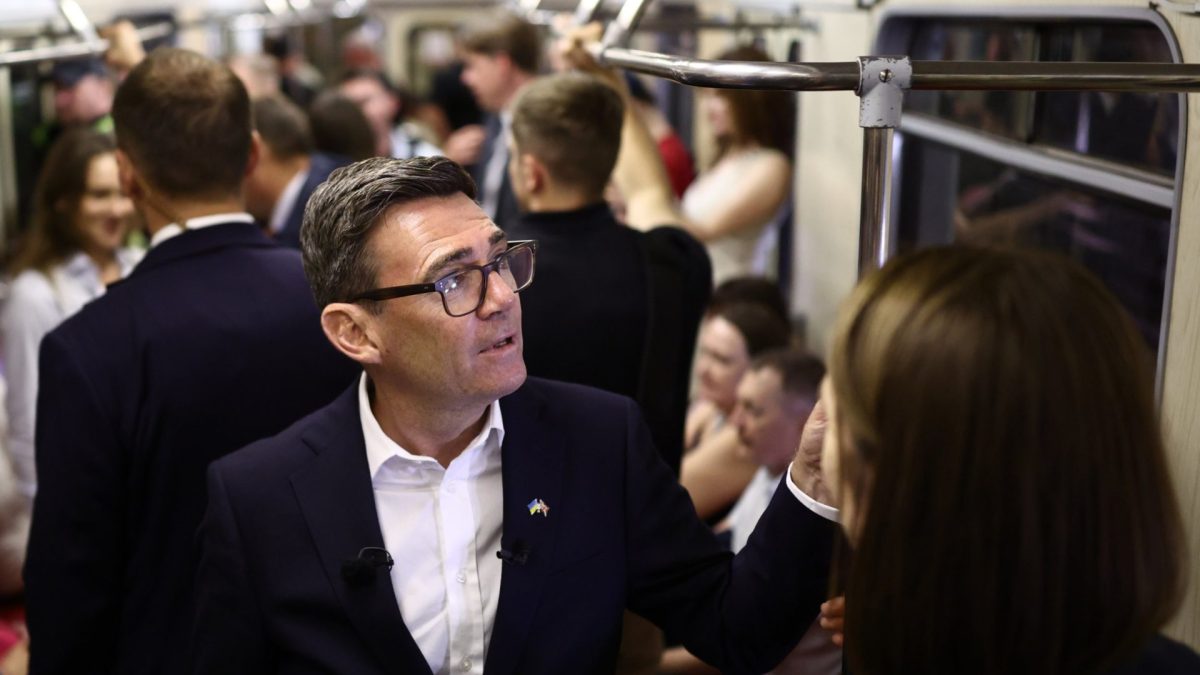
Andy Burnham has declined to rule out raising taxes in his autumn Budget, saying he would not be “unrealistic” about the state of the public finances. Speaking to ITV News while in Ukraine on Monday, the Prime Minister vowed to take a “careful approach” to the country’s finances – and said he “won’t take risks” with people’s jobs or livelihoods. However, Burnham did admit that the UK is in a “challenging position” financially. He said: “Whatever I do will be carefully thought through. It will be funded. That is exactly what I have done so far but there will be more to come as we go into the autumn.” Shorts It is not clear how much Burnham and his Chancellor John Healey might have to raise on 28 October. The Government will have to find at least £4.7bn to cover a gap left by the former chancellor Rachel Reeves in the funding of the Defence Investment Plan. Healey resigned as defence secretary from Sir Keir Starmer’s cabinet over – pushing Starmer closer to the exit – over what he said was an inadequate defence plan. Burnham has already announced a number of cost of living measures – such as removing VAT from electricity bills and cutting the cost of bus fares – and is promising more. These commitments will have to be paid for. At the same time, Healey’s fiscal headroom – the breathing space which the Government gives itself against its own fiscal rules constraining borrowing – is likely to have shrunk from the £22bn left by Reeves in her final Budget as a result of the ongoing economic impact of the Iran war. So what are Burnham’s options? Raising income tax, national insurance or VAT The biggest revenue raising levers which Healey has at his disposal relate to income tax, national insurance and VAT, which make up 54 per cent of the tax base. However, Labour’s 2024 general election manifesto committed not to raise any of these taxes, and Burnham has repeatedly said he will stick to the commitment. Going back on the manifesto – and his own word – would be extremely damaging for a Prime Minister who has made much about restoring trust in politics. Political risk rating: 4/5. Having ruled it out, it seems inconceivable that Burnham would U-turn on the commitment by the 28 October Budget – unless there was some major economic shock which meant all bets were off. Equalising Capital Gains Tax One of the more likely options would be to raise Capital Gains Tax (CGT), which currently sits at 18 per cent for basic-rate income taxpayers and 24 per cent for higher and additional-rate taxpayers. CGT is levied on gains made when an asset – like equity in a company or a second home – is sold. Raising the tax is popular in the Labour Party. It has previously been backed by Burnham’s second-in-command, First Secretary of State Louise Haigh, and the Defence Secretary Wes Streeting – albeit both before their roles in Burnham’s Cabinet were confirmed. Streeting has called equalising CGT with the income tax rates of 20, 40 and 45 per cent a “wealth tax that works”, and the idea is also supported by former Labour leader Lord Neil Kinnock, who Burnham has identified as a mentor. How much money CGT equalisation would raise is fiercely contested. The Institute for Public Policy Research think-tank has claimed it could raise £14bn a year, but sceptics suggest that it could actually end up costing the Treasury money if people delayed asset sales or moved overseas. Nimesh Shah, chief executive of tax firm Blick Rothenberg, said: “Even if full alignment is considered a step too far, the Government may narrow the gap by increasing CGT rates – to say 30 per cent – reducing reliefs or tightening exemptions.” Political risk rating: 2/5. As well as being popular on the left, CGT is paid by a relatively small number of people, with just 32,000 taxpayers accounting for 80 per cent of CGT payments. As tax rises go, it would not be particularly politically painful, although Burnham’s opponents would accuse him of being anti-entrepreneurial. Wealth tax Burnham has faced calls from figures on the left to introduce some sort of wealth tax. Last month, the former football and broadcaster Gary Lineker was among 120 so-called “Patriotic Millionaires” who signed a letter backing paying more tax in the form of a 2 per cent levy on wealth over £10m. Economists and academics at the Paris School of Economics and King’s College London claim that such a tax could raise £10bn a year for the Exchequer and affect only the 1,000 most affluent households. However, sceptics such as tax expert Dan Neidle have said that the policy would be highly vulnerable to a small number of wealthy individuals ceasing to be UK tax residents or “gaming” the valuation of their assets. Carrying out regular valuations would also be extremely complicated. Neidle said last month: “The problems with the wealth tax are serious. That’s why no country in the world has ever implemented a tax like the one proposed.” Political risk rating: 2/5. Polling suggests that a wealth tax along the lines of the “Patriotic Millionaires” would be popular. The more important issue is that it could be unworkable. Pension tax changes There has been persistent speculation that the Government could cut the size of the tax-free lump sum people can take from their pensions, which is either 25 per cent of the amount or £268,275 – whichever is lower. Another option would be to limit pension tax relief. If you pay into a pension, you receive relief at whatever income tax rate you pay, so higher rate payers get more generous tax relief. Political risk rating: 3/5. Tax changes adversely affecting older people would be a bold step. There is a reason why the state pension triple lock has appeared almost impervious to reform, and why Sir Keir Starmer’s decision to cut winter fuel payments provoked a hugely damaging backlash: older people vote. Sin taxes Burnham could target business sectors or activities which he thinks are “anti-social” or damaging for people. The Prime Minister has already signalled a shift in this direction, saying that the 20 per cent business rates cut for pubs, clubs, and small live music venues will funded by reducing reliefs for stores perceived as causing social harm – specifically vape shops and betting establishments. Healey could also raise taxes on cigarettes, vapes, unhealthy food and alcohol – though on the latter, the tendency in recent years has been for politicians to trumpet tiny price cuts on the cost of pints in pubs. Capital Economics has suggested that sin taxes could raise £1bn. Political risk rating: 1/5. With the exception of alcohol, sin taxes incur little political cost. The bigger problem with them is they tend to raise trivial sums.
The taxes Burnham could raise in his first Budget – and the risks
Full Article
Original Source
Read the full article at Inews →KhanList aggregates and links to publicly available news content. We do not host full articles from third-party sources. Always verify important information with original sources.