
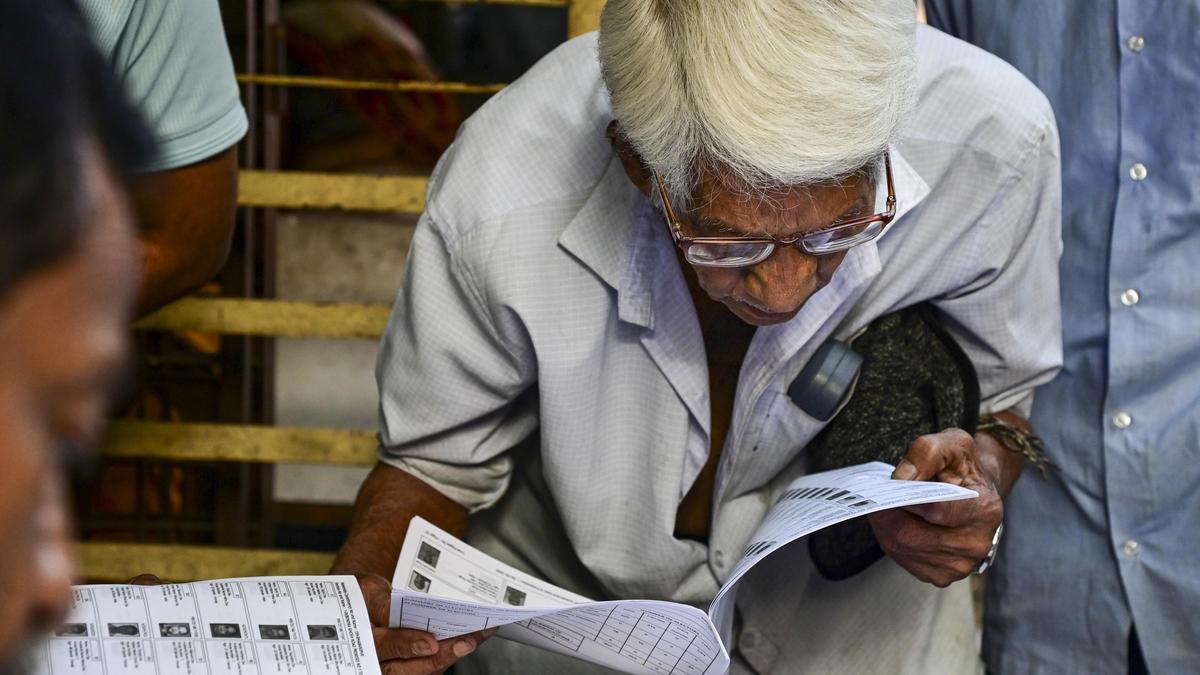
‘The fight for the vote and livelihood is one’ | Photo Credit: PTI On November 26, 2026, India marks 77 years since the Constituent Assembly adopted the Constitution in 1949. That founding charter made a bold promise for a poor, deeply stratified country emerging from colonial rule. Every adult citizen, regardless of property, caste, gender, or creed, would stand equal at the ballot box. Today, that core principle of political democracy, which B.R. Ambedkar placed at the heart of the Republic, is being systematically erased in practice.In the Constituent Assembly on November 25, 1949, a day before adoption, Ambedkar warned of the peril ahead. “On the 26th of January 1950, we are going to enter into a life of contradictions,” he declared. “In politics we will have equality and in social and economic life we will have inequality. In politics we will be recognising the principle of one man one vote and one vote one value. In our social and economic life, we shall, by reason of our social and economic structure, continue to deny the principle of one man one value.” Those suffering from inequality, he added, would blow up the structure of political democracy so laboriously built by the Assembly, if we fail to eradicate this grave injustice.Ambedkar was addressing two distinct questions — who holds the vote and what that vote is worth. When he urged reliance on constitutional methods, he attached a vital condition — that constitutional methods must remain genuinely open. Friedrich Engels had noted that universal suffrage serves as the gauge of the maturity of the working class. By tampering with the voter roll itself, the state undercuts the very terrain on which working masses organise in an electoral democracy.Over the past year, the Special Intensive Revision (SIR) of electoral rolls has become an engine of mass exclusion. After Bihar, phase two began on November 4, 2025, across 12 States and Union Territories covering about 51 crore electors, while in phase three in 17 States and Union Territories, roughly 6.15 crore names, or 17%, were chopped from draft rolls. Bihar’s electorate fell from 7.89 crore to about 7.42 crore, and West Bengal saw around 90.8 lakh deletions, roughly 11.9% of its voters, prior to tribunal appeals. Meanwhile, reports of internal dissent within the Election Commission of India (ECI) revealed that the Election Commissioners, Vivek Joshi and Sukhbir Singh Sandhu, raised 14 objections in 10 months to decisions issued without their consent. Amidst surging street protests, 240 Opposition Members of Parliament marched to the ECI on October 6, demanding an immediate halt to SIR, resignation of the Chief Election Commissioner of India. On November 1, thousands of people rallied at the Ramlila Maidan to reiterate these demands.The SIR was an unprecedented revision (rather removal) with an inversion of the burden of proof. The logic of the National Register of Citizens was brought into action when enrolled voters were forced to prove their citizenship, overturning the rule that people on the roll are presumed citizens. While the Supreme Court of India upheld the revision, its direction that names deleted over doubtful citizenship be forwarded to the Union government built a pipeline from voter rolls to citizenship screening. Published - November 26, 2026 12:08 am IST
The systematic erosion of political equality in India
Full Article
Original Source
Read the full article at Thehindu →KhanList aggregates and links to publicly available news content. We do not host full articles from third-party sources. Always verify important information with original sources.