
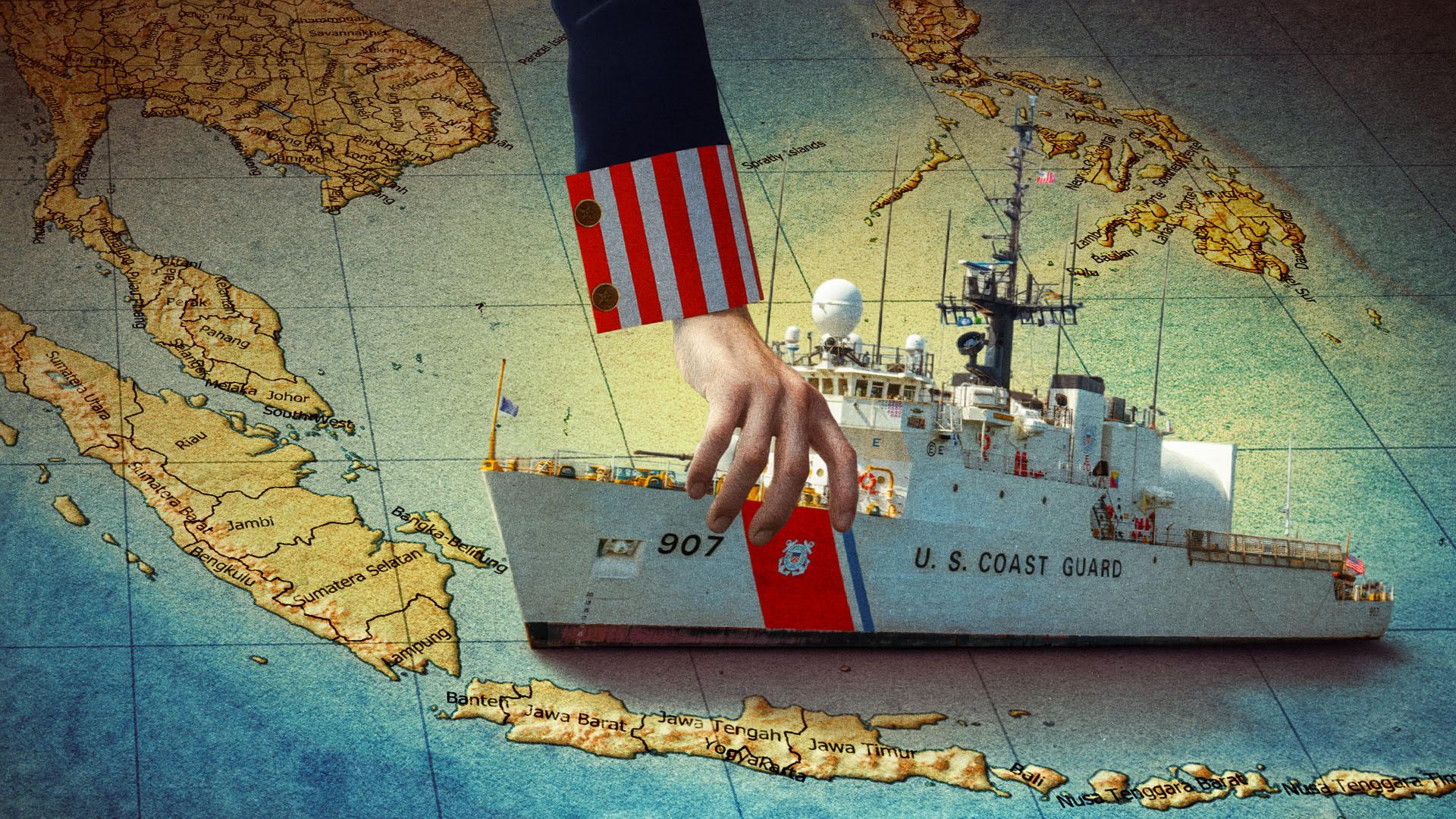
Squadron ends a more than 20-year mission in the Middle East US Undersecretary of War for Policy, Elbridge Colby, announced the deployment of four US Coast Guard fast response cutters to partner with the Philippine Coast Guard in patrolling the country's exclusive economic zone. This deployment reflects a strategic shift towards the Indo-Pacific to counter China's influence, as Colby emphasizes the need for US allies in the region to increase their defense budgets and capabilities. While the deployment is seen as a show of support, its short-term nature and lack of operational details raise questions about its substantial impact on regional security. This is AI-generated. Read the article for full context. Report any errors. When Elbridge Colby, US undersecretary of war for policy, announced during his recent visit to Manila that four US Coast Guard (USCG) fast response cutters will “actively partner with the Philippine Coast Guard in patrolling and securing your exclusive economic zone,” it was meant to show “concrete visible support” to the Philippines, its oldest treaty ally in Asia. They will stay until next month, a USCG spokesperson told Janes Defence, “in response to national security requirements” and will operate out of Singapore and Subic Bay. These 150-foot patrol cutters, “designed for maritime security, interdiction, coastal patrol, and partner-capacity-building missions,” belong to the Expeditionary Cutter Squadron. This message of help differs from what the Pentagon usually imparts to American security partners in the region. Since last year, Colby has been asking friends, mainly Australia and Japan, to up their defense budgets to 3.5% of GDP—similar to what they have been demanding from the North Atlantic Treaty Organization (NATO) members. The Economist reported that the Philippines has been asked the same but “appears to be under less pressure.” Colby is the Pentagon’s third-ranking official and he has been leading this big-ask mission of the Trump administration. In Manila, he appeared satisfied that the Philippines is “stepping up, taking the lead to defend itself, and investing more to modernize its military and coast guard.” China is priority The move of the USCG to deploy the Expeditionary Cutter Squadron, composed of six cutters, to the Philippines’ Subic Bay and Singapore reflects Colby’s push to reassign troops to the Indo-Pacific to counter China. (Singapore is the command and logistics hub; Subic Bay is where four of the cutters will rotate.) He had written extensively about this. In 2021, in Colby’s book, The Strategy of Denial, he argued that “the most important strategic objective of the United States is to prevent China’s regional hegemony.” As such, the priority in US defense planning should focus on the Indo-Pacific. He was then with a think tank and had served in the first Trump administration as deputy assistant secretary of defense for strategy and force development. Under the second Trump administration, Colby has argued for a US military pivot toward Asia and a focus here rather than elsewhere. He has said that America “should seek to avoid, reduce or eliminate costly or demanding commitments in other parts of the world.” He warned: “What is used for the Middle East will not be available for Asia.” That is exactly what is happening. The US is pulling its last aircraft carrier, the USS George Washington, out of the Western Pacific to replace the USS Abraham Lincoln in the Middle East, the Associated Press reported. This deployment may be short-lived if the US Navy sends a replacement. Given this context, the shift of the squadron—which previously operated under the name Patrol Forces Southwest Asia (PATFORSWA) out of Bahrain—to Subic Bay and Singapore appears more symbolic than substantial. The Trump administration is not trimming its forces in the Middle East where they are fighting an off-again, on-again war with Iran. Moreover, a short-term deployment of the USCG cutters—only until September—would not have much of an impact in the West Philippine Sea. No operational details yet The details of the USCG Expeditionary Squadron’s operations in the Philippines have not been made public. They are currently operating in the US Pacific Command area of operations. A USCG spokesperson said that, for operational security, they do not discuss “specific numbers of assets, detailed locations or schedules of cutter movements.” This was in response to my question on whether the USCG and Philippine Coast Guard will conduct joint patrols in the West Philippine Sea, including resupply missions to Second Thomas Shoal. I asked if there will be another round of rotational deployment after September. The USCG, the spokesperson said, “adapts to meet urgent national needs.” Its new assignment “reflects the Coast Guard’s intent to provide agile, capable, and responsive maritime forces” and they will “rapidly support national security objectives across a range of operational theaters…” Two of these vessels had participated in a drill with the Philippine Coast Guard and armed forces last June to expand capabilities at sea. The exercise included a series of interoperability and maritime domain awareness activities. In July, two other USCG cutters arrived in Puerto Princesa, Palawan, for a port visit. Some view and see the Expeditionary Cutter Squadron as a boost to stabilizing security in our region. They can “limit the effectiveness of [China’s] gray zone operations,” Michael Mazza of the Institute for Indo-Pacific Security wrote in Taipei Times. They should be “effectively integrated with other tools—including military forces, legal argumentation, diplomacy and public messaging.” Let me know what you think. You can email me at marites.vitug@rappler.com. Till next newsletter! ICYMI Related articles and videos: https://www.facebook.com/reel/2050258942364206 https://www.facebook.com/watch/?v=1030669409809913 How does this make you feel? Loading
The symbolic shift: US deploys Coast Guard cutter squadron, operates off PH and Singapore
Full Article
Original Source
Read the full article at Rappler →KhanList aggregates and links to publicly available news content. We do not host full articles from third-party sources. Always verify important information with original sources.