
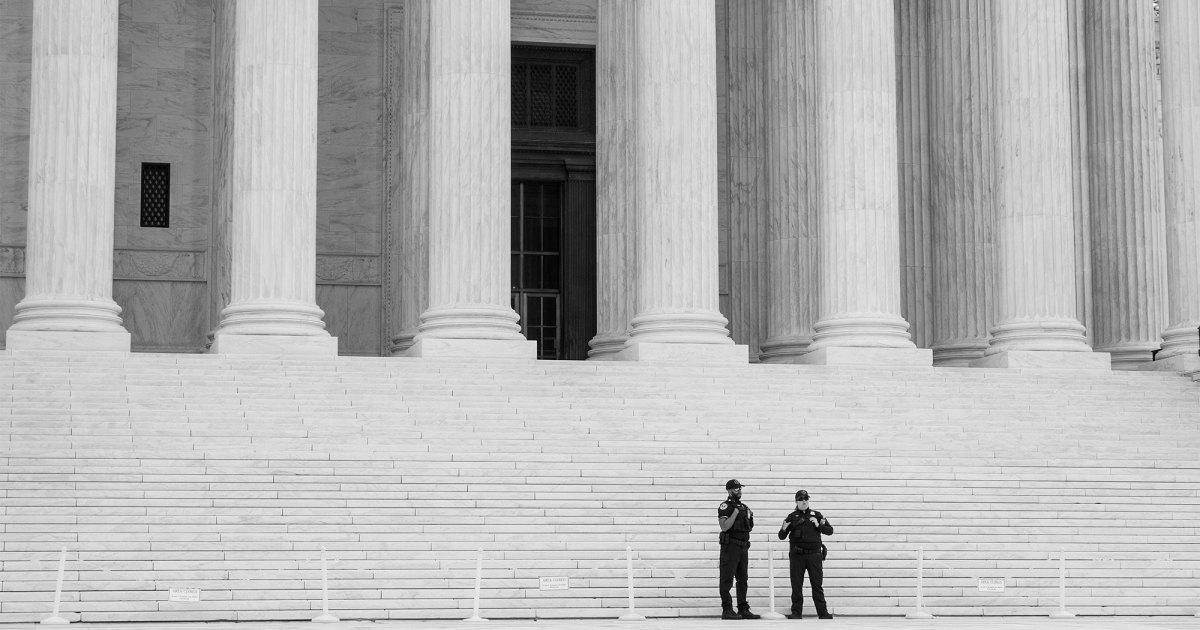
Officers outside the court this month.Kevin Carter/Getty Get your news from a source that’s not owned and controlled by oligarchs. Sign up for the free Mother Jones Daily. The Supreme Court may be deferential to President Donald Trump and the legal arguments put forward by his Justice Department. But when it comes to their own physical safety, the justices seem to view the administration with appropriate skepticism. The court is now ditching the longtime protection of the executive branch’s US Marshals Service, and instead creating a robust, in-house security force to guard themselves at all times. Though famously without its own army, the Supreme Court is building up its own police. While the new security seems necessary, the change is also the product of the world the Roberts Court has built: one where the executive branch cannot be trusted, a violence-prone political movement has returned to power, dangerous people have readier access to firearms, and the justices decide the biggest political questions of the day. Historically, the marshals, housed in the Department of Justice, provided security to the justices, lower court judges, and federal courthouses, as well as to selected witnesses and lawyers. In addition, the Supreme Court relied on a small police service, called the Supreme Court of the United States Police Department, to patrol its building. In recent years, its officers have begun to take up work once done by the marshals; this spring, the justices’ residential security details changed hands. Now, the justices are expanding the Supreme Court police into a sweeping force that can replace their longtime protectors. The justices are seeking to rapidly grow the department, which numbered some 200 officers last year, to more than double its size. The justices’ 2027 budgetary ask to Congress includes funds to build their own police command center, assess threats, and provide round-the-clock security to the court’s nine members. To compete with other federal agency forces, including the Capitol Police and Immigration and Customs Enforcement, the Supreme Court Police offers starting salaries between $86,530 and $147,928 with up to $60,000 in bonuses with a three-year contract, depending on experience. The tagline in its recruitment videos: “The highest court. A higher calling.” The justices empowered Trump—and placed their own security in his hands. It’s essential for our political system that the justices live and work free from fear and violence. “The security request is important and necessary,” says Gabe Roth, who runs Fix the Court, a nonpartisan group that advocates for reforms to make the Supreme Court more transparent and accountable to the public. “They don’t want to be beholden to the whims of another branch, which is more political.” It is not mere happenstance that the justices no longer trust the executive branch to protect them. Under Chief Justice John Roberts, the court has embraced the unitary executive theory, cooked up by Republican lawyers in the 1980s, which gives presidents direct authority over everything carried out inside the executive branch. The Republican appointed justices explicitly gave the president power over the Department of Justice in their 2024 immunity decision. While never technically independent, since Watergate, the DOJ had worked to keep its prosecutorial functions walled off from the White House. But Roberts’ decision in Trump v. United States clarified that the attorney general is the chief law enforcement officer for the president, redirecting the office’s ultimate loyalty from the rule of law to the occupier of the Oval Office. The result is that the Justice Department under President Donald Trump is increasingly unmoored from Congressional oversight and acting as the personal legal attack dog of the president. This is important because the US Marshals are part of the DOJ. By removing any taboo around presidential meddling in the department’s affairs, the justices more directly placed their own security in Trump’s hands. The head of the Marshals’ Service reports to Attorney General Todd Blanche, who not only serves at the pleasure of the president but has described his department as being in a “war” against judges. Trump, who has called Supreme Court justices “disloyal to the Constitution” and said some “sicken” him, is ultimately in charge of their personal security. It’s not hard to imagine Trump ordering the marshals to lighten security to apply pressure over a particular decision, or to withdraw it as a punishment for a ruling. Clearly, the justices are uneasy with this arrangement, too. The concern is “probably 10 or 20 percent of the reason that this transition is happening,” Roth says. “They just want to have that control.” While the marshals struggled to meet demand under a stagnant budget since the Biden administration, the squeeze has tightened under the chaos of Trump’s corrupt and personalist second term. As threats to judges ramp up—in part because of rhetoric from Trump, his deputies, and allies—the judiciary’s security needs have increased. But at the same time, the marshals have been pulled onto Trump pet projects, immigration enforcement, and crime, depleting resources for protecting judges and the courts. The marshals were also assigned to provide a security detail to Health and Human Services Secretary Robert Kennedy Jr, an unusual arrangement that took staff away from the service’s core duties. Meanwhile, some of the justices were unnerved that officers showing up to protect their homes were sometimes only a few weeks out of training, according to Politico. In response to questions, the Marshals Service confirmed it provides security to Kennedy; its 2027 budget request includes an additional $34 million for judicial security and $228 million for immigration enforcement and local crime operations. The Trump administration has also overseen more direct political weaponization of the marshals. In March 2025, DOGE and an official from the State Department used the marshals to gain access to an international development agency they were attempting to dismantle, wielding the marshals against another federal agency. “There’s some question of whether it falls under the marshals’ duties,” one expert told Mother Jones last year. “You have an extragovernmental agency assigning marshals to do something that’s questionable in the first place.” Indeed, the marshals assisted DOGE, a rogue operation greenlit by the president alone. (While the Supreme Court justices never weighed in on this particular Musk-induced skirmish, they generally abetted DOGE’s efforts, granting it access to Americans sensitive Social Security data while denying the public access to information about DOGE.) In what may have been a signal of the marshals’ unreliability, this spring the Justice Department informed the Supreme Court that they would stop providing security at the justices’ homes before the Supreme Court police were expected to take over the job, sending the justices scrambling. “We were suddenly confronted with the loss of US Marshal protection,” Justice Elena Kagan explained in testimony to a Senate panel last month as the court asked for an additional $18.9 million to cover its growing security costs. “We thought we were going to have US Marshal protection at our residences for another six months, and all of a sudden learned from the Justice Department that that was going to be impossible.” Left in the lurch, the court’s police department took over their residential security with the help of outside contractors. The US Marshals did not answer a question about why they pulled security ahead of schedule. The court has made it harder to keep guns from dangerous people. The level of protection around the justices has increased dramatically in recent years. “I joined the court in 2010, and it was an entirely different world then,” Kagan told the senators. “I just walked out on the street, I had no security with me at any time. I drove back and forth to work by myself… Honestly, none of us particularly thought about it.” But after Justice Antonin Scalia died on vacation in remote Texas, hours from the closest marshals, the court began to reconsider its protocols. Not long after, two congressmen who served on the House oversight committee and were assessing the government’s personal protection practices paid a visit to the chief justice. “They said, ‘We think you’re out of your mind,’” Kagan summarized. “They said the director of the Office of Personnel Management has more security” than the justices of the Supreme Court. Slowly, the high court began to raise its guard. This accelerated in the wake of the May 2022 Dobbs leak indicating the court was poised to overturn Roe v. Wade, when protests erupted at justices’ homes and a would-be assassin showed up at Justice Brett Kavanaugh’s house. Now, the justices have round-the-clock security and arrive at work in armored SUVs. As part of that ramp up, some justices turned to the court’s police department. According to public records obtained by Fix the Court, Roberts, Kagan, and Justice Clarence Thomas have been using the court’s police when they travel for several years. “Life has changed a great deal for all of us,” Kagan said. The Supreme Court has played a part in the country’s uptick in political violence. The justices helped Trump return to office after he incited a deadly insurrection, and his MAGA movement is behind many of the threats the justices now face. But more broadly, the court has made it easier for people to access guns. The court’s landmark 2008 decision in District of Columbia v. Heller gave every individual the right to a firearm. In 2022, New York State Rifle & Pistol Association, Inc v. Bruen added another hurdle to state firearm regulation: even though guns themselves have changed drastically, a six-justice majority held that gun restrictions must be similar to a law that existed in the nation’s past. The court went on to greenlight bump stocks, and this year, blocked state attempts to limit guns on private properties like stores and restaurants. In the coming term, it will decide the constitutionality of assault weapon bans. The United States was racked with gun violence before the Roberts Court began loosening gun restrictions, but its decisions have made it harder to keep firearms away from dangerous people. Notably, the court upheld a Biden-era regulation of untraceable ghost guns, several months after Luigi Mangioni used one to assassinate the CEO of United Healthcare—perhaps a moment of clarity for some of the conservative justices, realizing that the nation’s elite are not immune from the violence spurred by letting anyone be armed. Justice Amy Coney Barrett, testifying to senators alongside Kagan, relayed how one of her kids noticed she had a bulletproof vest. “I didn’t expect that performing this service was going to put me in the position of explaining to my children what a bulletproof vest was and why I had to wear one,” Barrett said. It’s not something anyone’s job should entail, yet it’s one that the justices’ own decisions made more likely for many people—including themselves. Barrett, a Trump appointee who in a few important cases has ruled against the president, including by invalidating his claim to broad tariff powers and his birthright citizenship executive order, has seen violence directed at her and her family alongside right-wing vitriol tinged with sexism. She described a swatting hoax directed at her home, and the eerie pizza deliveries sent in the name of a federal judge’s murdered son, which have been received by many federal judges since Trump returned to office. “I think the message on the deliveries being sent is clear,” Barrett said. The court is drawing more attention because it keeps putting itself in the position to decide contentious issues, from college admissions policies to whether Trump can stand trial for instigating an insurrection. Again and again, the justices are taking cases that make them the ultimate deciders of not just the law but the pressing social and political debates dividing the country. Indeed, the justices’ security was increased after a leak showed the court poised to end the right to abortion. The justices have never been so important, nor further from the people whose lives they impact. In the 19th century, the justices rode regional circuits, spending months presiding over trials. It put them up close with not just local judges but juries and ordinary people. In 1935, as the justices were striking down New Deal legislation, their courtroom moved from the basement of the US Capitol to the august marble facade across the street; an appropriate perch for a branch of government busy upending the work of the other two. Today, there’s usually a security detail or a bullet-proof windshield between the justices and the people. More than ever, the justices shape the country we live in—and as their new security is evidence, it isolates the justices from the privilege of living in it.
The Supreme Court’s Security Upgrade Fits the World It Helped Make
Full Article
Original Source
Read the full article at Motherjones →KhanList aggregates and links to publicly available news content. We do not host full articles from third-party sources. Always verify important information with original sources.