
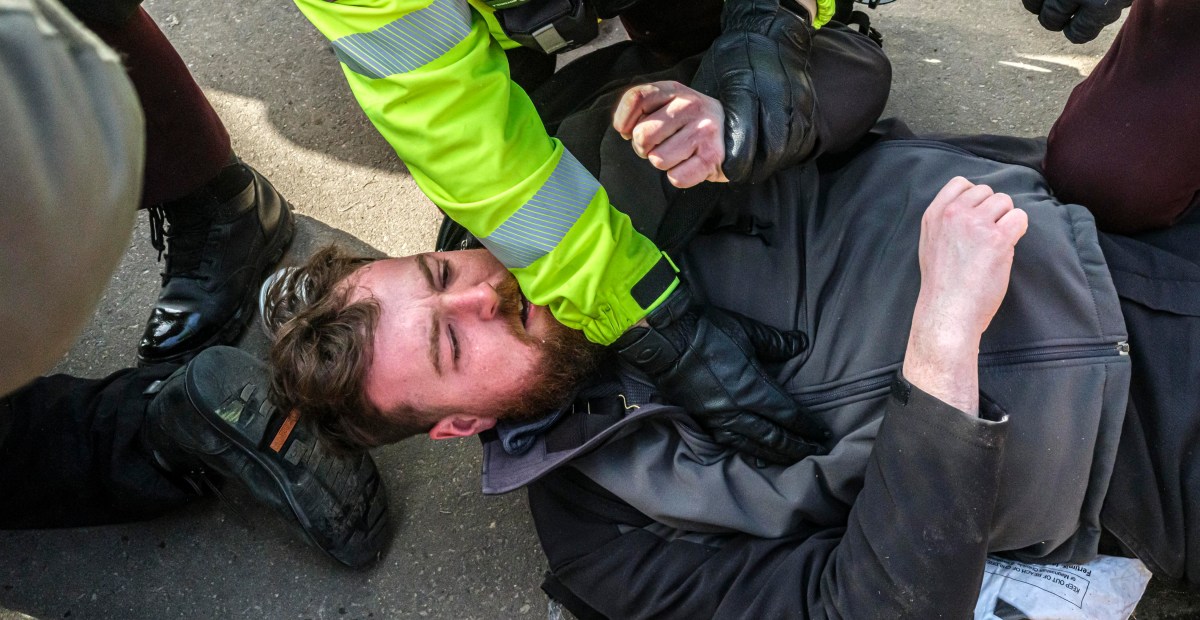
Let’s say that you’re savagely beaten by a federal officer despite the fact that you committed no crime. Or maybe your home is ransacked by FBI agents who didn’t even bother to get a warrant. Or maybe you’re shot in cold blood by immigration officials engaged in a paramilitary occupation of your home city.The Supreme Court has worked hard, especially in recent years, to ensure that you will have little, if any, recourse against federal law enforcement officials who abuse their power. In one case, decided about six years ago, the Court’s Republican majority gave lawsuit immunity to a US Border Patrol agent who fatally shot a Mexican teenager in the face.SCOTUS, ExplainedGet the latest developments on the US Supreme Court from senior correspondent Ian Millhiser.Now, the Court is poised to finish the job. On November 9, the Court will hear Nielsen v. Watanabe, a case that could eliminate all remaining hope that someone targeted by a federal officer with no regard for the Constitution might be able to hold that officer accountable in court. Among other things, the justices could use Nielsen to overrule its decision in Bivens v. Six Unknown Named Agents (1971), which established that federal law enforcement officers may sometimes be sued if they violate someone’s constitutional rights.Bivens was rooted in something very similar to the Spider-Man Rule — with great power comes great responsibility. As the Court explained in Bivens, a federal officer who acts unlawfully “in the name of the United States possesses a far greater capacity for harm than an individual trespasser exercising no authority other than his own.” And thus the Constitution must offer some remedy to people who are injured by such an officer.But Bivens quickly fell out of favor in the Supreme Court as its membership moved rightward. The Court’s current, Republican majority is so unrelentingly hostile toward Bivens that it is hard to imagine any plaintiff prevailing in a Bivens suit before this Court. The Court’s most recent decisions have described Bivens suits as a “disfavored judicial activity.” In one decision, they’ve said that it is “doubtful that we would have reached the same result” if Bivens were “decided today.” And they’ve instructed judges to reject Bivens claims if there is “any rational reason (even one)” to do so.In Nielsen, the same justices who wrote these lines are now being asked to overrule Bivens altogether. Even if they decide not to go that far, they’ve already done so much to carve up Bivens that there is virtually no hope for anyone who sues a federal officer for violating their constitutional rights.What’s the specific issue in Nielsen?Nielsen arises out of an alleged violation of the Eighth Amendment, which forbids “cruel and unusual punishments.” The Supreme Court has long held that this amendment requires prisons to provide medical care to incarcerated people, because if the prison does not provide them with care, they will have no other way to treat their illnesses or injuries.The last time the Court ruled in favor of someone who sued a federal officer under Bivens was Carlson v. Green (1980), a decision that allowed the estate of a man who died in prison due to poor medical care to sue prison officials under Bivens. The Nielsen plaintiff, a formerly incarcerated man named Kekai Watanabe, raises a similar claim to the one in Carlson. Watanabe was assaulted by fellow inmates, and received some medical care for “severe back pain.” But when he asked to be treated in a hospital, that care was denied.He claims that, for months, he “received only intermittent and short-term treatment for pain, often over-the-counter medication,” despite repeated requests for more care. After seven months, according to his brief, Watanabe was finally given an X-ray, which revealed that he had a fractured tailbone and that “bone chips had migrated into the surrounding soft tissue.” Watanabe also claims that he was never given treatment by a medical specialist, and “remains in tremendous pain today.”A federal appeals court concluded that Watanabe’s legal claim “is identical to Carlson in all meaningful respects,” and thus his lawsuit against a prison health provider could move forward. Though the Supreme Court “has cautioned against extending Bivens remedies,” the lower court explained, “it has consistently maintained that” Carlson is “still good law.”On the one hand, the appeals court is correct that Watanabe alleges a legal violation that is very similar to the one in Carlson. In both cases, someone incarcerated in a federal prison alleged that their Eighth Amendment rights were violated because the prison did not provide them with adequate medical care. So that does suggest that Watanabe should be allowed to bring a Bivens claim for as long as Carlson remains good law.Still, the Court’s recent cases tell judges to rule against Bivens plaintiffs if there is “any rational reason” to do so. And there are certainly some distinctions that can be drawn between Carlson and Nielsen. The plaintiff in Carlson, for example, had an asthma attack and died within hours, while Watanabe is still alive and his medical condition played out over many months. The defendants’ lawyers in Nielsen also argue that Congress has changed the law governing suits brought by federal prisoners in ways that make their case meaningfully different from Carlson.These distinctions are fairly minor. But if judges are really supposed to look for any rational reason to deny Bivens claims, then these distinctions are almost certainly enough. Again, it’s hard to imagine this Supreme Court ruling in favor of any Bivens plaintiff, including Watanabe. In Nielsen, the lawyers asking the Court to overrule Bivens claim that, since Carlson, the Court has rejected 13 different suits raising Bivens arguments.For what it is worth, the legal debate over Bivens focuses on whether Congress must specifically authorize suits against federal officers before those suits can move forward. The Court’s Republicans claim that the absence of such a law means that no suits against federal officers are allowed (a federal law does authorize suits against state officials who violate constitutional rights).Meanwhile, proponents of Bivens argue that the 1971 decision merely added coherence to a long line of pre-Bivens decisions permitting suits against federal officials — some of which stretch back to the early 1800s. As the Court said in Larson v. Domestic & Foreign Commerce Corp. (1949), “the principle that an agent is liable for his own torts ‘is an ancient one and applies even to certain acts of public officers or public instrumentalities.’”But it matters little who is correct about this debate, because Republicans control six seats on the Supreme Court, and those six justices are fully dug into their opposition to Bivens.The biggest open question in Nielsen, in other words, is whether the Court will take the defendant’s lawyers up on their invitation to overrule Bivens in its entirety. Just a few years ago, a decision overruling Bivens would have been a very big deal. But, in light of the Court’s decisions holding that judges should look for reasons to deny Bivens claims, little of Bivens remains to be further undermined by this Court.Federal officials already enjoy such broad immunity from suit that an opinion overruling Bivens will probably do little more than rescue judges from the menial task of hunting through legal records in Bivens cases, searching for a reason to rule against the plaintiff.
The Supreme Court could make it impossible to sue federal officers
Full Article
Original Source
Read the full article at Vox →KhanList aggregates and links to publicly available news content. We do not host full articles from third-party sources. Always verify important information with original sources.