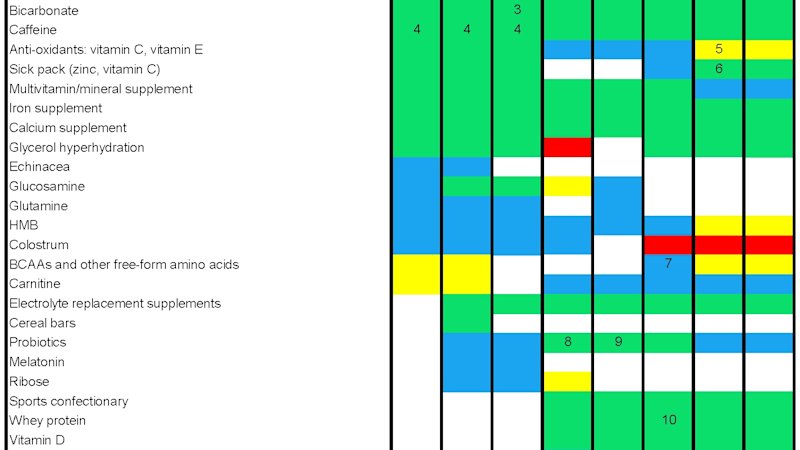
Athletes have always added supplements to the special sauce they use in pursuit of a performance edge.In 500–400 BC, they swallowed deer liver and lion heart hoping that these ingredients would produce bravery, speed or strength; in the early 1900s, they’d upped the ante with amphetamines; while those competing at the 1972 Olympic Games in Munich relied heavily on multivitamin supplementation.Today, most, if not all, the Australian athletes bathing in gold, silver and bronze at the Commonwealth Games also take supplements. But they are more likely to be using creatine, caffeine or protein. Perhaps beet juice, bicarb soda or beta-alanine too.Louise Burke was the dietitian for the Australian Olympic teams for the 1996 to 2012 Summer Olympic Games.Ruby AlexanderThese are the ones that can provide modest but important gains in specific contexts – providing the “small margins” that matter at major competitions, says Gary Slater, a professor of nutrition and dietetics and the head of performance nutrition for the Australian Olympic Team in Tokyo.The best supplements can improve performance by about 3 per cent, adds sports dietitian Louise Burke.That is significant in sports where the difference between winning and losing can be less than 1 per cent.Athletes have teams guiding them on safe sources, what to take and when. That hasn’t always been the case.Supplements sold in laundriesIn the late 1990s, sports dietitians toed the party line of sporting organisations which was outright rejection of supplements.There’s no single universal definition for supplements in sport, but often refers to formulations of tablets, powders, drinks and foods containing isolated or mixed ingredients that may assist an athlete’s health and performance.“If you put forward the idea that maybe there’s potential for some supplements to benefit athletes, you got shut down,” says Burke, who was the chief of nutrition strategy at the Australian Institute of Sport (AIS) for 30 years, as well as the dietitian for the Australian Olympic teams for the 1996 to 2012 Summer Olympic Games.But, outside the strict confines of sporting organisations, it was the Wild West, as amateur and elite athletes experimented with unregulated substances.The rise of the internet and loosened regulations made supplements freely available. Then, ahead of the Sydney Olympics in 2000, there was a proliferation of network marketing companies promoting and selling them.“These companies were like Tupperware, you know: you buy it, and you sell it to all your friends,” explains Burke, now chair of sports nutrition at ACU’s Mary MacKillop Institute for Health Research.Unlike the congenial atmosphere of Tupperware parties, these new supplement companies were aggressive as they competed for market share: “There were a couple of instances of suppliers coming onto the campus and setting up in the laundry, to try to sell supplements.”Many athletes, desperate to be the best, were vulnerable to the emotive (often unsubstantiated) hype and framing of supplements as cutting-edge. They could now easily bypass the professionals tasked with helping them, and they did.“We started to realise that athletes were paying lip service to us, and then finding their own sources of information on supplements,” Burke says.To athletes and their coaches, sports dietitians had become ultra-conservative – obsolete even, says Professor Ben Desbrow, performance nutrition consultant to the Gold Coast Titans NRL team: “We were a bit like Sandy at the beginning of Grease … and just like Sandy, we had to really move out of our comfort zone.”There’s no single universal definition for supplements in sport, but often refers to formulations of tablets, powders, drinks and foods that may assist an athlete.Getty ImagesIll-informed use of supplements can compromise athlete wellbeing and integrity: about one-third of doping violations are attributed to supplements and up to 50 per cent of supplements are contaminated with anabolic agents or other prohibited substances.So they started sifting through the evidence systematically, sorting various supplements into categories based on these questions: is it safe? Is it effective? Is it permitted for use in sport?This formed the basis of the AIS Sports Supplement Framework, a world-first which launched in 2000 ahead of the Olympic Games.“It was a watershed moment,” says Burke. “We reframed ourselves as a profession.”Now, Burke, Desbrow and Slater are among the authors of a 25-year review of the framework, published in the International Journal of Sports Medicine.They note the need to keep up to date with the thousands of performance-branded products have appeared on the market since 2000.It’s a challenging task.“The sheer turnover of new ingredients and proprietary blends makes it impossible – and inappropriate – to try to count them all,” says Slater.And the flashes in the pan are many: ketone esters, citrulline, antioxidants and colostrum to name a few.This list shows how supplements have been reclassified over time.Today, there is buzz around lactate supplements, polyphenols and broccoli sprouts. Whether they will make the list or die out with the rest remains to be seen.The dynamic interface of the framework allows the experts to reclassify supplements as evidence accrues or as claims are debunked.From there, they fine-tune how and when a supplement is used.Creatine, for instance, once used primarily for muscle mass and cellular hydration, is now being used by various football teams (including those Desbrow works with) prophylactically for concussion.Sprinkles on the icing of the cake to make it popEven when there is evidence that a supplement works in an elite setting, it may not benefit the rest of us.Take chocolate milk, for example, which is no better at enhancing recovery than water and having something to eat, Desbrow explains. But, because endurance cyclists will neck some choccy milk while they are on the road and may not have access to whole foods or time to eat between sessions, many assume that it is somehow superior.“In my mind there’s a spectrum of people who definitely need sports supplements,” adds Desbrow, who doesn’t use any himself. “The vast majority of people definitely don’t need them.”Even for those who do, without good nutrition, a good training program and good recovery, supplements are useless.“It’s the sprinkles on the icing of the cake,” says Burke. “It’s not very nourishing or fulfilling, but if you bake the cake, and you’ve put the icing on it, and you’re at the Olympic Games, that packet of sprinkles is the bit that just makes it pop.”The framework helps athletes and sports to focus on “food first” nutrition, use only those supplements that genuinely add value, and minimise the risk of inadvertent doping from contaminated products, Slater says. And, it seems to be working.Desbrow tells me a story about Titans captain, Tino Fa’asuamaleaui, who was in America receiving treatment for an ACL injury last year.Fa’asuamaleaui sent Desbrow a picture of a dodgy-looking supplement with a message saying he had seen this supplement and was about to take it: “What do you think?”Desbrow was fuming. “I was saying to my wife, ‘what the f--k is this bloke doing?’”He calmed himself before replying that he hoped Fa’asuamaleaui hadn’t taken it. Ten minutes later Fa’asuamaleaui wrote back.“Hahaha. I would never take it. I just thought I’d pull your leg,” he said. “And I was like, ‘you arsehole.’ But that’s what you want, right?”Make the most of your health, relationships, fitness and nutrition with our Live Well newsletter. Get it in your inbox every Monday.Sarah Berry is a lifestyle and health writer at The Sydney Morning Herald and The Age.Connect via X or email.From our partners
The supplements athletes are using at the Commonwealth Games
Full Article
Original Source
Read the full article at Smh →KhanList aggregates and links to publicly available news content. We do not host full articles from third-party sources. Always verify important information with original sources.