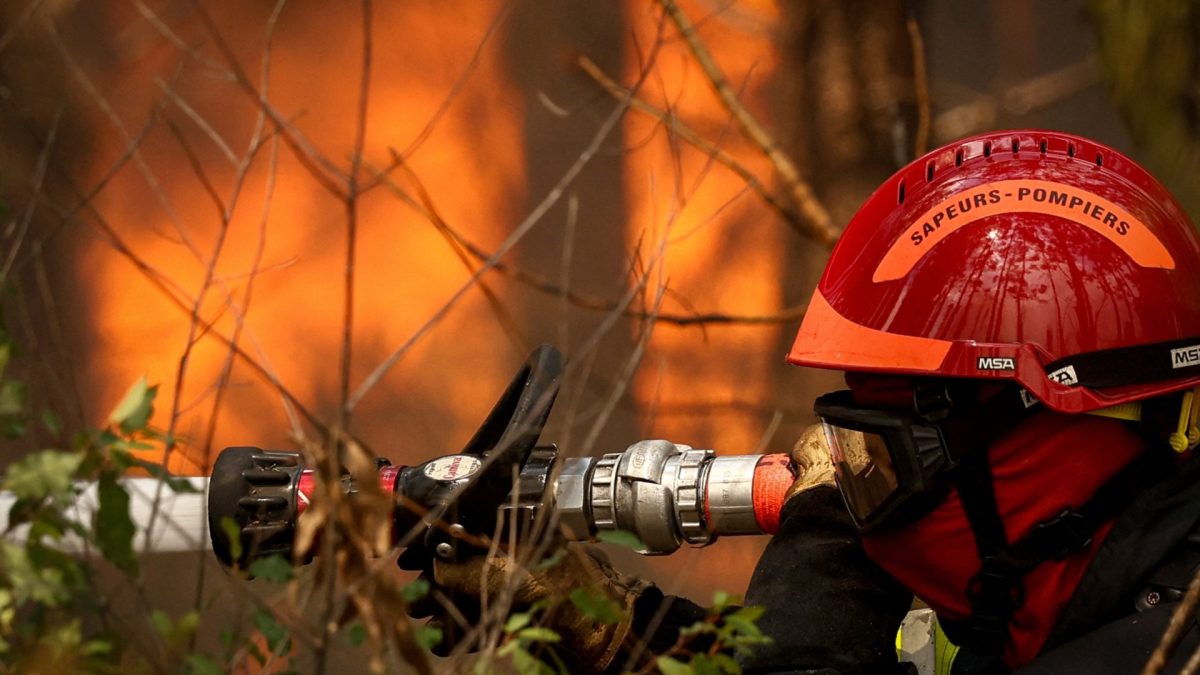
British expats and holidaymakers caught in the wildfires that have forced more than 300,000 people to evacuate in France and Spain described apocalyptic scenes and hasty retreats. As flames ravaged the province of Bordeaux, forcing local authorities to evacuate 55,000 people from villages to the south of the city, one British couple living close to the area held their breath – literally. “All I could see yesterday for the entire day were thick clouds of smoke that had travelled long distances,” Diane Kirkwood told The i Paper. “There was smoke everywhere coming from the fires around Bordeaux, the sun had almost been covered black, there was little sunlight and it was a bit hard to breathe.” Kirkwood and her husband run an off-grid holiday retreat of glamping cabins in the woods of Dordogne, a tiny village to the north-east of Bordeaux. “We know we’re lucky, our area over here has been spared by the flames. The fires were tens of miles away from where we live and run the cabins,” she said. “We have been living here for years and it has never been so hot as this summer. It is hard not to worry as we do live in a forest full of trees after all.” A new rule has been introduced for safety. The Kirkwoods have instructed their glamping guests not to light barbecues or bonfires to cook their meals. Tourists in the area have been forced to run for their lives. Zac Morrison, 21, said police were going door-to-door to evacuate tourists from the popular Cap Ferret area, dubbed the “French Hamptons”. “It was like something out of a movie – we had to take everything,” he told the BBC. The Londoner said his family took shelter on a beach before being able to leave the area. “Other people have been sleeping in schools and warehouses… There’s people on the beach here with their suitcases,” he said. An exhibition centre being used for people displaced by the wildfires in Bordeaux (Photo: Ed Jones/AFP/Getty) In the Cap-Ferret peninsula, known for its pine forests, tall, white sand dunes and quaint oyster-farming villages, more than 50.000 people were taken to safety by boat. In France, almost 100,000 hectares have reportedly burnt to ashes, with about 250,000 people evacuated in the south-west of the country. Bordeaux authorities are considering evacuation plans for the entire city. In Spain, authorities have declared a national emergency after wildfires destroyed almost 7,000 hectares of land around Madrid, leading to the evacuation of 20,000 people living in nearby villages. In the village of Chapineria, just west of the capital where barely 2,500 people live, hundreds found shelter inside the public gym, sleeping on camping cots. Flames have destroyed areas close to the medieval town of Avila, and Valencia. In southern Italy, particularly in the regions of Calabria and Sicily, there have been over 1500 wildfires this past week, with many concentrated around the Sicilian cities of Palermo, Agrigento and Syracuse. Hotels and shops in central Palermo, swarming with tourists, experienced prolonged black-outs while several B&Bs had to cut down on shower water for guests. The UK government has advised travellers to or in Spain to avoid affected areas in Madrid and Ávila, while for those in France to follow instructions from the local authorities, noting that campsites and tourist areas in the south-west have been evacuated. The UK embassy in Paris has also advised to check online guides for active wildfires. A firefighter helicopter dumping water on a blaze near Madrid (Photo: Oscar del Pozo/AFP/Getty) Rhys Jones, travel insurance expert at Go.Compare, said: “Wildfires can move quickly and cause serious disruption, so if you’re due to travel to an affected destination, the first thing to do is check the latest Foreign, Commonwealth and Development Office advice for that country and your specific resort or region.” Some insurers policies’ will offer protection – but not others. “Some include cover for natural disasters under ‘catastrophe cover’, but this is not always included as standard and not every insurer will define wildfires in the same way.” According to Christian Mulder, professor of ecology and climate emergency at the University of Catania, Sicily, the fires across southern Europe are being fuelled by climate change and rising temperatures, but these are not the only causes. “Excessive heatwaves and the ongoing ‘desertification’ of the Mediterranean, expected by 2035, will only get worse. There will be more fires in future, it’s very hard to stop the process. Countries need updated national emergency and crisis-management plans to stave off tragedies and better safeguard natural resources”, he told The i Paper. But he added that there are multiple causes of fires, with human action often acting as a trigger, either “deliberately or accidentally”. Mulder said arson is a cause of wildfires in Calabria, where heaps of dry grass were intentionally left piled up on the ground over a vast territory to be rapidly set aflame. According to local reports, candles and cats were used to spread blazes in the area. “Authorities in Calabria are offering a reward of just €1.000 to those who step forward to identify the arsonist,” he said. “That’s a ridiculously low amount, people are afraid to speak out.”
‘The sun was black’: Brits in France describe apocalyptic wildfires
Full Article
Original Source
Read the full article at Inews →KhanList aggregates and links to publicly available news content. We do not host full articles from third-party sources. Always verify important information with original sources.