
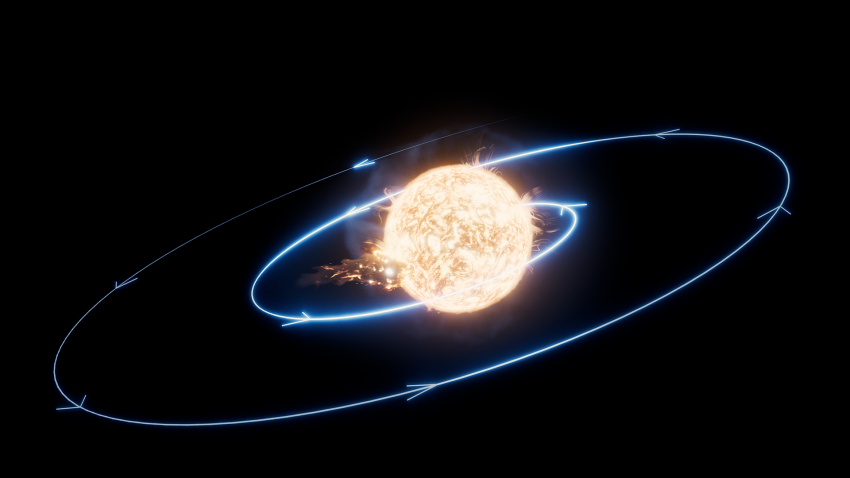
New research suggests that some unusual characteristics of the Sun may be explained if it swallowed a large planet sometime during the Solar System’s formation. Astrophysicists know quite a lot about the behaviour of stars, after centuries of observing and modelling them. We know how they form, what they’re made of, even how they change as they evolve. In recent decades, however, scientists have begun to notice a few things about our own star that are unusual. For one thing, the Sun’s surface appears to be lithium-poor: excessively so. The proto-solar nebula from which the Sun formed billions of years ago is believed to have had two orders of magnitude more lithium than is currently seen in the Sun’s outer shell. So where did all the lithium go? A second oddity has to do with the speed of sound near the bottom of our star’s convection zone. The convection zone is in the Sun’s interior, just beneath the outermost layer. Here, heat is transported around via roiling plasma (as opposed to being transferred via radiation, which happens even deeper within). Astronomers are able to measure pressure waves rising up through the convection zone as they approach the surface. These ‘helioseismic’ measurements tell us about the Sun’s bowels, just as seismic measurements on Earth tell us about the Earth’s own interior indigestion. One bit of information scientists have gathered using these techniques is the speed of sound in different parts of the Sun’s interior. The layers of the Sun. AeroSci, using photos of the Sun by NASA. Attribution (CC BY 4.0) And here’s the weird thing. The measured speed of sound near the bottom of the convection zone does not match our best models of what it should be. Something is off. That’s where this new paper, written by Mutlu Yildiz, Professor at Ege University in Turkey, comes in. He wondered whether both the lithium problem and the speed of sound problem might be solved by the presence of an engulfed planet stirring up the Sun’s guts – the leftovers of a meal eaten eons ago. “By modelling the Sun's evolution and comparing the results with precise observations of its interior, we find that the ingestion of a super-Earth could help explain long-standing differences between standard solar models and observations, including subtle changes in the Sun's internal structure and its depleted lithium abundance,” he told the Royal Astronomical Society. Yildiz modelled a variety of scenarios with different sizes of planets and different compositions, to see if it was possible to recreate the observed conditions within the Sun. Sure enough, one of their models suggested that, indeed, a buried planet could be causing these discrepancies. The planetary characteristics that best reproduce the known features of the Sun suggest an object about 5.6 times the size of Earth: a rocky, but lithium-poor, super-Earth. And we know from studying exoplanets around other stars that planetary migration is quite common in the universe. It's not crazy to imagine a super-Earth forming within the orbit of Mercury: so close that it would have spiralled into the young Sun. The paper does not prove that there is a planet buried in our Sun. But it is striking that it can simultaneously solve several mysteries about the Sun, while also matching other observed features of the Sun like the depth of its convection zone and its chemical composition. Yildiz is hopeful that observational evidence might in future reveal that the planet is really there. “Our paper asks whether the Sun itself could still carry observable evidence that such an engulfment actually happened, and we believe it could. The next step is to see if these fingerprints can be independently detected.”
The Sun May Have Swallowed a Planet
Full Article
Original Source
Read the full article at Universetoday →KhanList aggregates and links to publicly available news content. We do not host full articles from third-party sources. Always verify important information with original sources.