
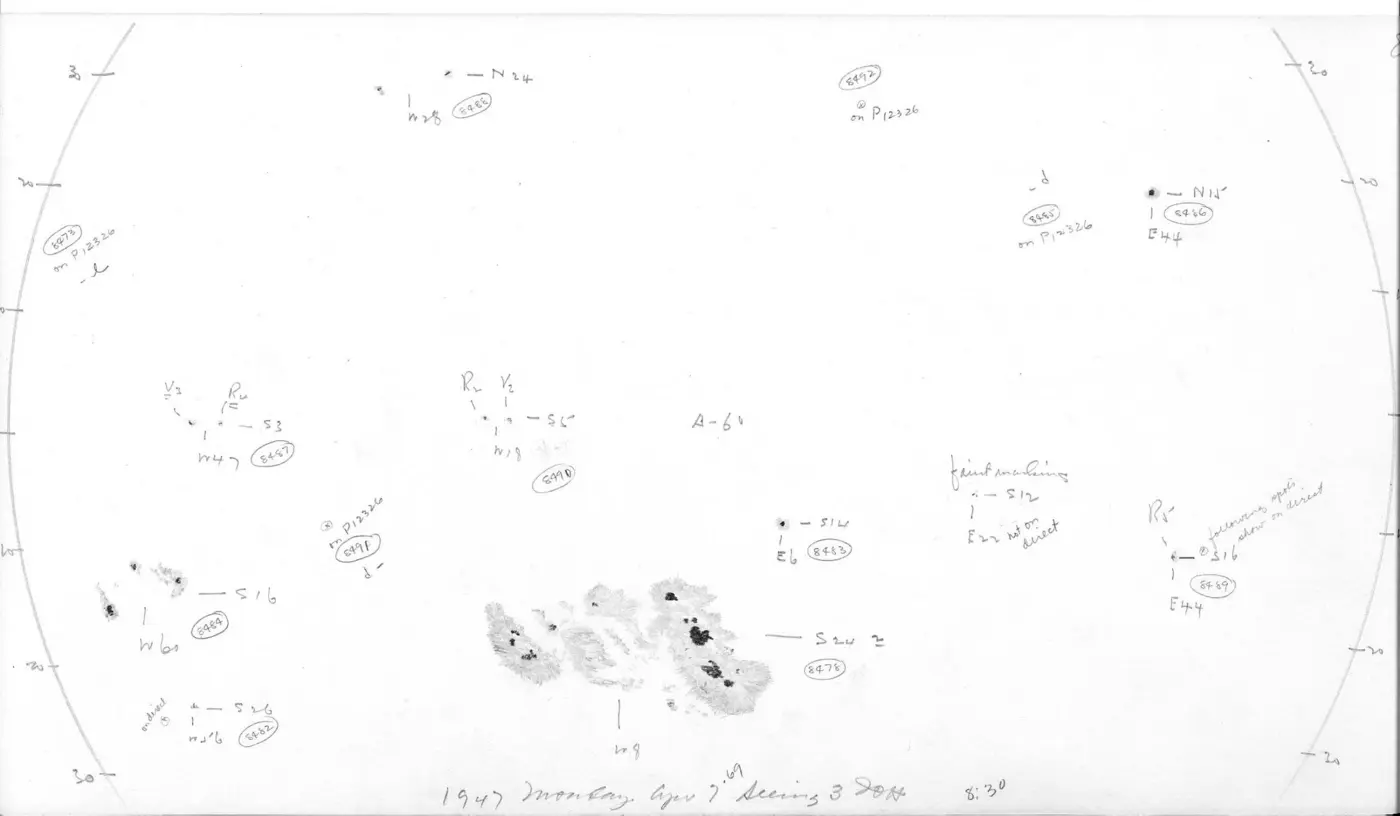
We have long known that the Sun is active. It “flares” quite often, sending huge amounts of energy off in a certain direction - sometimes directly at Earth. But we also know that, compared to other Sun-like stars, it seems relatively quiet, and not capable of producing the “superflares” we sometimes see in its stellar equivalents. That sounds like great news for humanity, and some scientists have even argued that lack of superflares was a critical impetus for the development of complex life on Earth. But a new paper from Natalie Krivova of the Max Planck Institute for Solar System Research and her co-authors in the journal Philosophical Transactions A calls the assumption that our Sun is incapable of such dramatic outbursts into question. That also means that, eventually, our highly technological society could bear the brunt of one of them. Scientists have been collecting data on the Sun for decades, and one of the most interesting features they watch out for are solar flares. These massive outbursts of energy occur when the twisted magnetic fields located in what are known as the Sun’s “Active Regions” (ARs) snap and reconnect, releasing a huge amount of stored energy. Commonly known as “sunspots”, ARs also leave behind a residual glowing area known as “flare ribbons” that occur after their high-power snap-back. Using data collected by NASA’s Solar Dynamics Observatory between 2010 and 2016, the authors analyzed what they believed to be a critical relationship - between the total area of an Active Region, the size of its resultant flare ribbons, and the total energy released during their creation. They found a very accurate statistical correlation that also makes sense intuitively - the larger the active region, the larger the ribbon area, and the more maximum potential flare energy. And critically, they found the flare energy scales exponentially with the ribbon area. Fraser talks about the Carrington Event - the largest solar storm in recorded history. With this understanding, the authors looked even farther back to AR data that had been collected even farther back in history. Perhaps the most famous solar storm in history is the Carrington Event. In 1859, this storm made it possible for people in the Caribbean to read newspapers at night by the light of the auroras it created. But more menacingly, it also made a series of telegraph poles and stations literally spontaneously catch on fire. By the authors’ calculations, the sunspot that presaged the event would have resulted in a maximum energy release of around 10^33 ergs - the unit of measure used for solar storm strength. Not quite “superflare” level, but large enough to align almost perfectly with modern estimates of the storm’s strength based on other factors. However, the Carrington event wasn’t the largest sunspot the Sun has ever produced in recorded history. That title is held by one even more recently - the “Great Sunspot” of 1947. This was more than double the size of the Carrington Event AR. And when plugged into the team’s formula, crossed the threshold into “superflare” territory with a theoretical energy release of over 10^34 ergs. To be clear, the Great Sunspot itself didn’t erupt with that amount of energy. But it did have the potential to - and it means that, at least in theory, our Sun is capable of producing flares in the same order of magnitude as similar stars throughout the galaxy. There are several nuances to that statement, though. First, just because a sunspot of that size formed doesn’t mean it will inevitably erupt in a potentially damaging solar flare. The Great Sunspot itself is a case in point for that. And the conflux of physics that has to happen in order for such a massive spot to form in the first place is relatively rare. Fraser talks about how bad solar storms can get. However, astronomers have previously calculated that such events do happen about once every century. And if it does occur and is pointed at Earth, our way of life is potentially in danger. The Coronal Mass Ejection that would accompany such a flare would potentially wipe out electrical grids over entire parts of the planet, with repair efforts taking months to complete. And we are clearly not prepared for that possibility. Just because such an event can happen doesn’t mean it inevitably will. But as time goes on, it becomes more and more likely that something of that magnitude will erupt from our Sun. Whether we’ll see it in time, and whether we will be prepared for when it does, remains up in the air. But this new paper serves as another reminder that our Sun, while it is critical to almost all life as we know it, can also be extraordinarily dangerous under the right circumstances. Learn More: MPS - Sun: New Evidence of Superflares Natalie Krivova et al. - Empirical flare energy limits for the largest historical sunspots UT - Scientists Spot a Solar Flare With Surprising Spectral Behavior UT - Is the World Ready for a Catastrophic Solar Storm?
The Sun Is Physically Capable of Producing a "Superflare" According To A New Study
Full Article
Original Source
Read the full article at Universetoday →KhanList aggregates and links to publicly available news content. We do not host full articles from third-party sources. Always verify important information with original sources.