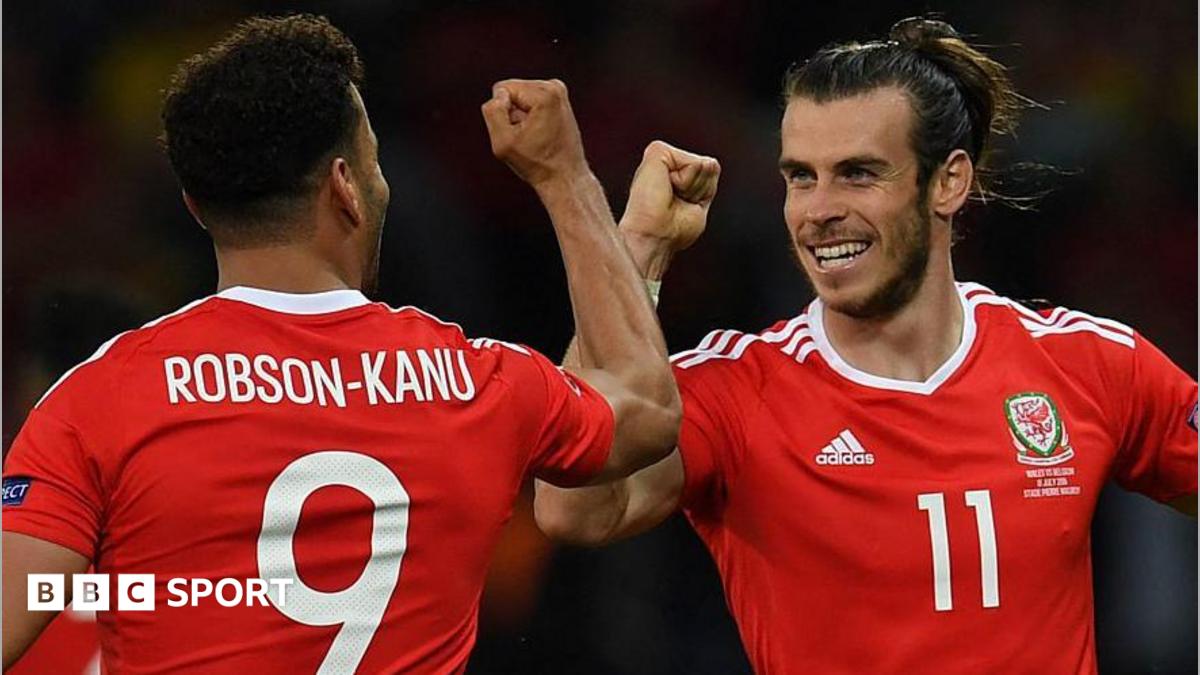
"Walking to the ground in Bordeaux and what I find hilarious, in hindsight, is how low our expectations were."Elis James was not alone.Wales had gone more than half a century without playing at a major tournament, so it was understandable that expectations were modest.Generations of fans had been scarred by agonising near misses and downright dismal failures of the past so, when Wales finally realised a nation's dream by qualifying for Euro 2016, just being there was enough for many.Bordeaux was bathed in sunshine on the afternoon of Saturday, 11 June, tens of thousands of Welsh supporters descending on the French city for their opening game against Slovakia."We were all saying things like, 'Oh, the anthem's going to be good, that's guaranteed'. We could have lost 10-0 but they were definitely playing the anthem," the comedian and presenter tells BBC Sport Wales as part of Iconic: The Summer that Changed Welsh Football.An anthem heard at a major tournament for the first time in 58 years. Glorious catharsis to stir the soul.Wales had ridden a wave of emotion to get there, a golden generation of players - Gareth Bale, Aaron Ramsey et al - scaling new heights under the guidance of their charismatic manager Chris Coleman."I was saying to all the players, 'Keep calm, don't act like we're too excited to be here'," Coleman recalls."But Bordeaux was like the centre of Cardiff, Welsh fans everywhere outside the hotel and, as soon as we were getting on the bus, I was chanting with the fans! I was like, 'What am I doing? Calm down'. I got lost in it."Coleman and his players eventually composed themselves. After a trademark Bale free-kick had put Wales in front, Hal Robson-Kanu came off the bench to score a late winner and send a nation into raptures."Euro 2016 was a turning point for Welsh football," says Ben Davies, the Tottenham Hotspur defender who made a crucial goalline block early in the game."There was so much talk about 1958 and I'd heard about it, I'd seen the odd clip about it, but it felt like a pipedream to actually have Wales in a major tournament."So to do it, forget about how well we did in it, just to even get to that tournament, it gave us a belief that it was possible."For those among the sea of red shirts in Bordeaux that day, it did not feel like life could get any better - but this was only the beginning.This was the summer that would change Welsh football forever.Until Euro 2016, Wales' story had been dominated by tales of heartache, Joe Jordan's handball in 1977 and the Romania defeat of 1993 among many painful chapters.But by getting to France, Wales freed themselves from that history."There had been some really low points for Wales, so to finally do that was a huge achievement," says Ramsey, the then Arsenal midfielder who would go on to be named in Uefa's team of the tournament.Wales had momentum they had never felt before coming into the competition. Victory over Slovakia - and the prospect of getting to the second round - took that to another level.A last-gasp defeat by England in Lens momentarily punctured that optimism, but the final group game against Russia presented Coleman's side with a chance to secure their place in the knockout stages.This was meant to be nerve-wracking for a team with no major tournament experience against seasoned opponents.But under a lilac sunset in Toulouse, Coleman's men played with a flair and verve unlike any other Wales side."That was our best performance," says Coleman. "We were awesome."Wales cut Russia to ribbons with a breathtaking attacking display, racing into a 2-0 lead in 20 minutes.After Ramsey's delicate finish put Wales in front, they poured forward with such gusto that even Neil Taylor scored - the wing-back's first goal since he was playing in non-league for Wrexham six years earlier."When Tayls scored, that summed up how things were falling for us," says Joe Allen, who was exceptional in midfield that night."This was one of those once-in-a-lifetime moments you've got to capitalise on."That is exactly what Wales did. Bale added a third in the second half to become the tournament's top scorer at that point, and the winning margin could have been even wider."We completely dominated them," says Joe Ledley, who ran the game alongside Allen in midfield.As well as Ledley played, though, what elevated him to cult status was his post-match dancing in front of the Wales fans."I don't know where those moves came from," he grins. "I used to dance with my mates all the time at local pubs in Fairwater [in Cardiff]. I just went for it."Wales fans could scarcely believe what they had witnessed. Having already lived a dreamlike existence in France, this was starting to feel surreal.The odyssey took them to Paris next, Wales' first knockout fixture since Pele had scored the only goal as Brazil beat them in a 1958 World Cup quarter-final.This time, Coleman's men had the novelty of being favourites against an obdurate Northern Ireland side, who made life difficult for their opponents in a tense last-16 tie.Bale eventually prised them open – his cross turned into his own net by Gareth McAuley – to set up a quarter-final against Belgium, and what would turn out to be the greatest night in Welsh football history.Wales fans made a lasting impression in France, with their distinctive bucket hats and chant of 'Don't Take Me Home', which became an unofficial anthem of the Euros. Uefa even gave them an "outstanding contribution" award."What I loved about Welsh supporters at the Euros was we were just desperate to enjoy every second and suck the marrow out of it because we didn't know if it was going to happen again," says James."We're there to have fun. I'm not saying the result was secondary, but we all had realistic expectations."No wonder when you consider Wales' quarter-final opponents were Belgium, ranked number one in the world at the time with a squad boasting stellar talents such as Kevin de Bruyne, Romelu Lukaku and Eden Hazard."That Belgian side, on paper, was like a team to represent Earth against Mars," James adds. "It was like a team from space."It did not help matters that the game was essentially a home fixture for Belgium, whose fans filled the stadium in Lille, fewer than 10 miles from the Belgian border.The odds were stacked against Coleman and his players, lengthening further when Radja Nainggolan's thunderous long-range strike gave Belgium an early lead.But Wales believed they could win, not least because they had beaten Belgium in a qualifier in Cardiff 13 months earlier, and they responded magnificently as captain Ashley Williams headed in a deserved equaliser.Then, nine minutes into the second half, Bale played a raking long ball to Ramsey, who found Robson-Kanu in the penalty area. And time stood still."I remember controlling the ball in the box and there was momentum carrying everyone away from the goal," Robson-Kanu says. "I just remember Cruyffing the entire opposition."With a manoeuvre as audacious as it was inspired, Robson-Kanu flummoxed three surrounding Belgian defenders with a Cruyff-turn before finishing supremely beyond Thibaut Courtois."It was an out-of-body experience," adds the forward, who was without a club at the time."Looking back, you realise careers are defined by moments, and to have a moment that you're truly remembered for is a real honour."Belgium pushed desperately for an equaliser but Sam Vokes headed in superbly to seal a 3-1 triumph. The celebrations were as ecstatic on the touchline as they were in the stands; disbelief as it dawned on players, staff and fans that Wales were heading to their first semi-final."There are certain moments in your life that are so good you wish you could just stop it and say, 'Let's just sit in this moment'," says Coleman."That was one of those moments. We got back in the dressing room and I can't describe the atmosphere."Allen, another Welshman in Uefa's team of the tournament, adds: "That's the moment where it crossed from being a good story into, 'This is more than anyone dreamed was possible'."The next, and what would prove to be the final, stop on Wales' magical ride was a semi-final against eventual champions Portugal in Lyon.Shorn of the suspended Ramsey and Davies, Wales were stifled by their canny opponents, who secured a 2-0 win with second-half goals from Cristiano Ronaldo and Nani.This was the end of the adventure in France, but the beginning of a glorious era for Welsh football."It was a really important moment for Wales, our history and generations to come," says Ramsey.Having been absent from major tournaments for 58 years, Wales went on to qualify for a second successive European Championship, before achieving what Davies describes as the "holy grail" of reaching a first World Cup for 64 years in 2022."We opened the door that had been closed a long time," says Coleman.The milestones kept coming, with the women's side qualifying for their first major tournament at Euro 2025.Whereas Welsh national teams only used to dream of playing on the world's grandest stages, there is now an expectation they get there – and that stems from 2016."With more money coming in from qualification for the European Championships, particularly Euro 2016, we ended up being more cash-rich," says Jonathan Ford, chief executive of the Football Association of Wales (FAW) from 2009 to 2021."That enabled us to put more money across the board: women's football, grassroots football. We transformed the women's game."Uefa vice-president Laura McAllister is a former captain of Wales who played a leading role in getting the FAW to formally establish a national women's team in the 1990s."There was nothing inevitable about what happened post-2016 and that's why I think we should give credit to the FAW, and Jonathan Ford particularly, for steering us out of the tournament into that era," says McAllister."I was part of the FAW Trust in 2016. I can remember times before that when Jonathan came into the board and said things like, 'Until the men qualify for a major tournament, we can't invest in X, Y and Z'. And that included the women's national team."While I bristled at that because it felt unfair, the financial realities of the FAW meant until the men got to a position where they generated income from participating and winning, it was going to be impossible for us to deliver the strategy we had for Welsh football."McAllister travelled to France 10 years ago as a fan, and Qatar in 2022 to cheer on Wales' men at a World Cup.When the women played at Euro 2025 in Switzerland, McAllister was there again to see the legacy not only of her own pioneering work in establishing the team but the far-reaching effects of 2016."Something happens when you qualify. It's flicking a switch in mentality - it becomes something realistic and achievable," she adds."What matters far more is what you do with the breakthrough moment, not how you've performed."Wales' women are now trying to take the next step of qualifying for their first World Cup, while the men looked on enviously as their showpiece event happened without them in the United States, Canada and Mexico this summer.Disappointing as it was, that frustration itself represented a shift in mindset that came after Euro 2016 – a sharp contrast to the passive acceptance that met Wales' previous absence from major tournaments.Since that golden month in France, Wales feel like they belong at this level."The best thing we could give the teams coming after us was to say it's possible," says Coleman.Subsequent qualifications have been the legacy of Euro 2016, while future ambitions are proof of a desire to ensure generations to come continue to build on the foundations laid by their predecessors.There is plenty more Wales' men and women want to achieve but, whatever happens, there will never be another summer quite like Euro 2016."We're so proud of each other and what we achieved," says Ledley."Nobody thought we'd do it. When I walk down the street now, everyone says, 'Thank you for 2016, the best summer of my life'."James can attest to that. "It remains the best month of my life," he says. "I don't think you often know it's the best month of your life as it's happening."With the benefit of hindsight, it is laughable to think you could find a Welsh football fan who would disagree.You can listen to all three episodes of Iconic: The Summer that Changed Welsh Football on BBC Sounds.
The summer that changed Welsh football
Full Article
Original Source
Read the full article at Bbc →KhanList aggregates and links to publicly available news content. We do not host full articles from third-party sources. Always verify important information with original sources.