
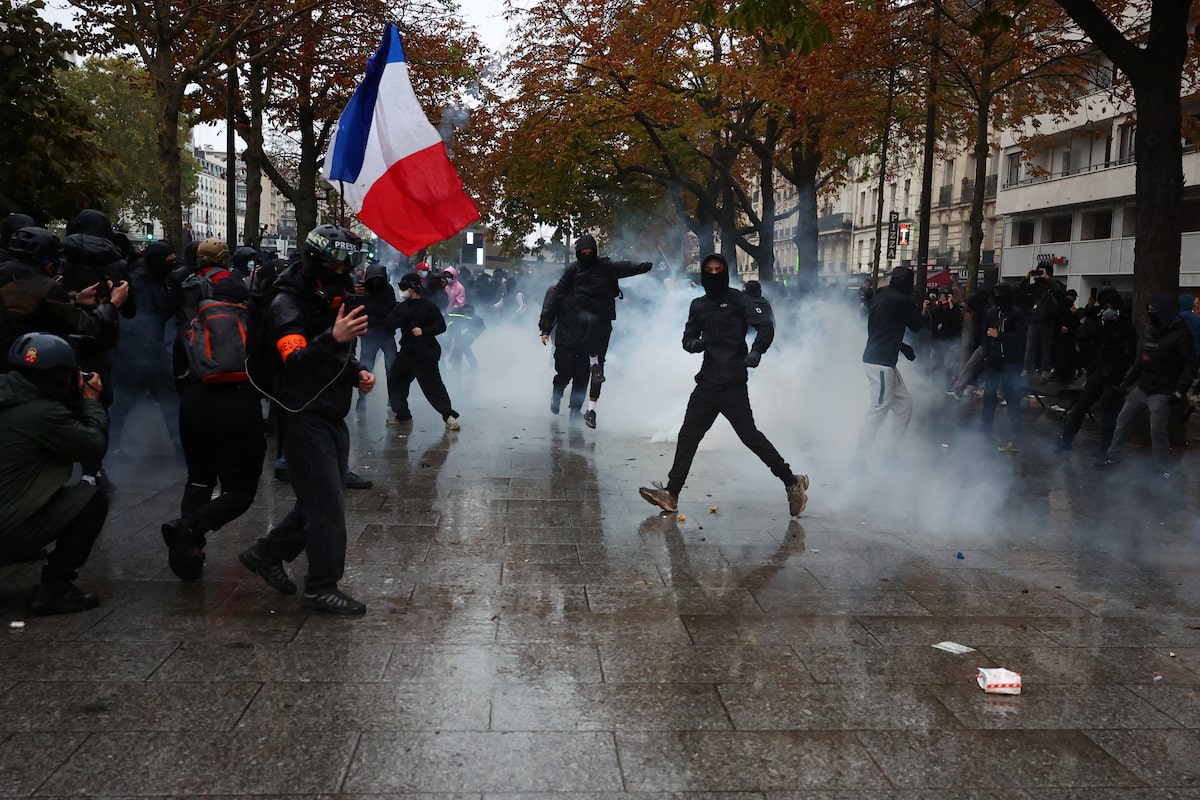
Open this photo in gallery:Clashes in Paris on Oct. 24, as more than 400,000 people protested across France over education funding and living costs.Pedro Nunes/ReutersThe student-led protests that engulfed Paris, Milan, Bologna and other European cities have died down. They will be back. The economic conditions that triggered the mass demonstrations have not changed.Government budgets are coming under extreme pressure and social and welfare spending will suffer. If students and families are angry today about rising prices and declining living standards, they might be doubly angry tomorrow. The protests in Western Europe were triggered by a teacher walkout that began in Créteil, a suburb of Paris, on Sept. 17, over lack of school resources. Students joined the next day. The protests spread rapidly across France, becoming nationwide by late September as they evolved into mass cost-of-living demonstrations.Workers’ unions supported the student-teacher protests and blockades. Chaos ensued when the casseurs, the hooded, provocative protestors who are associated with the anti-capitalist, anarchist left, joined in. Thug looters entered the fray and intensified the violence. Open this photo in gallery:The aftermath of protests in Paris, on Oct. 18.Benoit Tessier/ReutersInspired by the French, similar protests broke out elsewhere in Europe, with Italy at their epicentre. Marches to protest waning education funding and the soaring prices for housing, food and fuel began in mid-October in Milan, Turin and Bologna. They too turned ugly. Shops were looted in Milan and fires were set in the city’s main square. Prime Minister Giorgia Meloni deployed 500 soldiers to the city and gave them policing powers. In southern Italy, truckers angry about soaring diesel prices blocked roads. Food deliveries fell off, causing the loss of millions of euros when mozzarella production was forced to stop, and supermarket shelves went bare. In the last few days, the Western European protests have petered out. But in the Balkans, they are raging away. In Albania, a student and youth uprising – dubbed the Flamingo Revolution – was triggered in May when signs of construction of a luxury seaside resort tied to Jared Kushner, son-in-law of Donald Trump, came with more questions than answers. The development was supported by Prime Minister Edi Rama, whose government had eased restrictions on building in environmentally protected areas. “There was no transparency in this deal,” Afrim Krasniqi, executive director of ISP, the Albanian Institute for Political Studies, told The Globe and Mail. “The problem is with our leaders and their capacity to respect the law and the constitution.”Open this photo in gallery:A protester launches fireworks during an anti-government rally in Tirana, Albania, on Oct. 24.Hameraldi Agolli/The Associated PressThe protests surged and evolved into a mass campaign against a government and its leader that Albanians perceive as corrupt, anti-reform and too cozy with the oligarchs who, in their view, treat the economy as their dinner plate. While the protests are more political than economic, they share an economic element with those in Europe. Young people increasingly view the economy as a zero-sum game: I lose, the rich win. “This is a protest against the establishment,” Mr. Krasniqi said. “The young people here say they go to university but have no future because the oligarchs control everything.”Albanians are inspired by the largely peaceful Serbian uprising that began two years ago as an anti-corruption, anti-cronyism campaign and expanded into a political backlash against the country’s populist, strongman leader Aleksandar Vucic. The results were sensational. On Sunday, Mr. Vucic, who had been president since 2017, conceded defeat in an election that was won by the Student List, a grassroots movement made up of students, university professors, actors and farmers. Their victory is bound to inspire student movements elsewhere in Europe. In Western Europe, and possibly in the Balkans and elsewhere in Eastern Europe, the economic recipe for more protests is in place. Young people in Europe find themselves on the have-not list. The post-Cold War peace dividend that was a gift to their parents and grandparents is vanishing. Rising pensions and well-funded health care and education systems are no longer guaranteed.The peace dividend saw once-hefty defence budgets shrink, allowing increased spending elsewhere. At the same time, low interest rates, low inflation, relatively low energy costs (with occasional spikes) and fairly solid GDP growth of 2 to 2.5 per cent a year in the 1990s and into the 2000s were any finance minister’s dream. Then came the 2007-08 financial crisis, the Greek-inspired sovereign debt crisis that crippled many banks, the COVID-19 pandemic, Russia’s invasion of Ukraine and, now, painful energy prices that are largely the result of the U.S.-Israeli attack on Iran earlier this year and the widening wars in the Middle East. Explainer: Why is the French economy, and the country in general, in such a mess?Inflation rates are stubbornly high. Sovereign bond yields and, ultimately, the cost of servicing expanded levels of sovereign debt, are climbing. In France last week, 10-year yields topped 5 per cent for the first time since 2002. At the same time, GDP growth is low – high growth rates helped keep government budgets intact – and defence spending is climbing fast.In a July note, Morgan Stanley said, “For several decades, the region’s nations could afford to expand welfare programs because declines in defence spending and debt costs helped to absorb the expense. Now that backdrop is changing as aging populations drive pension costs higher, interest rates increase the cost of servicing debt and geopolitical tensions require greater investment in defence.”This economic reality means EU governments will have to make some hard choices. To keep welfare-state budgets fully intact, they will have to borrow more, which could backfire by raising debt loads and deficits and putting credit ratings at risk. Or they could trim budgets, or merely raise them at less than they had expected a few years ago. Pensions seem sacred. Something has got to give and that may be education and health care budgets. The bottom line is the budgets’ bottom line. Governments will deliver less. Anger among the young will rise. There will be more protests as Europe enters a tight, new fiscal era.
The student-led protests in Europe may have died down, but they will be back
Full Article
Original Source
Read the full article at Theglobeandmail →KhanList aggregates and links to publicly available news content. We do not host full articles from third-party sources. Always verify important information with original sources.