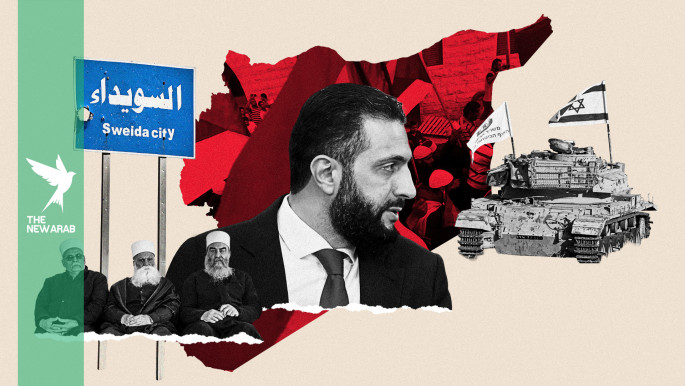
Syria's southern province of Suweida remains mired in crisis a year after violence between Bedouin militias, Syrian government forces, and Druze armed groups killed around 1,700 people. The death toll includes 1,342 Druze civilians killed by Syrian government forces and Bedouin militias in what has been described by activists and the UN as a massacre. In the year since, the crisis has only grown more complex. Questions over the Syrian government's ability, or willingness, to deliver transitional justice have fuelled deep scepticism among the Druze community, while a hardened frontline has emerged alongside a new authority in Suweida that appears unwilling to negotiate and increasingly reliant on Israeli backing for security. The stakes, however, extend far beyond the province itself. Razan Rahidi, Executive Director of the Syrian Campaign, told The New Arab that "a just and peaceful transition for Syria is not possible while entire communities are isolated, living in fear and awaiting truth and justice". Transitional justice central to Suweida's future Rashidi said Syria's transitional government must prioritise several steps to rebuild trust in Suweida. These include pursuing an inclusive political solution, ensuring independent and impartial proceedings for trials, ensuring guarantees for the return of internally displaced persons (IDPs), and doing more to end the proliferation of hate speech and incitement to violence. On 1 July, the government began judicial proceedings following an official investigation into the massacres in a bid to establish facts and hold those responsible to account, regardless of position or affiliation. It comes after the Syrian government and the UN released findings of separate investigations into the events. The Syrian government has laid the blame on low-level individuals rather than senior officials and has disregarded any systematic level of abuses. The UN's Commission of Inquiry on the Syrian Arab Republic (CoI), however, noted systematic violations on the part of government forces. Fadel Abdul Ghani, the Director of the Syrian Network for Human Rights, described the start of trials as a "positive and necessary development". "Nevertheless, the information publicly available to date does not establish that comprehensive, independent, and non-selective accountability is in place," he told The New Arab. "The appropriate position is therefore one of conditional support accompanied by rigorous critical scrutiny." Over 1,300 Druze civilians were killed by Syrian government forces and Bedouin militias in July 2025, in what has been described by activists and the UN as a massacre. [Getty] Ghani highlighted several positive aspects of the process, which had its second hearing on 13 July, including the start of judicial proceedings - unprecedented in Syria's history - and a stated commitment to accountability regardless of status or affiliation, public hearings, and access to defence counsel. However, he raised several shortcomings and reservations, including insufficient public information, the number of defendants in each case, their affiliation at the time of the massacres, the charges, mechanisms for witness protection, and the process of appeals. Ghani also took issue with the use of military courts in the trials, raising broader concerns about ensuring equality of the law and of responsibility. He added that transitional justice was essential to "address the full consequences of the events in Suweida," calling on the state to ensure the provision of truth, justice, reparations, the return of IDPs, institutional reform, and guarantees of non-recurrence. The UN's Commission of Inquiry on the Syrian Arab Republic echoed Ghani's remarks, saying in a statement to The New Arab that though the beginning of trials was positive, there is a lack of information on a host of issues, including on the nature of the crimes and on how victims can participate in the process. The CoI said it "would expect to see more information and communication to the victims and affected communities concerning efforts to hold perpetrators at all levels to account and the steps taken to ensure non-repetition". Though there has been progress, "one year on, the civilians of Suweida remain in limbo and redoubled and visible efforts are needed in each of these areas to address the justice needs of all the people of Suweida", it added. 'Zero faith' in justice and the government Despite the judicial process in Damascus, the Druze community remains deeply sceptical of the government and its accountability efforts, according to activists and monitors from Suweida who spoke to The New Arab. Loubna al-Basset, a Druze activist, said that people in Suweida don't recognise the trials, noting that the government and its forces carried out the massacres. "On that basis, it is illogical to recognise politicised courts that serve the same authority," she told The New Arab. "How can the executioner also be the judge? Especially when, to this day, there has been no official acknowledgement by the Jolani [Sharaa] authorities of these crimes," she added. Despite ongoing public trials in Damascus for individuals involved in last year's violence in Suweida, the Druze community remains deeply sceptical of the government and its accountability efforts. [Getty] Khuzama Aldebs, a member of the Fajawat collective, which researches and monitors the political situation in Syria, says that residents were left traumatised by the violence after initially hoping the post-Assad period would bring improvements. "They know that these people who hold power in Damascus are just killers and murderers; because at the beginning it was a feeling of shock, you could not believe what was happening," Aldebs, who grew up in Suweida, told The New Arab. Syrian writer and human rights activist Sara Hunaidi said she had little expectation of justice from the government, citing cases where families of victims killed by government forces were told to change the cause of death of their loved ones in order to attain death certificates. "These daily, small micro-aggression acts like these are what makes me have zero faith in any justice process, and in anything that the Syrian government does," she told The New Arab. No return for the displaced In the aftermath of the massacres, Suweida remains outside of government control, with the UN reporting that some 200,000 people, including around 155,000 Druze, are still internally displaced. During the violence, some 35 Druze or mixed villages were burned and looted in the province. The UN cited these attacks as part of its assessment that the events amounted to a systematic targeting of the Druze community. The return of IDPs has since stalled. Hunaidi cited cases where returnees were killed by government forces, including the killing of four Druze men in al-Matouna who went back to their village in February. The incident is also being overseen in a trial in Damascus, according to Ghani. Both Hunaidi and Aldebs said that government forces had painted over burnt houses as part of reconstruction efforts, arguing that this could compromise evidence and did not address the underlying insecurity. "People don't feel safe to return and live under the interim government forces who killed them," Hunaidi said. Increasing online sectarianism against the Druze community is also inhibiting IDP returns, with many in Suweida becoming disappointed in wider Syrian society. Civil society groups have accused militias affiliated with Druze leader Hikmat al-Hijri of acting like a 'mini dictatorship' in Suweida. [Getty] Earlier in June, the UN's Deputy Special Envoy for Syria, Claudio Cordone, told the Security Council that there had been "no progress" in confidence-building efforts between Druze authorities in Suweida and the government in Damascus. Aldebs told The New Arab that within Suweida there are those who say that the community has no choice but to negotiate, though given the increasing sectarianism, trust would likely take decades to build. 'Political games' and a hardened frontline In the aftermath of the violence, a political deadlock between authorities in Suweida under spiritual leader Sheikh Hikmat al-Hijri and the government in Damascus has ensued. According to Mouaz Moustafa, Executive Director of the Syrian Emergency Task Force, there have been back-channel negotiations alongside efforts to release detainees and those kidnapped by both sides, which had been called for by the CoI in its statement to The New Arab. "Hijri's militias act more like a mini dictatorship than a true representative of the people of Suweida," Moustafa told The New Arab, adding that Hijri has publicly been unwilling to talk to Damascus, leading to a political standstill. According to Muaz Al Abdullah of the conflict monitor ACLED, this deadlock between the Syrian government and Hijri is part of a larger political play between both sides, making prosecutions for accountability more of a "political game" than an authentic attempt at transitional justice. "Even if high-ranking leaders of the government forces are held accountable and put in prison, al-Hijri will not look at this step as a sufficient step for them to start to regulate or normalise relations with Damascus, because there are many other obstacles," he told The New Arab. This includes members of the Assad regime seeking refuge and becoming part of Hijri's Suweida National Guard. Hijri has both publicly called for support from, and thanked, Israel and issued statements insinuating the province would secede from Syria. Israeli airstrikes in southern Syria in July 2025 took place following calls from Israel’s Druze community to protect those in Suweida, with strikes also hitting the defence ministry building in Damascus. In the absence of a political breakthrough, Abdullah detailed a hardened frontline that is spilling over into civilian suffering in Suweida "on multiple levels". ACLED has registered monthly clashes on the frontline which have killed 84 civilians since a 19 July, 2025 ceasefire halted the violence, with 64 attacks and abductions leading to 53 civilians being killed. This includes 21 carried out by Suweida National Guards. There has also been an aid crisis in the province, including shortages of bread and fuel, with local government employees, including national guard members, waiting for salaries, and Jordanian airstrikes targeting continued Captagon smuggling through the border. These broader issues "won't be solved unless there is an agreement between both fighting parties; the government of Syria and the Suweida National Guard," Abdullah said. Oliver Mizzi is a journalist at The New Arab Follow him on X: @OllyMizzi99 or on Bluesky: ollymizzi99.bsky.social Edited by Charlie Hoyle
The struggle for Suweida's future: A test for Syria's transition
Full Article
Original Source
Read the full article at Newarab →KhanList aggregates and links to publicly available news content. We do not host full articles from third-party sources. Always verify important information with original sources.