
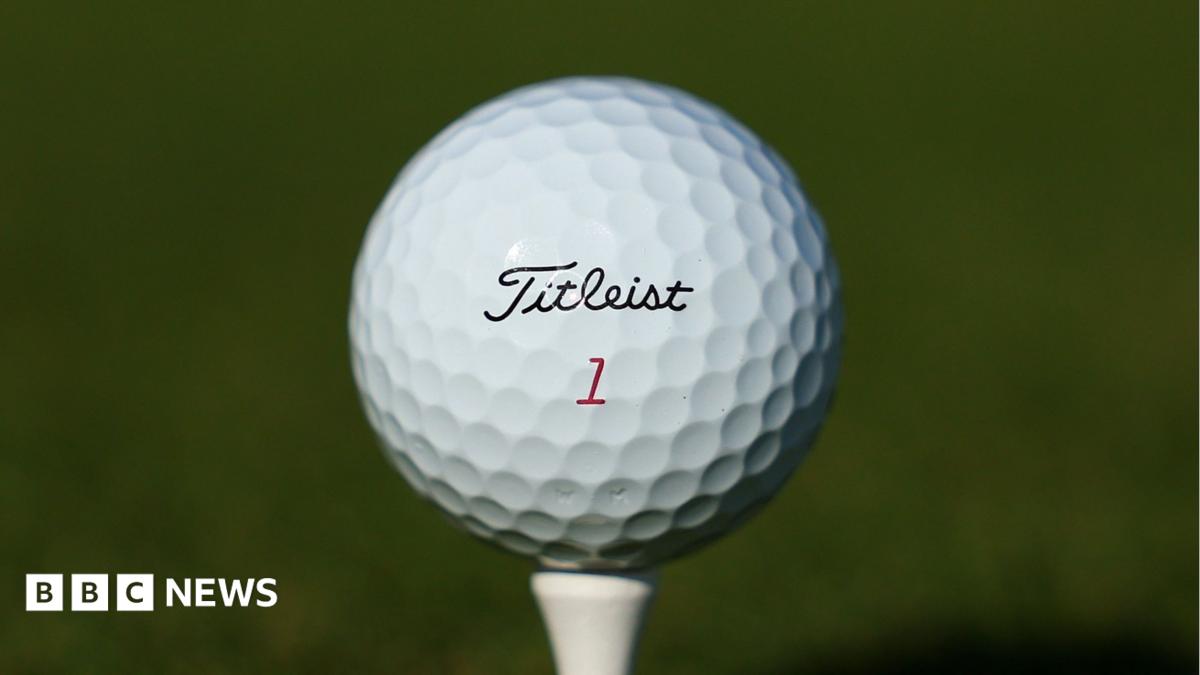
Gavin Bottrell, who makes replicas of old and rare golf balls and owns Timewarp Golf in Warwickshire, said for several hundred years, golf balls were made of leather sewn together and stuffed with feathers - which were called featheries.Then, from the mid-19th Century, Bottrell said golf balls began to be made from gutta-percha - a natural tree sap - but golfers found they did not fly very well."They knew empirically that they needed to mark the surface of balls, but they didn't know why," Bottrell said.Taylor founded lens making company Taylor Hobson with his brother in 1886, with the firm producing large numbers of camera lenses of such "high quality", The Royal Society said, they were desired all over the world.In a bid to temporarily escape from the demands of his career, Taylor started playing golf.According to the firm he founded, it became common practice at the time to produce balls with "irregular" patterns. However, Sophie Edwards said the results "weren't consistent"."He [Taylor] was a very skilled engineer and he'd taken golf as a hobby to relax, but obviously decided also that he would seize on this problem," she said.Taylor settled on a dimpled surface design for a golf ball, and patented it alongside his mechanical driving machine for testing the balls, according to The Royal Society."He was the guy who really developed it," Gavin Bottrell said. "I mean, like a lot of things, there were other people probably working on it at the same time, because even then golf was a big business to be in. "The boom time for golf was actually between 1890 and 1900. That's when golf really exploded as a past-time. "And so it was a huge market potential for anybody who could develop a better golf ball."The United States Patent Office received Taylor's application in 1906, and granted it in 1908."Be it known that I, William Taylor, a subject of the King of Great Britain, residing at 57 Sparkenhoe street, Leicester, in the county of Leicester, England, engineer, have invented certain new and useful improvements in golf-balls," an extract of the document reads.It adds the main objective of the invention is to "obtain better results in the flight of the ball in the direction of a sustained hanging flight giving a flat trajectory with a slight rising tendency".According to golf equipment firm Titleist, dimples reduce the drag force on the ball.Bottrell added the design Taylor came up with consisted of quite "big dimples" compared to modern golf balls, with balls starting to look like modern ones from about the 1930s onwards.
The story of how golf balls got their dimples
Full Article
Original Source
Read the full article at Bbc →KhanList aggregates and links to publicly available news content. We do not host full articles from third-party sources. Always verify important information with original sources.