
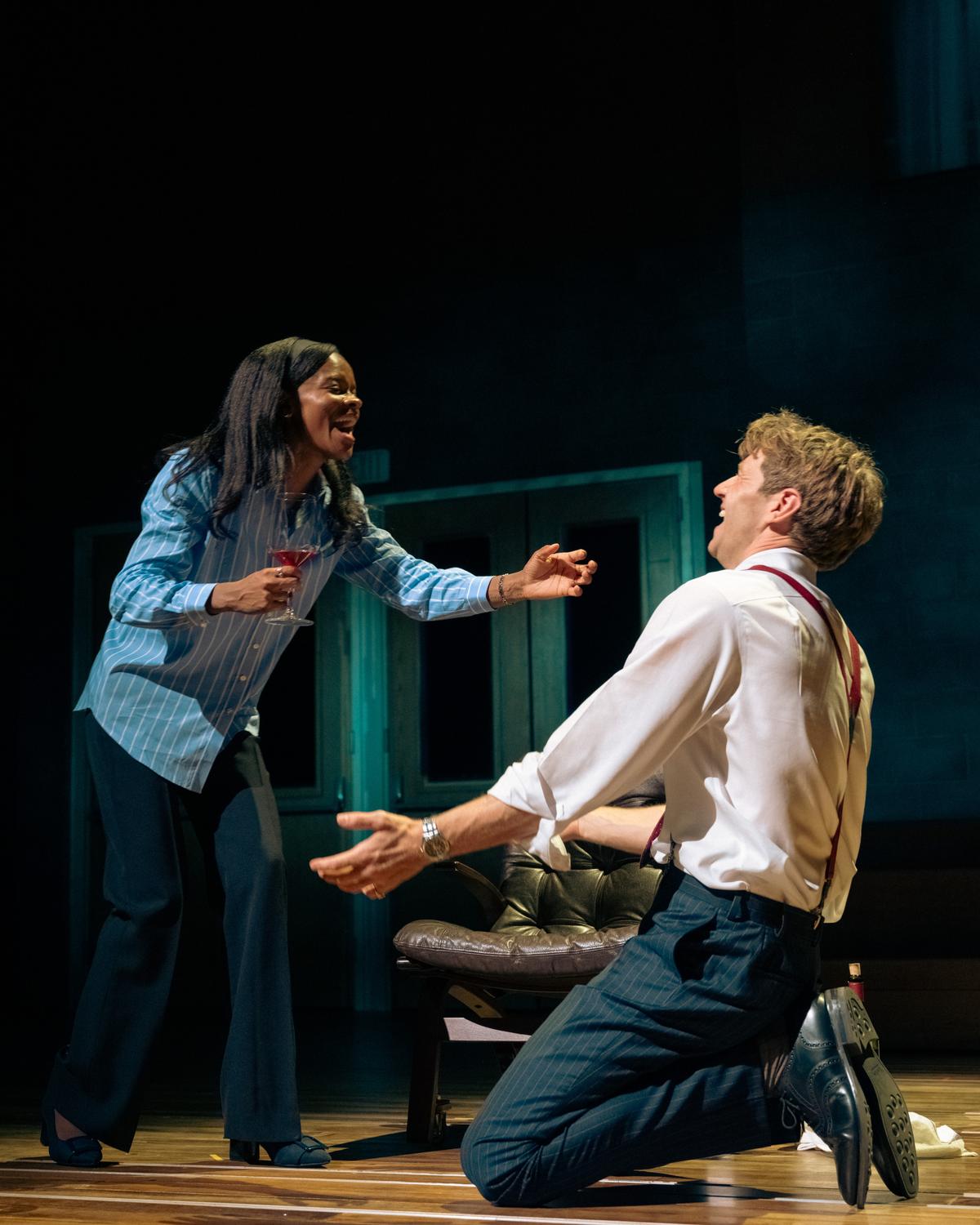
A cracking melodrama about race and the media in America, Tracey Scott Wilson’s 2003 play has the pace and punch of a superior streaming drama, and twists into intriguing directions. Clint Dyer’s production features bracing, full-throated performances from the British Black Panther star Letitia Wright and US stage and screen veteran Lorraine Toussaint. It’s funny and provocative and goes places a British play might not.We first see a black high-school choir rehearsal; then the random shooting of a white teacher from a wealthy family in a black area; then the offices of a newspaper called The Daily, where Wright’s young black hotshot reporter Yvonne is about to start work. Fast cuts and parallel or overlapping scenes are a hallmark of Wilson’s style. The setting is carefully non-specific but suggests Chicago.Yvonne’s CV boasts stints at Harvard and the Sorbonne and a facility with four languages. Her white boss and boyfriend Jeff (a suitably rangy and clean-cut Wilf Scolding) is the scion of the family that founded The Daily. Initially, we later learn, as a pro-segregation mouthpiece.Yvonne is irked to be assigned not to the newsdesk with a fast-track to foreign postings and management, but to the Vanguard section. Here Pat (Toussaint), an implacable, battle-scarred veteran of the 60s Civil Rights movement, and the younger Neil (Ashley Thomas) process all the paper’s “urban” (ie black) stories.Handed endless assignments about community centres by the hostile Pat, Yvonne comes up with an incendiary scoop: that a member of a black girl gang killed the teacher, not a black man. This scuttles Neil’s somewhat flimsy theory that the man’s white, grieving and pregnant widow ordered a hit. When Yvonna is stabbed, Pat must decide what to do with the powerful but unsubstantiated story.Antonia Bernath (Jessica Dunn) and cast in The Story at the National Theatre Feruza AfewerkiWilson is good on the supercharged tensions of American society. The arrest of countless youths after the murder triggers protests, which in turn spark cross burnings in Arkansas. Yvonne’s story expands police brutalisation from black boys to black girls.Wilson wades boldly into prejudices within the black community, particularly between low and high achievers: Yvonna talks about “ignorant n*****s” and is herself slurred as an “Oreo”, and worse. And between men and women: Neil mocks “uncertain sisters” who don’t know where to place themselves in society, and Pat brutally debunks the idea of egalitarian 60s solidarity. The script probes the degree to which Yvonne and Jeff fetishize each other’s skin colour and background, with savage humour.Wilson is also good on the romance of newspapers – the thrill of the deadline and securing the front-page splash, the urge not to let facts get in the way of a good story. As someone who’s spent most of his life in print, I approve heartily of this, and of Wilson’s willingness to play fast and loose with the tedious reality of newsroom life to ramp up tension.The play can’t help but look dated in the online perma-storm of today of course, where unreliable narratives are the norm. (And this is an issue that the superhero universe of which Wright is sometimes a part has had to address: Superman and Spider-Man worked for newspapers. Could they operate as TikTokers? No.) The script has been half-heartedly updated to 2011, so journalists confusingly use payphones as well as cellphones, and edit on paper.The main plot twist might also look improbable, were it not inspired by a true case, and backed up by countless other real-life examples, here and in the US. There are still soap-operatic elements, but they are sold with conviction.Read MoreWright and Toussaint are coruscatingly powerful as the play’s mirroring leads. Thomas and Scolding flit nimbly from amusing to sinister in the supporting male roles. Rising talent Aliyah Odoffin contributes a vivid and crucial cameo.I suspect Clint Dyer would have preferred a smaller stage: the hectic action and snappy exchanges in his production are somewhat strung out on the daunting Olivier stage, but he orchestrates the overlapping scenes superbly. This is a big, bold, entertaining swing at major issues, led with considerable star power.
The Story: Cracking melodrama about race and the media in America
Full Article
Original Source
Read the full article at Standard →KhanList aggregates and links to publicly available news content. We do not host full articles from third-party sources. Always verify important information with original sources.