
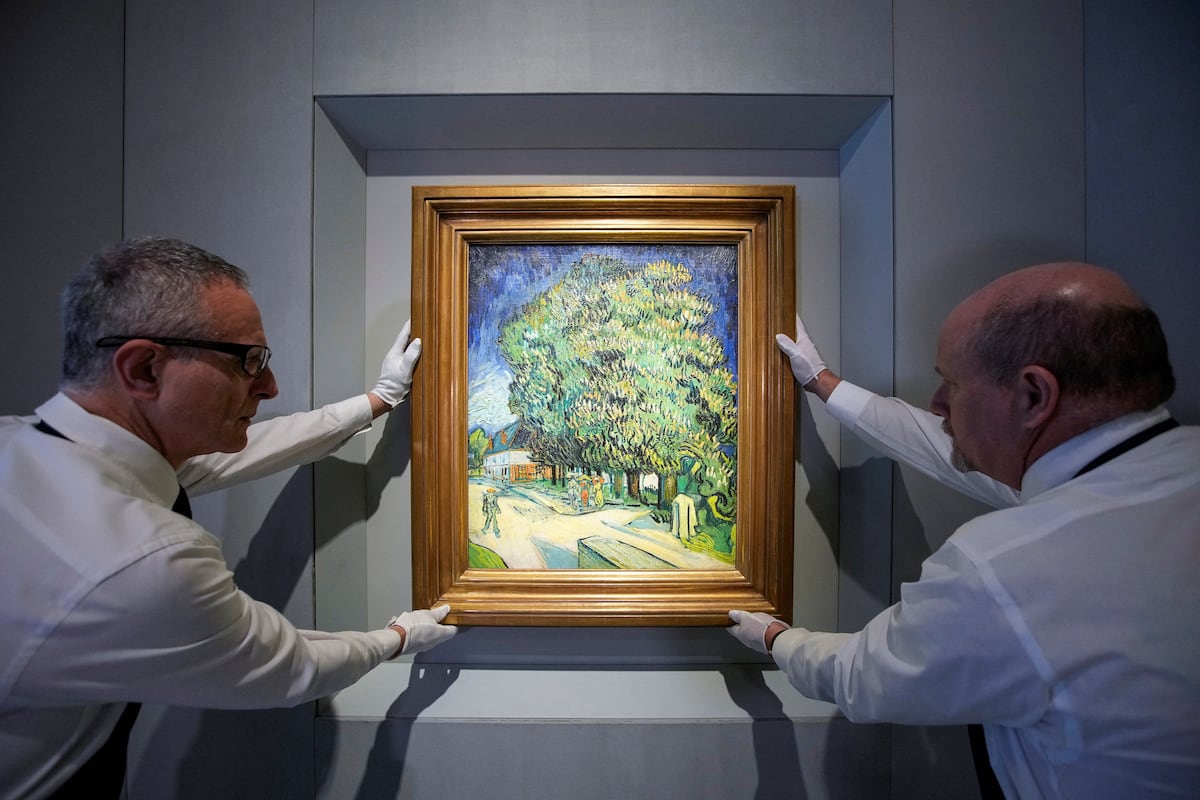
A painting by Vincent van Gogh valued at about $180 million will go up for auction on Wednesday, November 18, weighed down by its journey through Nazi Germany and Argentina’s military dictatorships. A last-minute agreement between the current owners — the children of wealthy Argentine couple Nelly Arrieta and Carlos Pedro Blaquier — and the heirs of the painting’s former Jewish owner, who tried to challenge the sale, will allow this highlight of the Arrieta-Blaquier collection to change hands.Châtaigniers en fleurs was painted by the Dutch artist in May 1890, in his final weeks of life, soon after he left a psychiatric asylum.“A period in which he explored his inner emotional world through the landscapes and people around him in Auvers-sur-Oise,” Simon Shaw, a senior adviser at Sotheby’s, said when the auction house announced it would put the work up for sale on November 18.The painting’s former owner was the Jewish publisher Samuel Fischer, who bought the work in 1909 and founded the German publishing house S. Fischer Verlag. Decades later, with the rise of Nazism in Germany, the firm faced censorship. Amid persecution, Fischer’s descendants fled Berlin for Vienna with the painting. They sold it in 1936 through a gallery in Amsterdam, three months after leaving Germany.The painting now forms part of an impressionist and post-impressionist collection assembled from the 1960s by the late Argentine collector Nelly Arrieta de Blaquier and her husband, sugar magnate Carlos Pedro Blaquier, and is being sold by their children. The collection includes works by other artists such as Cézanne, Paul Gauguin, Claude Monet, Renoir, and Edgar Degas, among others. The works date from 1875 to 1905 and are estimated to be worth about $480 million.Alongside Cézanne’s Harlequin, Châtaigniers en fleurs is the most valuable item in the collection, and Wednesday’s lot is expected to set a new record in the art market. “In my 30-plus years at Sotheby’s, I’ve never had the privilege of handling a collection of quite this content and caliber,” Sotheby’s head of impressionist and modern art, told the Associated Press.The announcement had already attracted wide attention, but a week before the auction the heirs of the painting’s former Jewish owner asked Sotheby’s to withdraw the work from the sale, “arguing that it was sold under duress in 1936 as a consequence of persecution by the Nazis,” reporter Catherine Hickley wrote for The New York Times from Berlin on November 13.Sold under duressThe lawyer for Samuel Fischer’s heirs, who now live in the United States, told the newspaper that their relatives sold the work out of necessity and, in challenging the sale, asked Sotheby’s to prove the painting was sold at market value in 1936 and that the family “would have carried out the sale even without the Nazi regime.”At first, the Blaquier family distanced itself from Fischer’s accusation. It declared itself the “legitimate owner” of the painting “for more than 50 years” and said it had “purchased the work in good faith from a leading international gallery.” The painting entered their collection in 1975, a year before the coup that installed Argentina’s last dictatorship. In a statement, the heirs also emphasized that Châtaigniers en fleurs had been publicly exhibited on several occasions without any claim emerging.Still, they said they were open to negotiation — a process that has borne fruit and will allow the painting to be auctioned on Wednesday, Sotheby’s said in a statement. The auction house, which acted as mediator, declined to disclose the terms of the agreement but made clear it had the Fischers’ approval. “We are grateful for the trust and for the fair negotiation and collaboration of Sotheby’s and the Blaquier-Arrieta family, which has made it possible to acknowledge the suffering of the Fischer family during the Nazi era and to honor Gisela Berman’s pursuit of justice,” the claimants said.The deal was all but inevitable. Journalist and author Claribel Terré Morell, who wrote the book Traidores del arte (Traitors to Art), predicted that “both families will reach an agreement and one will receive a percentage of the sale. It’s something that has already happened in other cases. It may not be fair, but it is smart. Cases like this could occur again not only in Argentina but elsewhere in Latin America, where there are other families that bought works legally without knowing they had been stolen, looted, or sold under duress.”For Terré Morell, a well-known researcher and public educator on art crimes in Latin America, a collector who plans to invest some $180 million in a work “does not want the piece in question to have a sensationalized history that pits families against one another over ownership and that carries a burden including death and persecution during the Nazi era of World War II.”The controversy over the painting has also rekindled scrutiny of the Blaquier family’s history, particularly of the late patriarch, sugar magnate Carlos Pedro Blaquier, over his alleged responsibility for the disappearance of a group of workers from the Ledesma sugar mill, which he owned, during Argentina’s military dictatorship (1976–1983). In 2012, Blaquier was accused by the justice system of participating in the illegal detention of 29 people in Jujuy in July 1976, in an episode now known as “the blackout night.” But the case never went to trial and he died in 2023.Sign up for our weekly newsletter to get more English-language news coverage from EL PAÍS USA Edition
The story behind the Van Gogh going under the hammer at Sotheby’s: From Nazi plunder to the Argentine dictatorship
Full Article
Original Source
Read the full article at English →KhanList aggregates and links to publicly available news content. We do not host full articles from third-party sources. Always verify important information with original sources.