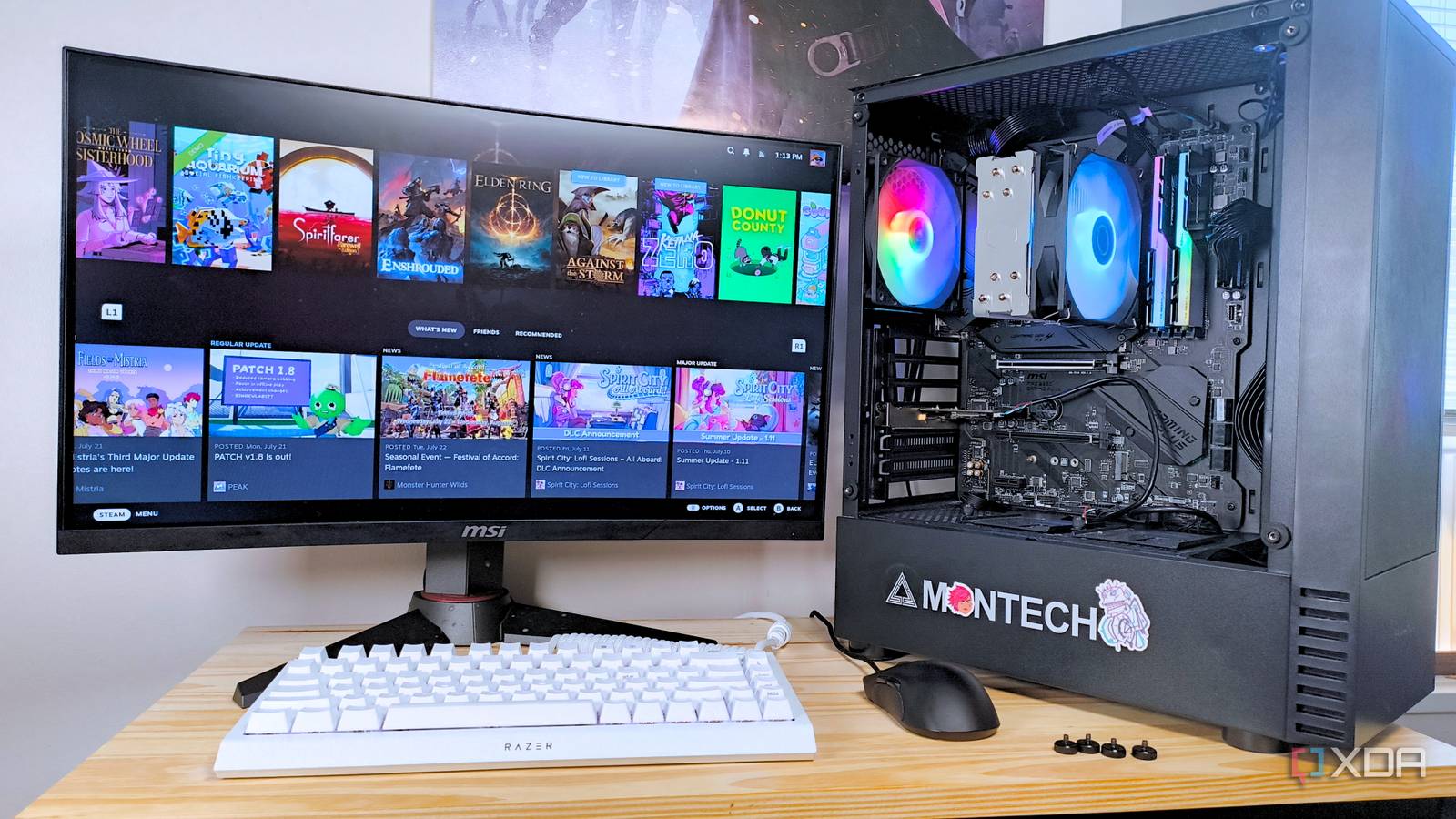
Published Jul 27, 2026, 8:00 PM EDT His love of PCs and their components was born out of trying to squeeze every ounce of performance out of the family computer. Tinkering with his own build at age 10 turned into building PCs for friends and family, fostering a passion that would ultimately take shape as a career path. Besides being the first call for tech support for those close to him, Ty is a computer science student, with his focus being cloud computing and networking. He also competed in semi-pro Counter-Strike for 8 years, making him intimately familiar with everything to do with peripherals. The Steam Machine finally shipped, the reviews are in, and the verdict on its silicon is blunter than Valve would like. Independent testing puts its GPU somewhere around a Radeon RX 6600, an Intel Arc B570, and an RTX 3060. These are all respectable cards if you had purchased them during their respective eras, but Valve is charging a premium for it. You receive more than just a normal PC for your money, but in terms of a pure price-to-performance ratio, you can do a lot better by just buying a cheap pre-built. The silicon is already behind RDNA 3 was old news before the Steam Machine even released In terms of the actual silicon inside the "GabeCube", it sports a semi-custom RDNA 3 GPU with 28 compute units, 8 GB frame buffer, and a power ceiling of about 110 watts. On paper, this puts it within reach of a desktop RX 7600 on its best day. In practice, you're looking at performance in line with the RTX 3060, which, in fairness, just had its production restarted, but it's still a GPU with a 2021 release date. When compared to a cheap prebuilt sporting an RTX 5060 or RX 9060 XT, it's not pretty. These are current-gen cards with the same or higher VRAM buffer, offering much greater performance than what's found in the Steam Machine. The CPUs in these prebuilts are usually respectable, but for the same price or lower than that of Valve's box, you're usually stuck with 14th or 13th Gen Intel, and on the AMD side of things, it's almost exclusively AM4. Most choices around this price point will not be any less performant in games than what you get out of the Steam Machine. Spending less for more flexibility An ATX box really isn't that bad as an HTPC Steam Machine's entry configuration is the 512GB model without a controller, and it's sitting around a grand. Prebuilts that out-spec Valve's box are easily found at and even below this price, and some of them are even mATX builds. Yes, the memory and NAND shortage has inflated everything in 2026, the Steam Machine included; Valve has been open that it's selling the box at cost precisely because component prices ran away from it. But that shortage taxes the prebuilt too, though the performance math is much friendlier. Not only are you spending less money for more frames, but you're also buying the ability to upgrade your system in the future. Yes, some of these systems are living on dead-end platforms, but that doesn't mean that there's zero room for a CPU upgrade, and upgrading the 5060 that's in most of these systems usually just takes a PSU swap along with the new card. You can add memory when it gets more reasonable to do so, too. You'll never be completely limited by the silicon inside the chassis like you would be with the Steam Machine, which, besides memory and storage, is non-user upgradable. The performance you see today is the performance you're going to get in 5 years. The Steam Machine is more than just a normal computer Performance is the last reason anyone would buy it in the first place Credit: Steam Store | Valve To be fair to Valve, price to performance wasn't really ever supposed to be the pitch for the Steam Machine. It was never trying to top benchmark charts, and that was clear by their choice to go with older silicon. It's a SteamOS appliance, first and foremost. It's a quiet, palm-sized cube you tuck under a TV, switch on, and play, with no Windows housekeeping and a library verified to just work. Set a mid-tower next to it in the living room and the tower loses on every axis that isn't frame rate. It's bigger, louder, and it wants a lot more configuration to get up and running as a couch PC. That configuration cost is minimal Even on Windows While you can't shrink an ATX box down if the parts inside are also all ATX, you can certainly turn any PC into a competently functioning HTPC. If you want the SteamOS experience, loading something like Bazzite or CachyOS is a great substitute, but even in the case of Windows, it's possible to have a really nice plug-and-play couch experience. It just takes a little setup, and it's minimal. Setting up a local account that automatically logs in and starts Steam in Big Picture Mode is 90% of the way there. And that's how you can have your cake and eat it, too. A PC that's not woefully under-equipped from the moment it's plugged in, and one that's easily accessible from the living room couch is possible to have. The Steam Machine isn't for anyone looking for true 4K at 60 FPS The Steam Machine is a well-made thing with a real audience, and if what you want is a silent console for your Steam library, buy it with a clear conscience. But if you're looking for an HTPC that can handle the 4K60 that Valve originally advertised, you're not going to get very far with it. A prebuilt for at or under the price of the base model will be a far better fit for maximizing price-to-performance.
The Steam Machine's GPU is already obsolete, and a cheap prebuilt PC proves it
Full Article
Original Source
Read the full article at Xda-developers →KhanList aggregates and links to publicly available news content. We do not host full articles from third-party sources. Always verify important information with original sources.