
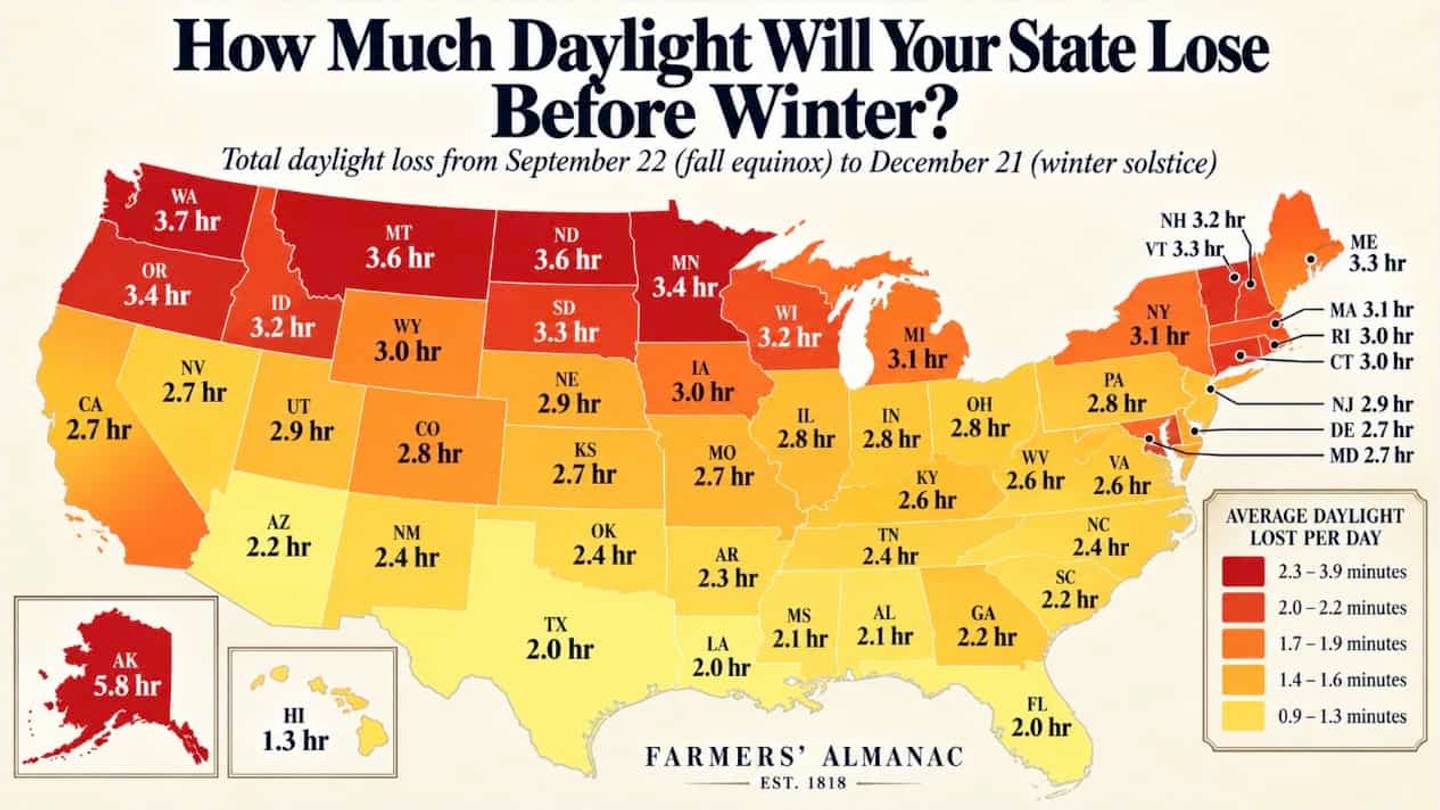
Autumn means beautiful fall leaves, festive holidays like Halloween and Thanksgiving, and a break from hot, muggy summer days. It also means less daylight as the winter solstice approaches on December 21.But just how much daylight will be lost by the time we get there? That depends on where you live, with some states seeing more of an effect on their hours in the sun than others. The Farmers' Almanac pulled together the data to help Americans figure out where they'll be able to stay in the sun, and where things will be getting dark as winter approaches.Northern states see the biggest dropFarmer's Almanac daylight states lose before winter map | Farmer's AlmanacLiving in a northern state means you see plenty of fall colors come out in October and November, but the beautiful changes mean you'll pay for them with extra darkness. The Earth's tilt is to blame, as it moves northern states away from the sun as winter sets in. That's why it's the northernmost state in the U.S. that bears the biggest brunt of this change. Alaska loses the most sunlight between the autumn equinox on September 22 and the winter solstice on December 21, with 5.8 hours of daylight disappearing by the first day of winter in Juneau, Alaska. On December 21, the sun rises in Juneau, Alaska, at 8:40 a.m. and sets at 3:10 p.m.While not as dramatic, other northern U.S. states also lose significant amounts of daylight as the winter solstice comes closer.Washington comes in second place with a loss of 3.7 hours of daylight, with the sun setting on the state at earlier and earlier times as winter nears. In Seattle, for example, the sun sets at 7:06 p.m. on the autumn equinox on September 22, but goes down at 4:20 p.m. by the winter solstice on December 21.Montana and North Dakota are tied for third place, with each state losing 3.6 hours of daylight by the time they reach the winter solstice.The top 10 states that will lose the most daylight in autumn include:1. Alaska2. Washington3. Montana3 (tie). North Dakota5. Minnesota5 (tie). Oregon7. Maine7 (tie). South Dakota7 (tie). Vermont10. Idaho10 (tie). New Hampshire10 (tie). WisconsinSunny days stay in the southWinter sunrise over snowy rural field | travellersnep / CANON 70DJust as the northernmost state in America loses the most amount of daylight in autumn, the southernmost state loses the least.Hawaii will lose some daylight from the autumn equinox to the winter solstice, but only 1.3 hours. On the winter solstice in Honolulu, the sun will rise at 7:04 a.m. on December 21 and set at 5:54 p.m. that night. That's more than two hours later than the official sunset in Anchorage, Alaska on the same date.Three states will only lose around two hours of daylight by the time the winter solstice comes around: Texas, Louisiana, and Florida. Miami residents may not notice much of a change when it comes to the sunset in September compared to December. On September 22, the sun will set at 7:16 p.m., and it will set at 5:34 p.m. on December 21. That's a difference of only 1 hour and 42 minutes.On average, states in the South lose around 1.3 to 1.6 minutes of sunlight per day in autumn, while Hawaii loses less than a minute a day. That hardly compares with northern states, which lose more than two minutes a day on average between the autumn equinox and the winter solstice. The top 10 states that lose the least amount of daylight include:1. Hawaii2. Texas2 (tie). Louisiana2 (tie). Florida5. Mississippi5 (tie). Alabama7. South Carolina7 (tie). Georgia7 (tie). Arizona10. Arkansas
The States Losing the Most Daylight Before Winter, Mapped
Full Article
Original Source
Read the full article at Mentalfloss →KhanList aggregates and links to publicly available news content. We do not host full articles from third-party sources. Always verify important information with original sources.