
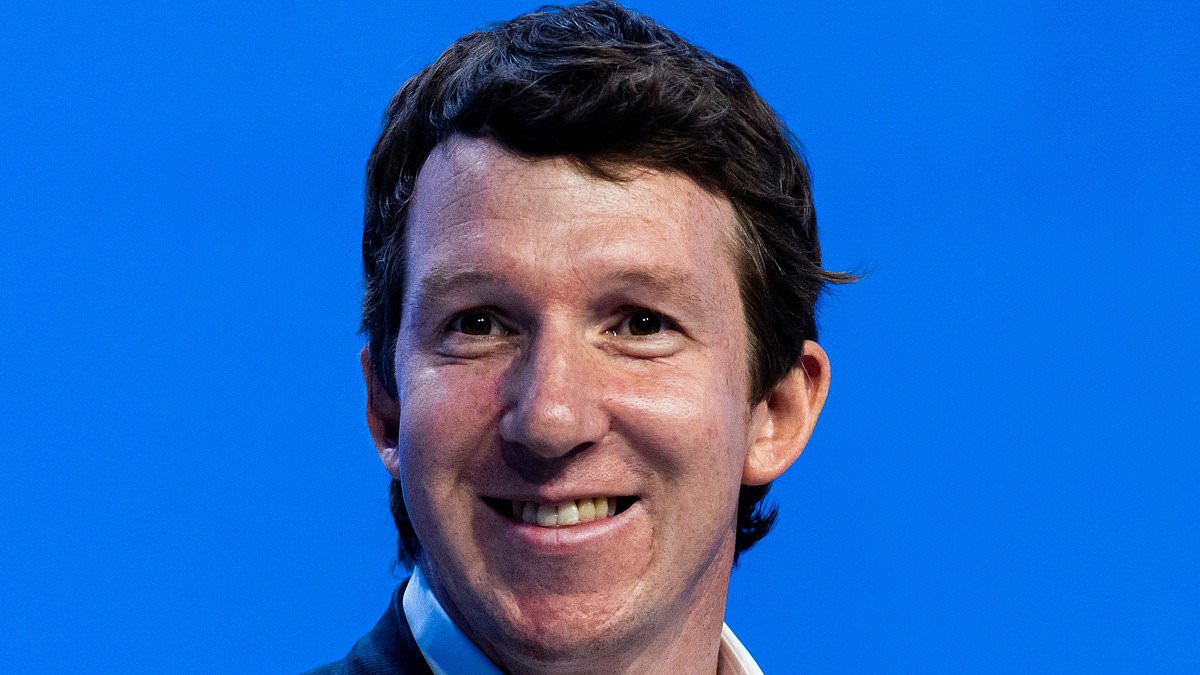
From a reporter earning under £20,000 a year to a billionaire tech tycoon in little more than a decade, Jack Clark's rise has seen him branded the world's most unlikely tech bro. Today, Brighton-born Jack is on the verge of becoming one of the richest men on the planet as his AI giant Anthropic prepares for its hotly anticipated stock market debut.The maker of the Claude chatbot is expected to float with a valuation of around $1.5 trillion on Thursday, potentially swelling Clark's fortune up to $20billion.Despite his vast fortune, he lives a notably frugal life outside work, spending time with his wife and daughters, hiking, watching Doctor Who and catching garage-band gigs. As investors fret over the future of Nvidia following the resignation of boss Jensen Huang, shares in Anthropic will begin trading in New York this afternoon.And while Huang's philandering has shredded Nvidia's share price and reputation, Clark is widely regarded as one of the nicest billionaires in the tech industry - and probably the least well known.One friend from his university days said: 'If the future of AI is in people like Jack's hands, I don't think we need to worry.'Clark already has a paper fortune of $13.7 billion (£10.2 billion), according to Forbes, and could bank billions more if Anthropic's flotation performs as analysts expect.His route to extraordinary wealth could hardly be more different from those of Silicon Valley contemporaries such as Meta founder Mark Zuckerberg, with whom he bears more than a passing resemblance.Clark attended Varndean School, his local comprehensive in northern Brighton, just a short distance from the Amex Stadium and the city's famous seafront.He later studied English at the University of East Anglia in Norwich, rather than computer science, mathematics or physics. And despite his huge wealth, apart from working long hours, he enjoys a largely frugal life spending time with his wife and daughters, hiking, watching British sci-fi classic Doctor Who and watching garage bands. British-born Anthropic tycoon Jack Clark is an unlikely tech bro after earning a degree in English Literature at his alma mater, the University of East Anglia, and worked as a reporter earning less than £20,000-a-yearHis first career was in journalism.Starting on a salary of less than £20,000 a year, he worked weekends as a sub-editor on the Metro website to make ends meet and help pay the rent on what he once described as a 'very dingy apartment'.As recently as a decade ago, Clark was working as Bloomberg's AI and Google reporter, covering the emerging technologies that would ultimately make his fortune.But his life changed when he joined OpenAI in a communications role in 2016. Five years later, he co-founded Anthropic, which has gone on to become one of the world's most valuable AI companies.Today he lives more than 5,000 miles from his hometown in Silicon Valley, California, with his wife Olivia, whom predictably given where he has ended up, he met online through the dating site OkCupid.The couple have two children, the youngest of whom was born at the end of 2025.He is one of the seven co-founders of Anthropic, the AI giant behind chatbot Claude, which is about to be listed on the stock market.Anthropic has sold 980million shares at $83 each - raising $81billion - as institutional and retail investors scrambled for shares in the IPO.That was far more than the 825million shares it was expecting to sell - and above the $70 to $78 price range targeted. Alongside its listing, Anthropic plans to raise $26billion in a private placement from partners including Nvidia, Microsoft and Google. The total fundraising of $107billion exceeds the $86billion raised by SpaceX in June - making it the biggest IPO of all time. What this will mean for Clark, born and bred in Brighton where his father still lives, is beyond the dreams of most people.The AI revolution, Anthropic says, could lead to Nobel Prize-winning breakthroughs in medical research, potentially curing Alzheimer’s and cancer, but has also warned of a 10 per cent chance it could kill us all within the next decade. Comprehensive school-educated Clark is therefore at the centre of what many believe is the most important and contentious debate of our age.He now holds dual British-American citizenship and lives in San Francisco with his wife Olivia, 37, who was once an amateur MMA fighter, and their two young daughters.His upbringing in the leafy suburbs of Brighton couldn’t have been more unremarkable.He attended the local state school, Varndean. His mother, a nurse, died when he and his younger brother, who also works in tech, were teenagers. A floppy-haired Clark, far right, stands with fellow UEA students, including Emmeline Saunders, who said he is a lovely and very clever man It is clear that the boys inherited their tech genes from their father Peter, a semi-retired financial and technical copywriter, now in his 70s, and an expert in cryptocurrencies. Speaking this week on the doorstep of the family home where Jack grew up, Peter was more than happy to take a modicum of credit for his son’s enormous success.‘I think Jack is a bit like me,’ he told the Daily Mail earlier this month. ‘People think I’m crackers because I’m always telling them about things that will happen in the near future.‘He is the same, right? Of course, he has a lot more insight than me, but he is also absolutely convinced the world will be unrecognisable in two or three years and he is trying to steer it in a way that it will not be hellish.‘Unfortunately I don’t get to see him as much as I’d like because he’s 6,000 miles away and he’s extremely busy, but when I do see him we get on really well.’Fellow UEA student Emmeline Saunders worked alongside him on the student newspaper Concrete, a name derived from UEA’s brutalist 1960s architecture, during their time there.The pair go back a long way: she is the young woman in the mauve cocktail dress in the photograph of the editorial team at a Christmas party in 2007.‘Jack was always incredibly clever,’ Ms Saunders, now a national newspaper journalist, said.'Whatever room he was in, he would be the smartest one there.‘But he was lovely with it. He didn’t tend to speak much.‘He had a self-assurance about him – quietly confident – that is quite rare.‘Even back then he was talking about technology that would help humans to share knowledge.‘Who could ever foresee anyone becoming a billionaire? But Jack doesn’t fit the mould of a “tech bro” in any way, which I think is for the best.’The pair’s paths crossed again at the same content marketing agency, Adfero, in London’s Canary Wharf – Jack’s first job after graduating in 2009.On his LinkedIn CV, he says that as a researcher and reporter he ‘covered technology, finance and environmental issues and became interested in data centres’. Jack's upbringing in the leafy suburbs of Brighton couldn’t have been more unremarkable‘It was an awful job, to be honest,’ said Ms Saunders. ‘Jack and I would go out for drinks together and be moaning about how little we were paid and how overworked we were. I don’t think we ever discussed where he was living but most of us were living in pretty s**t flat shares.’In 2013, he landed in San Francisco and eventually got a job with Bloomberg, a global leader in business and financial information. He was part of Bloomberg’s Big Tech team covering Google and AI and doing very well.Jack Clark then joined OpenAI, first working in strategy and communications, then as policy director.The vice president of research was Dario Amodei who had met Jack at a conference some years earlier.Amodei was the man who famously led the walkout from OpenAI at a virtual meeting in December 2020 when he suddenly announced that six key figures were quitting over safety concerns. The following month Anthropic was founded. The name derives from the Greek anthropos (human), which is meant to convey the message that human wellbeing is fundamental to the company’s ethos. Jack is said to be dedicated to ensuring his company does just that.Its shares will start trading in New York this afternoon in a major test of investor appetite for AI stocks following the recent market rout.The Nasdaq 100 – which includes US tech titans from Apple and Microsoft to Amazon and Meta – has fallen more than 10 per cent since its peak last month and Nvidia has lost more than a third of its value.Daniela Hathorn, senior market analyst at Capital.com, said the disappointing reaction to Nvidia’s results ‘could be read as a sign of market exhaustion’ but said it was ‘too early to call a lasting change in sentiment’.She added: ‘Anthropic offers the next test of appetite. Strong demand and a firm first day of trading would suggest investors remain willing to back AI growth, even if they are becoming more selective. A weak reception would add weight to concerns that expectations across the sector have run ahead of what investors are prepared to pay.’British investors who applied for up to $2,822 (£2,171) Anthropic shares were allocated in full, according to Hargreaves Lansdown, handing them 34 shares in the AI giant.Applications above that level have been scaled back with a maximum of 1,700 shares worth $141,100 (£108,538) allocated to any single UK retail investor.As a result, approximately 63 per cent of UK retail investors who applied for shares in the IPO have received a full allocation – meaning around two in five missed out.Simon Belsham, chief client officer at Hargreaves Lansdown, said: ‘We’re delighted that our clients have been able to invest in another blockbuster IPO and that so many of them have taken up the opportunity to be some of Anthropic's first shareholders.’Susannah Streeter, chief investment strategist at Wealth Club, said: ‘The swell of enthusiasm around Anthropic’s stock market debut is meanwhile creating a rising tide of optimism towards big tech. Demand appears to be running hot. The Nasdaq is set for a strong start to trading, with appetite seemingly returning for US technology giants. Even beleaguered chip giant Nvidia looks set to claw back some ground.‘With the FOMO effect so strong, Anthropic shares could pop at the start of trading, as more investors pile in, fearful of missing out on the AI zeitgeist. However, the stock could still be wracked with volatility in the days and weeks ahead, given the concerns still bubbling away about the sheer scale of spending required to build out AI infrastructure.’ The Anthropic IPO is understood to have attracted $500bn of orders – with $400bn coming from institutions while armchair investors have applied for $100bn of shares. Charles Lilford, co-head of equities at Edmond de Rothschild Asset Management, said: ‘We are excited by the fact that this is the first pure-play AI name coming to the capital markets. This IPO could represent a key catalyst for investors rotating back into the technology sector following recent months of rotation.’Garry White, chief investment commentator at wealth manager Raymond James, said: ‘Anthropic's IPO should be a clear litmus test of current market sentiment towards the AI investment boom.’He said the direction of shares will show if ‘investors still have an insatiable appetite for AI or are beginning to separate genuine winners from the wider hype’.Around 20 per cent of the offer was set aside for armchair investors in the US, UK, Europe and Australia with a minimum buy-in of £250.Given the scramble for shares, investors who applied for large parcels of stock have been left disappointed, as was the case in the summer’s flotation of Elon Musk’s SpaceX.Laurence Booth, global head of markets at CMC Markets, said: ‘The IPO is only the beginning. The real test will be whether Anthropic can continue to deliver the growth and economics needed to support the valuation the public market ultimately assigns to it.’
The state school boy set to become AI mega-billionaire: Anthropic co-founder Jack Clark who was born and bred in Brighton will be worth $19.7BN as AI giant makes stock market debut
Full Article
Original Source
Read the full article at Dailymail →KhanList aggregates and links to publicly available news content. We do not host full articles from third-party sources. Always verify important information with original sources.