
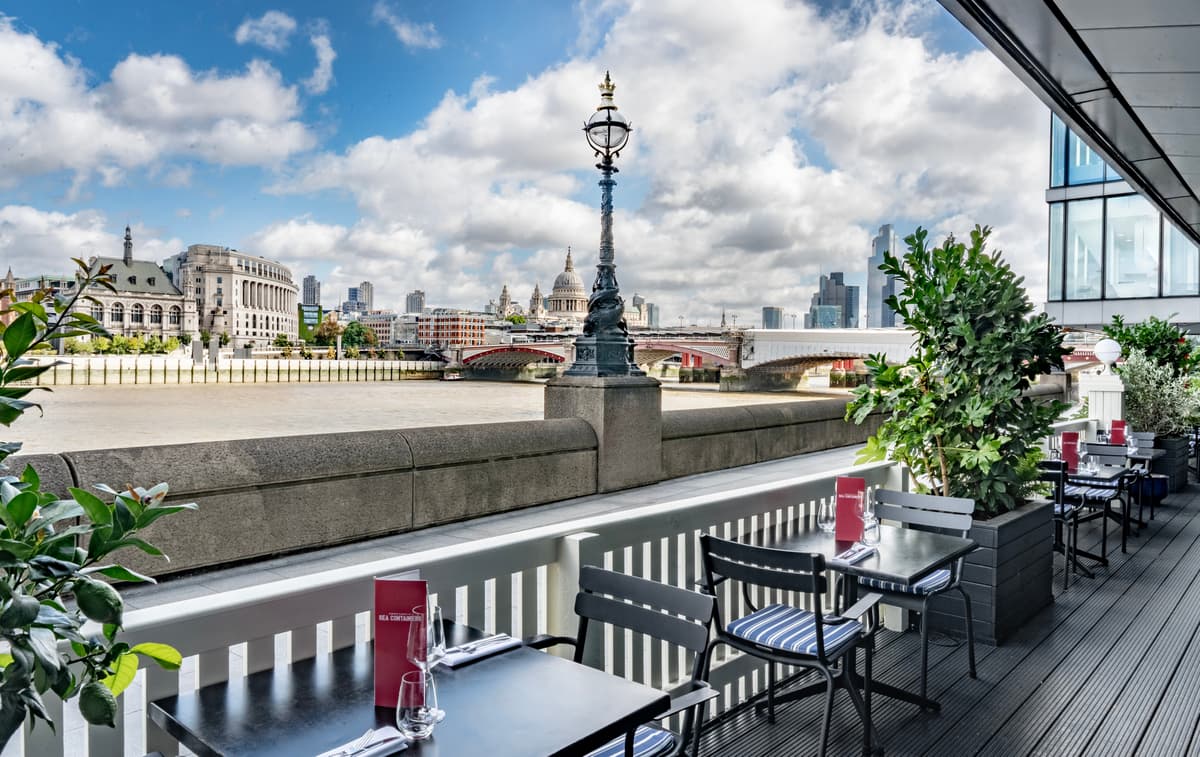
It’s Saturday on the South Bank and crowds are heaving. The London Eye, almost as old as the first Giraffe World Kitchen restaurant (1998, Hampstead), feels almost old amid all the selfies and Lime bikes. Tourists weave between hot-dog vendors and doughnut stands. Some find respite in the entrance to Sea Life, a once grand aquarium now easily missed along the thoroughfare, and others queue for the London Dungeon, which moved from its more fittingly sinister location in the belly of London Bridge to County Hall in 2013. The South Bank hasn’t been considered a cool part of town for decades. No district of London with an attraction called Shrek’s Adventure! can possibly inspire reverence or inspire prolonged visits from actual Londoners. That’s not to say there aren’t cultural touchstones here: the Southbank Centre, the National Theatre, Shakespeare’s Globe, the BFI and Tate Modern are some of London’s best ports of call. They’re world famous, in fact. But it isn’t them, it’s the overall feel of the place — the “vibe” in modern terms — and much of that can be pinned to food and drink. You can enjoy Hockney or Hamlet but you’ll be back over the river to Soho for a drink afterwards, or east to Borough Market for dinner (merhaba, Kismet; bonjour Camille). Or you would have until recently. These days, increasingly, the South Bank has options. It’s changing, evolving; people are starting to realise that all this brutalism, contemporary art and theatrical stardom is deserving of more than Wagamama, Strada and La Gamba. These might be fine, to a point — let’s not be snobbish. After all, accessible chains are generally willing and able to cough up for the soaring rents and why wouldn’t they invest in a site with riverside views? But they’re not exciting; they hardly match up to Shakespeare.Enter Gordon Ramsay. He’s gambling on a venture at Sea Containers, a hotel and restaurant en vogue 10 years ago but much less talked about on the London scene today. Sea Containers restaurant Sea ContainersAnd he’s not opened one of his affordable burger bars or pizza joints. It’s a fully fledged restaurant, serving tagliolini with crab from Brixham, Devon, and his famous beef Wellington. And sure, there are crowd-pleasers. This isn’t food for Michelin inspectors. His Idiot Sandwich Flight, at £26, attests to that. But it’s a big opening, and it’s a marker in the South Bank sand. Growing football at the Southbank“Opening a restaurant on London’s South Bank this month feels like the perfect time,” Ramsay tells me while on a flight from the US. “It’s one of the most multicultural and vibrant stretches of the capital — a place where the river brings people together, where street food, cafés and restaurants sit alongside music, theatre and art.”Ramsay is classically upbeat. Why wouldn’t he be? This is a part of London with a monster footfall; one which, even if Londoners don’t buy into it, will entice an endless deluge of tourists regardless. Last year, South Bank BID, which lobbies for business interests in the area, reported 38 million visitors, representing a 20 per cent growth over two years. But there also seems to be a sense that Londoners are, at least in part, reclaiming this stretch of riverside too. It should be for everyone. “It’s one of the most multicultural and vibrant stretches of the capital”Gordon RamsayRamsay adds: “Food here isn’t simply something you eat — it’s part of the culture, the conversation and the energy of the riverside. It’s exciting and that is exactly why we wanted to be here.” Read MoreRamsay isn’t the only high-profile hospitality man banking on the place. Soon, Jack Croft and Will Murray, of Fallow, one of London’s most lauded restaurants (500,000 Instagram followers and counting), will put their own stamp on the South Bank, albeit in a different guise to Fallow. Together with business partner James Robson, who’s also led the group to open Roe, in Canary Wharf, and Fowl in Mayfair, they’ve taken on the restaurant space at the Oxo Tower, a landmark that first launched as a hospitality space in 1996. Robson says there’s a “new energy” to the South Bank and taking on the Oxo Tower was ultimately a “no-brainer in 2026”. Fallow, soon to be at Oxo TowerFallow“There’s definitely something happening in the area,” he tells the Standard. “I got the call that the venue was for sale while on holiday, a quick approach, and we owned it 18 days later. “We moved ultra-fast because it’s an amazing site in an area with enormous potential. The views are incredible.” Robson says the team won’t be installing a branch of Fallow at the location. Instead, they’ll play to the strengths of the place, separating the 12,500 sq ft site into a chic brasserie on one side and, possibly, a more casual offering on the other. Much is still to be decided, he says. Either way, the current restaurant and bar is to be revamped and updated. “We’ll be polishing up the offering, giving it more value and a lot more love,” he says. “We’ll lean into the brand too and create something by our chefs. I think there’ll be an elevated concept on one side, and then we’ll draw on the history on the other. We’ve gone in fast, but we always think very carefully.”Is there money to be made here, beyond the churn of chains and the stream of modest street food vans? “The restaurant is turning over about £10 million a year at the moment. “Hopefully we’ll double that to get into profit. They’re losing money at the moment. We can turn it around, invest and sharpen the place up; get some economies of scale going. I really think the South Bank is on fire.” Restaurants are flocking to the areaRobson mentions other restaurant brands soon to arrive. Caravan, a growing group of brunch-style restaurants founded by the Kiwi trio Miles Kirby, Laura Harper-Hinton and Chris Ammermann, is opening at the Southbank Centre, on the terrace, in the old Ping Pong location, in November.“Borough Market isn’t far away either,” Robson adds. “And there are street food vans everywhere, which is great for passing trade.” With food and drink comes commerce. It’s little wonder other industries are identifying a blossoming landscape, one that will feed London’s office workers well, as well as affordably and conveniently. Next year, the Lego Group will move its London hub from Farringdon to the South Bank, taking on a 192,000 sq ft space over three and half floors. It shows intent. Loren I Shuster, chief people officer for Lego, said of the move last May: “We’re excited about moving to the South Bank. “It’s the cultural heart of London, which makes it the perfect location for a company dedicated to inspiring creativity. 76 Southbank is an iconic building.” Kudos, then, to those with the foresight to have come in early. “It’s the cultural heart of London”Loren I ShusterOne is Lasdun, which opened in the National Theatre way back in 2023. If anything, fanfare around the venture wasn’t frenzied enough at the time — judging by today’s standards, anyway, where restaurants are exalted as if Mayan gods — though it did get a four-star review from then Standard critic Jimi Famurewa, and a similarly joyful write-up from Grace Dent. Anyway, Lasdun is the work of Jon Rotheram, Tom Harris and John Ogier, the trio behind the critically acclaimed Hackney pub The Marksman. Today the £32 pre-theatre menu features dishes such as Cornish fish soup, smoked haddock fishcakes and slow-roast Hereford beef with bobby beans and mustard. Forza had been a part of Peckham’s dining fabric for years, but there came a time to grow. The South Bank was where co-founders and childhood friends Bash Redford and Michael Lavery pitched up (they’ve since opened another restaurant in Soho). Forza Wine at the National Theatre Caitlin IsolaRedford says: “I don’t want this to sound like a PR soundbite, but I think the South Bank is turning into a place that Londoners want to go. It’s still a place for visitors and tourists, obviously, but ours is a restaurant for locals too. It’s a balancing act. We have to think about everyone. “For a long time, our nearest competitor was Giraffe. Before we came here, I could count the number of times I’d visited the South Bank on one hand. I suppose it was a prospect, but a gamble too. But we thought, maybe we can make this work.” Forza Wine can be found on the first floor of the National Theatre. It boasts an enviable terrace overlooking Waterloo Bridge, Embankment and, newly, Nick Jones’ St Clement hotel. Things are happening on both sides of the river. “We planned it out and we were excited about the footfall,” Redford says. “I do think there’s long been an element of customers playing it safe. Maybe the younger crowd go to known brands and older ones stick to Pizza Express or Brasserie Blanc (Raymond Blanc’s casual chain). “But we were excited at the time, about the footfall and what we could achieve. I think there’s change happening here and it’s very much a case of ‘the more the merrier’. “Maybe this part of London was forgotten by the people who live here. There was snobbery around it. Not so much now.”
The Southbank renaissance: This time it's for locals
Full Article
Original Source
Read the full article at Standard →KhanList aggregates and links to publicly available news content. We do not host full articles from third-party sources. Always verify important information with original sources.