
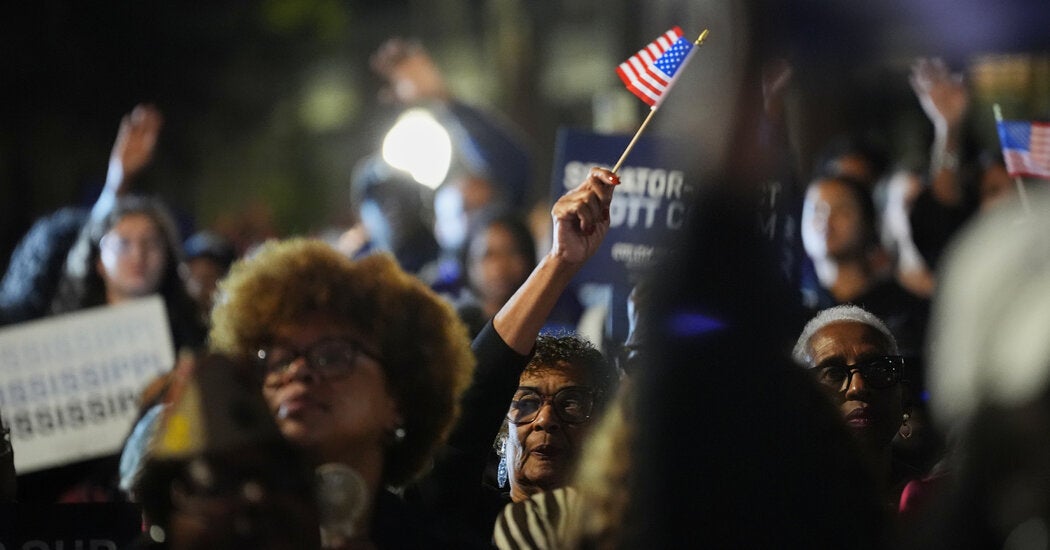
AdvertisementSKIP ADVERTISEMENTTressie McMillan CottomNov. 15, 2026, 6:00 a.m. ETCredit...Ellen Schmidt/Associated PressScott Colom won in Mississippi’s U.S. Senate race on Wednesday, giving Southern voters the final word in a midterm contest that dragged American democracy back from the brink of the authoritarian abyss. The American South birthed the nation’s original sin. If history is indeed prologue, so too must it give life to the nation’s redemption. I have always believed in the progressive South. When Colom took the stage at Tougaloo College, a historically Black college, as Mississippi’s first Black senator-elect since Reconstruction, it was the first time I realized that I might live to see it.It has been a political shibboleth that Republicans own the South since Lyndon B. Johnson signed the Civil Rights Act. The reasons are at this point mundane. Slavery, Jim Crow, mass incarceration, gerrymandering and, as of late, John Roberts’s Supreme Court.The Confederacy lost the war, but we never buried its ghosts.That’s why Donald Trump could consummate the Republican Party’s flirtation with fascism using a playbook straight from the Dixiecrats: Attack, dehumanize and never apologize. MAGA mainstreamed the kind of anti-Black, xenophobic rhetoric of hate that many thought had become too stigmatized to say in national politics. Then Jan. 6 broke the seal. Marauders with questionable Southern bona fides draped themselves in Confederate symbols to attack the U.S. Capitol building. The message was clear: They would rather this country be a corrupt white racist state than a legitimate multiracial liberal democracy. In 2024, techno-fascists and the G.O.P. united the right under that banner, and the country’s tenuous hold on representative democracy seemed like it would break for good.Instead, voters proved two years later that most Americans want government by the people, for the people.Across the world, people have looked to the civil rights movement for inspiration in their own freedom struggles. Wherever they do, they know Mississippi, the longtime foil to republicanism. It gave us Jefferson Davis and proudly curated propaganda for his Lost Cause. White Mississippi was so committed to racism that its leaders were prepared to permanently close public schools rather than integrate them. A native son, the writer Kiese Laymon, has said that Mississippi “was the root and residue of so much good on earth, in spite of that brutal uncanny white man.”When Colom won in Mississippi of all places, the South truly became what I always knew it could be: a battleground.What happened in Mississippi this year is the most profound of the Democratic Party’s gains, but what is most remarkable is that there were so many. Across the South, turnout in majority Black counties was higher than turnout in majority white counties. And all the big winners ran on some aspect of affordability, such as data center moratoriums, housing prices or child care costs. Considering the racial and gender makeup of the Southern voters who propelled the blue wave, a real chance exists to build a new brand of economic populism without appealing to racism and sexism. Surprising Democratic wins — and even a few Democratic losses — in this election signal that the dichotomies between the woke and the broke are a luxury that most of us cannot afford to entertain.Polls underestimated the Democrats’ performance in all the races where they flipped a Senate seat. The journalist Josh Marshall pointed out that no independent, nonpartisan public polls were held in Mississippi the entire election cycle. Political observers were busy obsessing over the U.S. Senate race in Maine, where an oyster farmer with a Nazi tattoo problem flamed out in his quest to unseat Susan Collins. And God love him for making fixing stuff for voters look cool, but the focus on Zohran Mamdani gave us political myopia. People did not just miss the ground shifting in the South; their obsessions reinforced biases against Southern candidates who don’t confirm people’s priors.Three years ago, I encouraged progressives to keep their eyes on the South. When I did, I talked to people like Aisha Nyandoro, who runs a fund for single mothers, in Jackson, Miss., and she told me then that Black folks could flip Mississippi. She’s been organizing ever since. “We’ve always been showing what’s possible here,” she told me hours after she and her family watched Colom make history. Regular people — most of them women, trained to run offices and churches — were going into apartment buildings in the cities and community centers in rural outposts to turn out the vote. They held classes on political issues and encouraged folks to make their voting plans as early as January. They weren’t leaving anything to chance — or to election interference.In May, I talked to Atima Omara, a political strategist, who told me that Black women in particular saw the Supreme Court decision that gutted voting rights as an existential threat. When the G.O.P. and right-wing activists targeted Claudine Gay when she was the president of Harvard University, Black women saw a warning that no amount of education would protect them from the same treatment. Then Elon Musk’s purge of public sector jobs and D.E.I. initiatives pushed so many Black women out of the labor market that it helped trigger a near-recession in Black America. Black women channeled their rage into building local political power.That echoed what I saw in my own life. Friends fired from USAID and scientific research laboratories and universities and Fortune 500 companies dusted themselves off and put their skills to work saving the democracy that had abandoned them. To do it, organizers across the South brought together voters on the Black left and the center, mostly without media attention or philanthropic support. In the hours after Colom’s win, Omara wrote to me to say that Democrats and progressives “must commit to learning from and supporting Black voters, organizers, strategists, particularly the leadership of Black women.”I saw that energy in Angie Nixon, who ran for the U.S. Senate in Florida. When I talked to her in October, she said she held town hall meetings in every county and was not afraid of red counties or rural counties or the white and Latino voters who make up the state’s Republican base. Nixon was once a labor organizer, and brought that approach to her Senate campaign. She lost, but by less than 3 percent in a race no one predicted would even be close.Other, similar, losses across the South suggest more trouble ahead for the G.O.P., should the Democrats find the wherewithal to invest in durable, progressive firewalls. The Republican Party held on to its dominance in Alabama but surprisingly lost the Second Congressional District, which was drawn after the Supreme Court weakened the Voting Rights Act to allow the G.O.P. to win. In Louisiana’s race for the Senate, the Democrat Jamie Davis came within two percentage points of the Republican Julia Letlow. The possibility of progressivism isn’t dead below the Mason-Dixon line — it’s just waiting to be nurtured.In Texas, new kinds of Democratic candidates were rebuilding the coalition that once elected Ann Richards. The blue wave in the Lone Star State may not have all of the left-progressive signifiers of wins in other states, but that reflects the region’s diversity. James Talarico did not reject the oil industry, but he did offer a compassionate religious position on reproductive rights. Gina Hinojosa will become the state’s first Latina governor, in part, by proudly embracing her cultural heritage. Winning big in the South, with candidates who look and talk like voters whom it had become cool to dismiss as “Woke 1,” suggests that the Southerners aren’t the ones living in echo chambers.Across gerrymandered districts in red states with powerful beliefs about race and identity, candidates showed us how to win without spurning the voters who put them there. Here’s what Democrats need to understand if they want to keep winning.Trump is a uniquely unpopular President. His talents for media spectacle informed his administration’s style. It was loud, bombastic and tacky. In other words, it was easy to see the destruction. Hoards of rashly hired ICE agents swarmed cities and towns to maximize media coverage. This administration’s corruption is so routine and so transparent that there is no cover-up, nothing to unearth to point to the crime. They’ve been criming in broad daylight.Seeing that is what it took for American voters to break out of their media silos and take their grievances to the ballot box. Democrats cannot expect the next iteration of the Republican Party, whatever it ends up being, to be so obvious.Flipping a district and a state is one thing. Now the work must begin to make those districts and states durable wins. That looks like investing in smaller, local races where the balance of power within a state often lies. No race is too small to defend when building electoral capacity for future wins. The organizers in those communities are the best ones to show how to keep them.The political currents that drove turnout aren’t going away anytime soon. The worst aspects of Trump’s “Big Beautiful Bill” start coming due after the legislative season begins in the new year. The Iran war is still exerting pressure on oil prices, which in turn promises that consumers will continue to pay more. ICE is making less social media content, but it is still raiding communities across this country. Children are still representing themselves in immigration hearings. Data centers are still being built, and people still hate them. And company profits continue to hit new highs as workers’ share of those profits continues to underwhelm.Democrats are already trying to temper hopes that they will be able to attack those realities, and they are relentlessly disavowing identity politics.The irregular voters who pushed Democrats over the Red Wall came with their identities and their economic woes. Working-class, rural and religious voters are also Black voters and Latino voters and Asian American voters and Native American voters. Political consultants should keep that in mind, and Democrats should consider ignoring those who don’t. Because the voters who just gave them the mandate aren’t as socialized to the nonsense of national politics. Small nonprofits or dedicated volunteers brought them into the fold. Before the election — and since — many of those organizers told me that they don’t have the money and resources to do all that they can do.It is our collective shame that they made history without it.In ways big and small, that’s what they did. They ignored nationalized culture wars and focused on local issues. They organized between election seasons, not just in the months before voting. They did not write off any voter and never gave up on the relationships they built with them.It showed. In the final days ahead of the election, Colom’s team set out for the electoral door-knocking ritual in which volunteers visit the homes of registered voters who have not yet cast a ballot. But Colom had been across Mississippi. His voters weren’t imagining their economic insecurity. They were living it. He instructed his staff to visit the stores, the warehouses, the offices where voters were likely to be working, too hard, and for too little — precisely the reasons he was running to represent them.To go where the people are, you have to first see the people as they are.Maybe we would still be talking about a blue wave if the South had not out-organized the money and maps working against them. But we are talking about a historic restructuring of American politics only because they did.Given the barest of chances to be heard, a Southern coalition spoke with a voice as progressive and multiracial as California or Brooklyn. They have been there all along, holding so much political promise that it took an activist court, political corruption and fake news to convince us that they didn’t. Their wins should silence the South’s many haters, but the brilliance of the organizing effort to get those wins should also scare their beneficiaries. This is the magnitude of the work needed to rebuild this nation.The South just gave its people a chance to fight another day. Now the Democrats have to show the people that they are the party who will fight to win again.Tressie McMillan Cottom (@tressiemcphd) became a New York Times Opinion columnist in 2022. She is a professor at the University of North Carolina at Chapel Hill School of Information and Library Science, the author of “Thick: And Other Essays” and a 2020 MacArthur fellow. @tressiemcphd Related ContentAdvertisementSKIP ADVERTISEMENT
The South Went Blue and I Lived to See It
Full Article
Original Source
Read the full article at Nytimes →KhanList aggregates and links to publicly available news content. We do not host full articles from third-party sources. Always verify important information with original sources.