
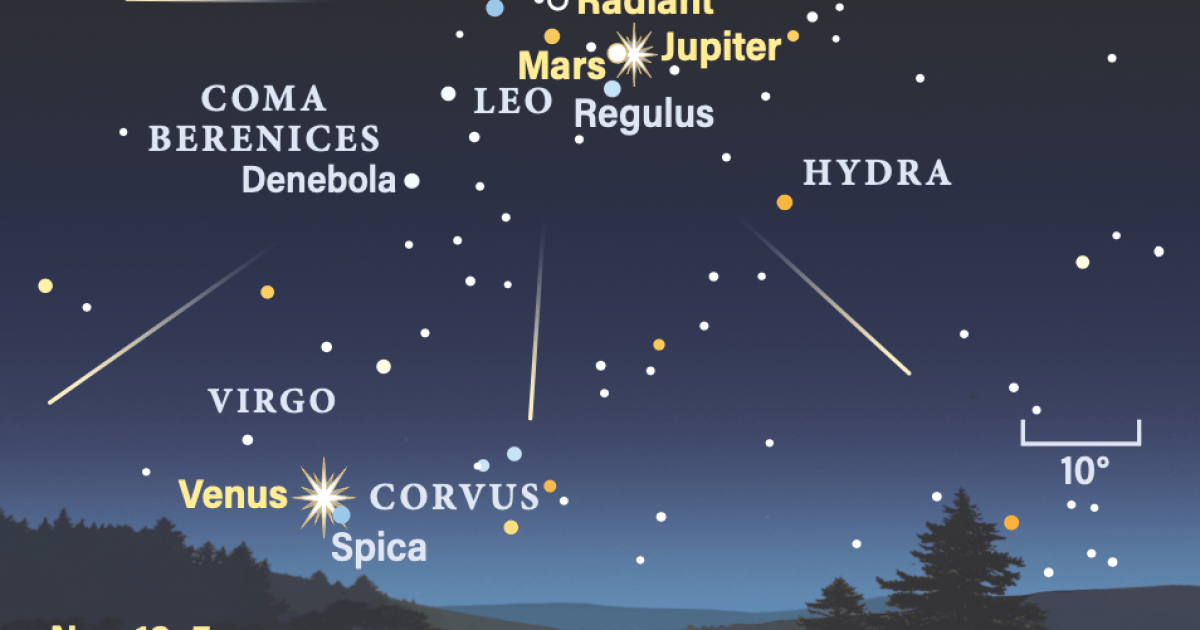
Check out fast-moving shooting stars in the hours before dawn as this annual meteor shower peaks with Leo high in the sky. | Published: November 18, 2026 The Leonids’ peak comes just days after a conjunction of Jupiter and Mars, also in Leo. Visible as well will be Venus, near Spica in Virgo. Credit: Astronomy: Roen Kelly Looking for a sky event this week? Check out our full Sky This Week column. November 17: Spotlight on the Pleiades The peak of the Leonid meteor shower, caused by the dusty debris of Comet 55P/Tempel-Tuttle, is best seen early this morning after the Moon has set and the shower’s radiant rises high in the hours before dawn. Two hours before sunrise, Leo is high in the southeast, with bright Jupiter and Mars joining the curved shape of the Sickle asterism. The Leonids’ radiant is located just inside the cuved blade’s inner edge, near 3rd-magnitude Zeta (ζ) Leonis to the upper left (north) of Mars and Jupiter. The two planets appear roughly side by side in the sky around this time, with ruddy Mars at left and more golden-yellow Jupiter at right. Regulus sits just to their lower left. To catch the most meteors, you’ll actually want to look a little ways away from Leo, about 40° to 60° to the left or right of the constellation. This is where meteors with the longest trains will also occur. Although this shower isn’t particularly strong, you can expect to see roughly a half-dozen or more Leonid meteors per hour. The Leonid shower produces some of the fastest-moving meteors we experience all year, streaking through the sky at some 44 miles (70 kilometers) per second. Sunrise: 6:49 A.M.Sunset: 4:41 P.M.Moonrise: 1:19 P.M.Moonset: 12:03 A.M.Moon Phase: Waxing gibbous (67%)*Times for sunrise, sunset, moonrise, and moonset are given in local time from 40° N 90° W. The Moon’s illumination is given at 10 P.M. local time from the same location. The solar system is a dynamic place. Let’s return to the predawn sky on November 19th to check out the inner planets’ progress relative to the stars of Virgo. An hour before sunrise, both Mercury and Venus are again well above the eastern horizon, with the stars around them still visible before twilight brightens too much. By the morning of November 19, Venus has moved north of Spica and Mercury has crossed into Libra. Credit: Stellarium Compared with earlier in the week, Venus now sits to the upper left of Spica, rather than directly above it. Venus will pass 1.8° due north of Spica later today at 6 P.M. EST. Now moving steadily east, it will track along the ecliptic, slowly headed for Libra. Mercury has already reached the Balance, sitting within its domain and to the far lower left of Kappa (κ) Virginis, as opposed to the pair’s close proximity a few days ago. Pull out your telescope to see how the planets’ appearances have changed, too. Mercury is now 55% lit and 7” across, while Venus is 18% lit and has shrunk more noticeably, now 47” across. Alison Klesman is senior editor of Astronomy magazine. She holds a Ph.D. in astronomy and has studied a variety of topics, from minor planets to supermassive black holes.
The Sky Today on Wednesday, November 18: The Leonid meteor shower peaks
Full Article
Original Source
Read the full article at Astronomy →KhanList aggregates and links to publicly available news content. We do not host full articles from third-party sources. Always verify important information with original sources.