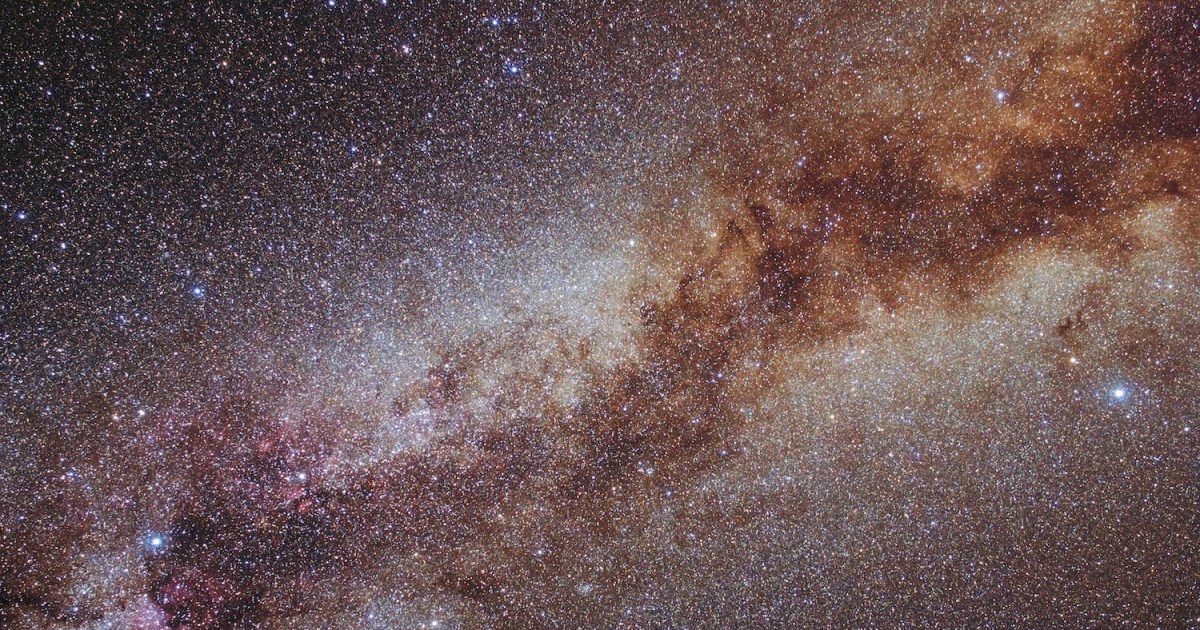
Look up this evening to find the season’s most famous asterism, the Summer Triangle, with the plane of the Milky Way running through it. | Published: July 15, 2026 The Summer Triangle is a large asterism whose points are marked by the stars Vega (top left), Deneb (bottom left), and Altair (right). It lies high overhead on short summer nights. Credit: Giuseppe Donatiello Looking for a sky event this week? Check out our full Sky This Week column. July 14: Mars sits north of Aldebaran Now that summer is in full swing, let’s check in with the season’s most famous asterism: the Summer Triangle. By late evening, this celestial shape is high in the southeast, bounded by the bright stars Deneb, Vega, and Altair. Magnitude 0.0 Vega in Lyra is the brightest, followed by magnitude 0.8 Altair in Aquila and magnitude 1.3 Deneb in Cygnus. Parts of Sagitta the Arrow and Vulpecula the Fox also fall within the Summer Triangle’s boundaries, which encompass some 415 square degrees, or more than 2,000 times the area of the Full Moon. If you can get to a viewing site with dark skies, you should see the plane of the galaxy flowing through this asterism. The Cygnus Star Cloud, one of the brighter regions along the Milky Way’s plane, also lies within the Summer Triangle. The Summer Triangle is named for this season because it is high overhead in the middle of short summer nights. Even if you’re in a relatively light-polluted area, you should be able to see its three anchoring stars and much of their constellations as well. Give it a try tonight! Sunrise: 5:44 A.M.Sunset: 8:28 P.M.Moonrise: 7:01 A.M.Moonset: 9:42 P.M.Moon Phase: Waxing crescent (4%)*Times for sunrise, sunset, moonrise, and moonset are given in local time from 40° N 90° W. The Moon’s illumination is given at 10 P.M. local time from the same location. Alison Klesman is senior editor of Astronomy magazine. She holds a Ph.D. in astronomy and has studied a variety of topics, from minor planets to supermassive black holes.
The Sky Today on Wednesday, July 15: The Summer Triangle overhead
Full Article
Original Source
Read the full article at Astronomy →KhanList aggregates and links to publicly available news content. We do not host full articles from third-party sources. Always verify important information with original sources.