
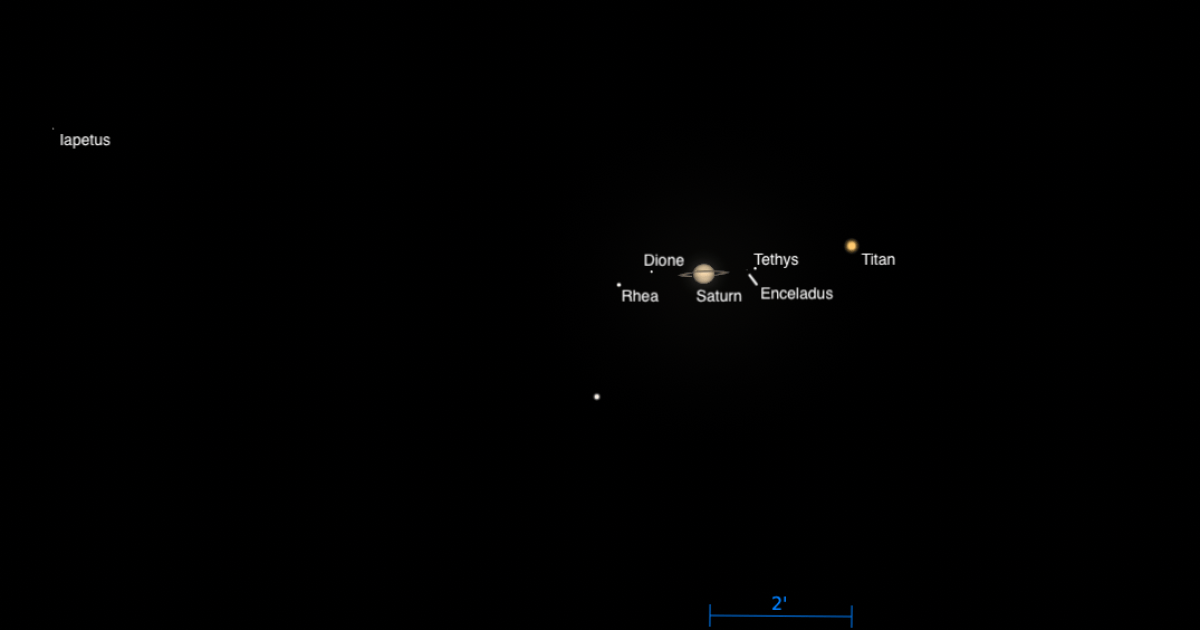
The two-faced saturnian satellite Iapetus lies far east of the ringed world today, while brighter moons cluster closer to the planet. | Published: November 10, 2026 Look for Saturn’s far-flung moon Iapetus at eastern elongation on November 10. Even if you can’t find the faint moon, several brighter satellites cluster closer to the ringed planet. Credit: Stellarium/Oleg Pluton Looking for a sky event this week? Check out our full Sky This Week column. November 9: Chase Comet 161P/Hartley-IRAS Challenge yourself to pick up Saturn’s moon Iapetus, which tonight reaches greatest eastern elongation 9.4’ east of the ringed planet. The two-toned moon is tidally locked to its parent world, which means it rotates in time with its orbit. At eastern elongation, Iapetus’ darker hemisphere faces earthward, reducing the moon’s magnitude to nearly 12. This, combined with its distance from Saturn, makes it more of a challenge to find, but you can give it a try if you’ve got a larger scope. Try around 9 P.M. local time when Saturn is highest, some 50° above the southern horizon. It’s the brightest point of light in this region of the sky, hanging just below Pisces and to the far upper left of Fomalhaut, the brightest star in Piscis Austrinus (much closer to the horizon). Even if you can’t locate Iapetus or don’t have a large scope, Saturn is magnificent through a telescope. Its disk spans 19” and its rings are roughly 43” across, showing off their southern side. You should definitely spot its largest and brightest moon, mid-8th-magnitude Titan, just over 2’ west of the planet. Depending on your scope and when you look, you may also spot at least three other moons: 10th-magnitude Tethys, Dione, and Rhea, closer to the planet. Tethys lies to Saturn’s west, while Rhea and Dione are to the east. Sunrise: 6:39 A.M.Sunset: 4:48 P.M.Moonrise: 8:15 A.M.Moonset: 5:19 P.M.Moon Phase: Waxing crescent (4%)*Times for sunrise, sunset, moonrise, and moonset are given in local time from 40° N 90° W. The Moon’s illumination is given at 10 P.M. local time from the same location. Venus reaches a stationary point among the stars of Virgo at 10 A.M. EST on November 11. This brings its retrograde (westward) motion to an end; after today, Venus will begin moving eastward or prograde through the sky, swinging north of Spica. Venus and Spica stand close in the predawn sky all week; on November 11, Venus also comes to a halt, reversing course from westward to eastward motion. Mercury may just be visible above the horizon for a short time before sunrise as well. Credit: Stellarium You can easily catch the bright planet in the eastern sky before dawn. Venus’ brightness has increased over just the past few days, and it now blazes at magnitude –4.7. An hour before sunrise, you’ll easily spot it alongside Spica, standing just to the star’s upper right. Both are 10° high and rising as dawn approaches. Check out Venus through a telescope: its disk shows off a crescent phase just 10% lit, but stretches an impressive 53” in the sky. Also just becoming visible at this time is Mercury, barely 1.5° above the horizon and glowing at magnitude 1.2. See if you can locate it about 13° east (to the lower left) of Venus, although you’ll need a particularly flat horizon free of trees, buildings, and lights. Mercury, too, rises as twilight brightens, which may make the planet harder to see in the growing light. Try scanning for it with binoculars, although make sure to put them away well before sunrise from your location Alison Klesman is senior editor of Astronomy magazine. She holds a Ph.D. in astronomy and has studied a variety of topics, from minor planets to supermassive black holes.
The Sky Today on Tuesday, November 10: Seek Saturn’s two-toned moon
Full Article
Original Source
Read the full article at Astronomy →KhanList aggregates and links to publicly available news content. We do not host full articles from third-party sources. Always verify important information with original sources.