
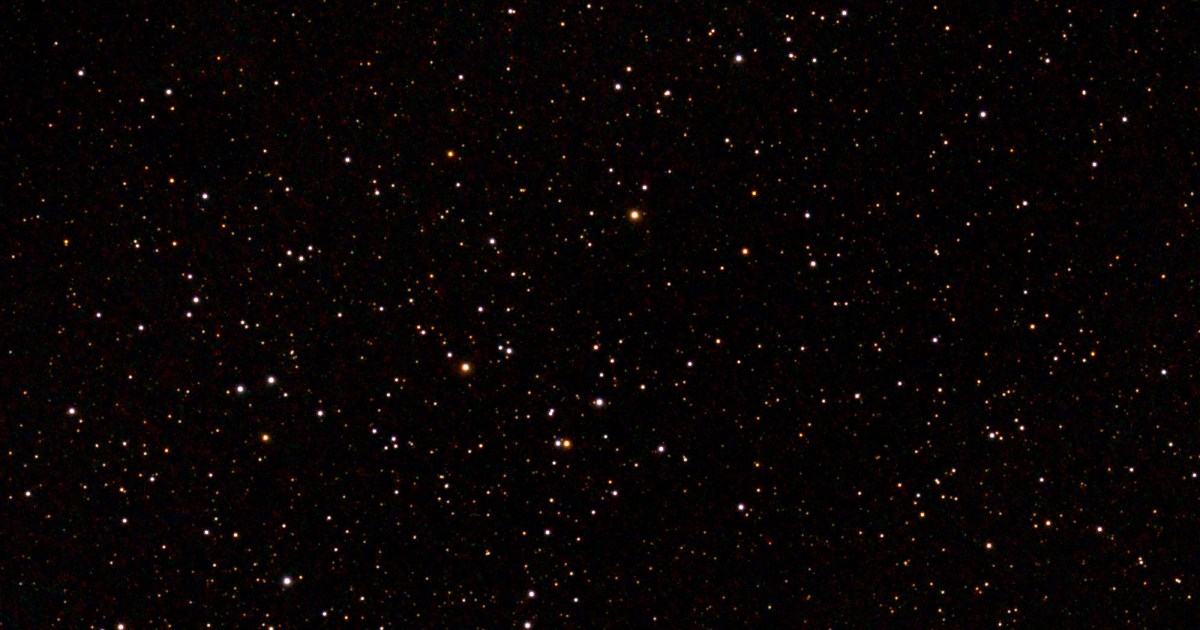
This crescent-shaped cluster shines in northern Cassiopeia, visible all night long as the stars wheel around the North Celestial Pole. | Published: October 29, 2026 Collinder463 is a loose open cluster of young stars located in Cassiopeia the Queen. At lower magnifications than that used to image the cluster here, many observers find it looks like a crescent. Credit: Yu-Hang Kuo (Flickr, CC BY-SA 2.0) Looking for a sky event this week? Check out our full Sky This Week column. October 28: The Moon hangs with Uranus The W-shaped constellation Cassiopeia is prominent in the northern sky after sunset as it wheels around the North Celestial Pole, which marked by the North Star, Polaris. Around 8 P.M. local daylight time — after dark but before moonrise — you’ll find the Queen to the right of Polaris when facing north, positioned such that her stars now look like the numeral 3. In the northern region of Cassiopeia, located to the lower left of the this pattern, is a loose open cluster cataloged as Collinder 463. The Collinder catalog, created in 1931 by Per Collinder, contains nearly 500 open clusters of young stars. Entry No. 463, our target, shines around 6th magnitude and sits roughly 8.2° north of 3rd-magnitude Epsilon (ε) Cassiopeiae, along a line drawn between this star and Polaris. Spanning roughly 73’, it’s easy to observe in binoculars or a small scope. At low magnification, such as through binoculars or a finder scope, many observers think its gaggle of stars form a rough crescent-shaped smudge of light on the sky. What shape do you see? Sunrise: 7:26 A.M.Sunset: 6:01 P.M.Moonrise: 8:41 P.M.Moonset: 11:47 A.M.Moon Phase: Waning gibbous (80%)*Times for sunrise, sunset, moonrise, and moonset are given in local time from 40° N 90° W. The Moon’s illumination is given at 10 P.M. local time from the same location. Magnitude 0.8 Mars, currently tracking eastward through the sky, stands at the border of Cancer and Leo the morning of October 30. It is still within the bounds of the Crab this morning, roughly 60° high in the southeast and just over 6° to the upper right of brighter Jupiter in Leo, about 90 minutes before sunrise. Mars stands at the border of Cancer and Leo the morning of the 30th, preparing to join bright Jupiter in the latter by tomorrow. Together with Regulus, the three points of light form a line in the early-morning sky. Credit: Stellarium To Jupiter’s east (lower left) is magnitude 1.4 Regulus, the brightest star in the Lion, which also serves as the great cat’s heart. Together with Jupiter and Mars, the three form a line slashing upward in the predawn sky. Far to the planetary pair’s upper right is Procyon, the bright nose of Canis Minor, the Little Dog. And to that star’s far lower right is even brighter Sirius, the nose of Canis Major, the Big Dog — the brightest star in the sky. However, Jupiter (at magnitude –2.0) currently outshines Sirius’ magnitude –1.4 glow. Alison Klesman is senior editor of Astronomy magazine. She holds a Ph.D. in astronomy and has studied a variety of topics, from minor planets to supermassive black holes.
The Sky Today on Thursday, October 29: Open cluster Collinder 463
Full Article
Original Source
Read the full article at Astronomy →KhanList aggregates and links to publicly available news content. We do not host full articles from third-party sources. Always verify important information with original sources.