
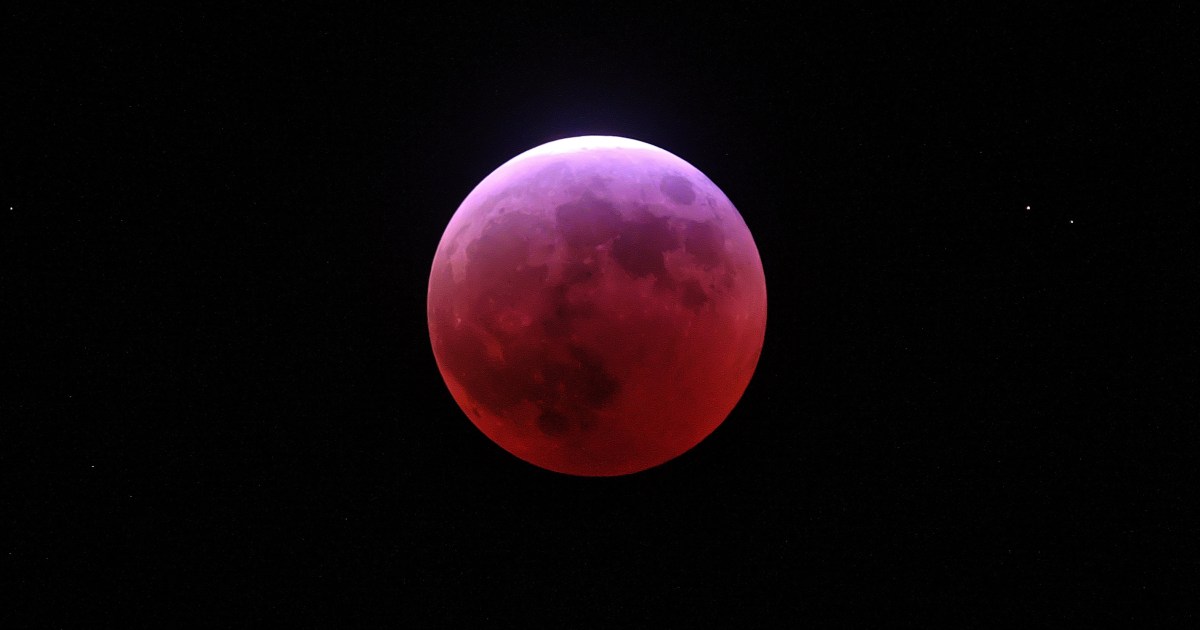
Minutes before reaching Full, the Moon is eclipsed this evening in a lovely event visible across the U.S. | Published: August 27, 2026 During a deep partial eclipse, the majority — but not quite all — of the Moon passes through Earth’s umbra, the darkest part of our planet’s shadow. Credit: Gene Ellison (Flickr, CC BY-NC-ND 2.0) Looking for a sky event this week? Check out our full Sky This Week column. August 26: Catch Barnard’s star A partial eclipse of the Moon occurs tonight, following August 12th’s total eclipse of the Sun. The deep lunar eclipse is visible across North and South America, Africa, and western Europe. The Moon rises around 7:30 P.M. local daylight time, located in Aquarius the Water-bearer. The eclipse begins at 9:23 P.M. EDT, as the Moon first enters the outer part of Earth’s shadow, the penumbra. But the real visual effects really start at 10:33 P.M. EDT, when the Moon first passes into the umbra — the darker, inner portion of our planet’s shadow — and the partial eclipse begins. This means the start of the partial eclipse is visible in the eastern half of the U.S., while the Moon is eclipsed shortly after rising in the Mountain time zone and right around the time of moonrise along the West Coast. The eclipse continues overnight for the eastern half of the U.S. Maximum eclipse occurs at 12:13 A.M. EDT on the 28th (in the Eastern time zone only for the U.S.), with 96% of our satellite’s total area covered by Earth’s inner shadow. Only a thin sliver along the Moon’s northeastern limb will remain bright white, while the rest of our satellite will appear a dim, dusky orange or red. The August Full Moon officially occurs at 12:19 A.M. EDT on August 28, just minutes after maximum eclipse. August’s Full Moon is also called the Sturgeon Moon, after the plentiful lake fish Native Americans relied on as a food source during this time of the year. The partial eclipse ends at 1:51 A.M. EDT (the 28th in the Eastern and Central time zones only) as the Moon exits the darker, inner part of Earth’s shadow, and the eclipse ends completely just before 3:02 AM EDT on August 28, when our satellite slips completely free of the outer portion of Earth’s shadow. Lunar eclipses are not like solar eclipses — they proceed slowly and can be viewed without any equipment or eye protection at all, making them readily accessible and enjoyable. There’s no rush to catch only a few minutes of action, either, as the Moon slides slowly into and out of Earth’s shadow, its appearance changing the whole time. You can opt to catch just part or all of the event, checking on its progress every few minutes without worry you’ll miss a vital moment. If you do choose to view for only a short while, try to make it around the time of maximum eclipse, as this is when the Moon will appear most dramatic. Sunrise: 6:23 A.M.Sunset: 7:39 P.M.Moonrise: 7:29 P.M.Moonset: 5:43 A.M.Moon Phase: Full*Times for sunrise, sunset, moonrise, and moonset are given in local time from 40° N 90° W. The Moon’s illumination is given at 10 P.M. local time from the same location. Alison Klesman is senior editor of Astronomy magazine. She holds a Ph.D. in astronomy and has studied a variety of topics, from minor planets to supermassive black holes.
The Sky Today on Thursday, August 27: A deep partial lunar eclipse
Full Article
Original Source
Read the full article at Astronomy →KhanList aggregates and links to publicly available news content. We do not host full articles from third-party sources. Always verify important information with original sources.