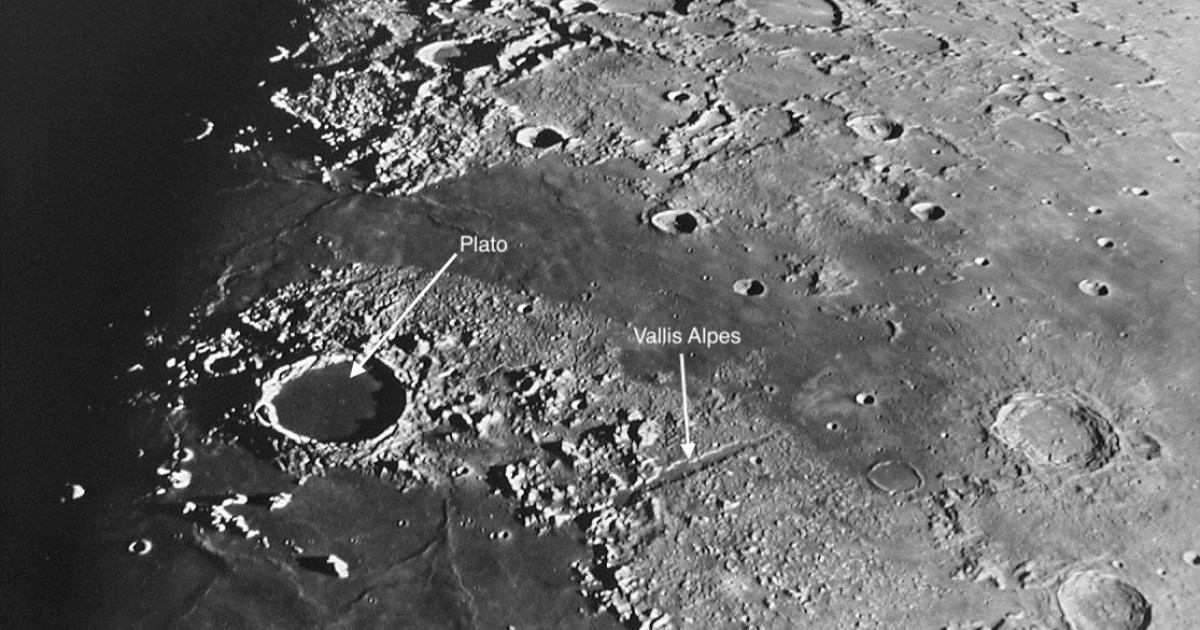
Set your sights on the Moon tonight to explore the crater Plato, as our satellite closes in on the bright red giant Antares. | Published: August 20, 2026 Plato’s dark, flat floor is pockmarked by several craterlets. To the crater’s east, Vallis Alpes gouges a track through the Montes Alpes range. Credit: Consolidated Lunar Atlas/UA/LPL Looking for a sky event this week? Check out our full Sky This Week column. August 19: The Helix Nebula The waxing gibbous Moon dominates the evening sky, located in Scorpius. You’ll find it close to the Scorpion’s red giant heart, 1st-magnitude Antares. Watch it close in as the hours tick by — our satellite will pass just 0.6° south of this star at 1 A.M. EDT on the 21st, visible from the western half of the U.S. An hour after sunset, the pair is roughly 20° high in the south. Zoom in on the Moon with a telescope and seek out the large, flat-floored crater Plato, located in the lunar north, along the northern rim of Mare Imbrium (the Sea of Rains). The crater should stand out clearly as a dark spot along the rugged rim of Imbrium. With the crater floor in your eyepiece, watch as the shadows streaking across it shorten as the Sun rises higher in the lunar sky. Over Plato, the terminator (the line dividing lunar night and day) is moving at nearly 6 mph (9.7 km/h), and you can notice changes in the shadows here in just a few hours. Although Plato’s broad floor may appear flat and featureless at first, look closely — there are several smaller craterlets carving out material here, like someone took an ice cream scoop to the Moon’s surface. These came after Plato’s initial formation, which was more than 3 billion years ago. Once you’re through with Plato, take a moment to skim just a bit southeast along Imbrium’s edge. Not far from Plato, there’s a straight slash mark, this time like someone gouged out a piece of the mountainous terrain with a palette knife. This is called Vallis Alpes, or the Alpine Valley, and it cuts through (perhaps predictably) the Montes Alpes, or lunar Alps. Sunrise: 6:16 A.M.Sunset: 7:50 P.M.Moonrise: 2:54 P.M.Moonset: 11:50 P.M.Moon Phase: Waxing gibbous (60%)*Times for sunrise, sunset, moonrise, and moonset are given in local time from 40° N 90° W. The Moon’s illumination is given at 10 P.M. local time from the same location. The Moon passes 0.6° south of Antares at 1 A.M. EDT on August 21, although it will have set before this for the eastern half of the U.S. Nonetheless, this part of the country will still see our satellite closely approaching the star before the pair sets.Once that happens, turn your gaze southeast to find Saturn already some 30° high, shining so brightly it’s easy to pick out among the dim stars populating this region. You’ll want a telescope — even a small one will do — to view the planet’s lovely ring system, which stretches some 43” from end to end. That’s more than twice the planet’s apparent diameter, which is currently 19”. The rings are showing off their southern side, and the southern pole of Saturn is visible as well. Titan is easy to spot near Saturn on August 21. Additionally, at 5 A.M. EDT, the 10th-magnitude moon Dione is preparing to just skim over the northern pole of the ringed planet. Observers in the western two-thirds of the U.S. will have the best views, as the sky will begin to grow light along the East Coast as Dione crosses north of Saturn. Only moons brighter than mid-10th magnitude are shown here. Credit: Stellarium/Oleg Pluton Now look just northeast of the planet — you should be able to identify Titan, Saturn’s largest moon, glowing at mid-8th magnitude less than an arcminute away. If you come back tomorrow morning, this moon will have slid westward in its orbit, standing northwest of Saturn the morning of the 22nd. It takes about 16 days in total for Titan to complete a full orbit. If you have dark skies and a larger scope, you may also spot 10th-magnitude Rhea, Dione, and Tethys near Saturn as well. Around 2 A.M. EDT, all three are east of the planet, with Dione to the northeast (but closer in than Titan), Tethys to the east, and Rhea to the southeast. Over the next few hours, you can watch Dione moving west at a much faster pace than Titan — observers in the Central time zone and areas west of this will see Dione skim just north of Saturn’s pole around 5 A.M. CDT. Alison Klesman is senior editor of Astronomy magazine. She holds a Ph.D. in astronomy and has studied a variety of topics, from minor planets to supermassive black holes.
The Sky Today on Thursday, August 20: Dark, flat Plato
Full Article
Original Source
Read the full article at Astronomy →KhanList aggregates and links to publicly available news content. We do not host full articles from third-party sources. Always verify important information with original sources.