
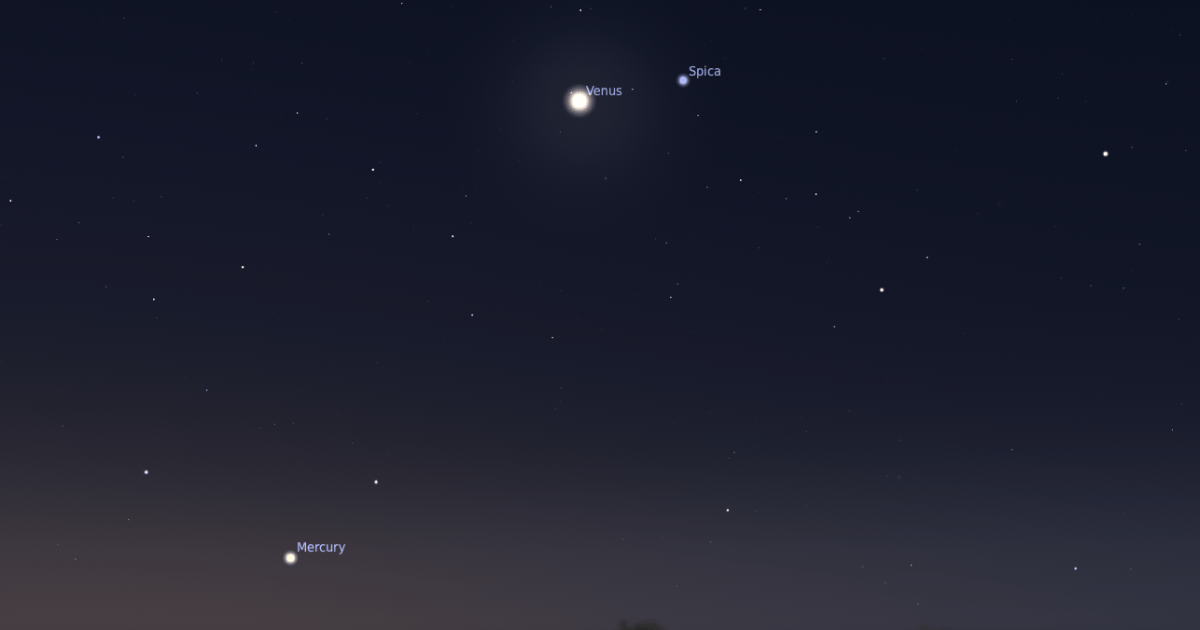
The bright morning star Venus blazes in the sky for several hours before dawn, along with inner planet Mercury. | Published: November 29, 2026 Venus reaches greatest brilliancy on the 29th, blazing as a morning star high in the southeast an hour before sunrise. Check out Mercury closer to the horizon as well — our views of this planet won’t last much longer. Credit: Stellarium Looking for a sky event this week? Check out our full Sky This Week column. November 28: Iapetus near Saturn Have you ever seen your shadow by planetlight? Venus reaches greatest brilliancy at 2 P.M. EST, now shining at magnitude –4.9. Rising nearly three and a half hours before the Sun, Venus will be so bright that it could potentially cast a shadow if you’re in a location with particularly dark skies (Bortle 1 or 2). Even without perfect viewing conditions, this morning star can’t be missed. By an hour before sunrise, Venus is roughly 25° high in the southeast, blazing just to the lower left of Spica, the brightest star in Virgo. Far to Venus’ lower left, closer to the ground, Mercury stands nearly 5° above the horizon, shining at magnitude –0.7. Compare the two planets through a telescope. Venus is a 27%-lit crescent, but its disk stretches 40” across. Mercury, by comparison, is much smaller, just 6” across, but its phase is 82%. Now through the first week of December is the best time to catch the solar system’s smallest planet, as it remains bright but appears to sink toward the horizon day by day. By the 5th, Mercury will be less than 2° high an hour before sunrise, making viewing challenging both because of potential obstacles on the horizon as well as the more turbulent layer of air near the ground. Venus, meanwhile, stays at roughly the same altitude an hour before sunrise all month, its phase growing to nearly 50% lit by the end of the year. Earth’s sister planet will remain prominent in the morning sky through the first half of next year. Sunrise: 7:01 A.M.Sunset: 4:36 P.M.Moonrise: 10:25 P.M.Moonset: 11:43 A.M.Moon Phase: Waning gibbous (62%)*Times for sunrise, sunset, moonrise, and moonset are given in local time from 40° N 90° W. The Moon’s illumination is given at 10 P.M. local time from the same location. Leo hosts a celestial get-together the morning of November 30, as the Moon joins two planets and the star that sits at the heart of the Lion, just beneath the Sickle asterism. Look south an hour before sunrise on November 30 to catch several solar system objects grouped up around Regulus in Leo the Lion. Credit: Stellarium/USGS/Celestia/Clementine The waning gibbous Moon is the brightest object here; next brightest is Jupiter, located to the Moon’s upper right and glowing at magnitude –2.2. The gas giant stands nearly side by side with Mars (to Jupiter’s left); the Red Planet is fainter but still a respectable magnitude 0.4. Both planets are slowly growing in brightness and size as they approach opposition early next year. Through a telescope, Jupiter stretches 39” across, offering excellent views of its alternating light and dark cloud bands, and Mars is now 8” wide. Shining between Mars and the Moon is 1st-magnitude Regulus, often drawn as both the heart of Leo and the base of the Sickle asterism’s handle. The curving backward question mark of stars that forms the Sickle’s blade and the Lion’s head in profile lies above the grouping in the sky before dawn. Alison Klesman is senior editor of Astronomy magazine. She holds a Ph.D. in astronomy and has studied a variety of topics, from minor planets to supermassive black holes.
The Sky Today on Sunday, November 29: Venus reaches greatest brilliancy
Full Article
Original Source
Read the full article at Astronomy →KhanList aggregates and links to publicly available news content. We do not host full articles from third-party sources. Always verify important information with original sources.